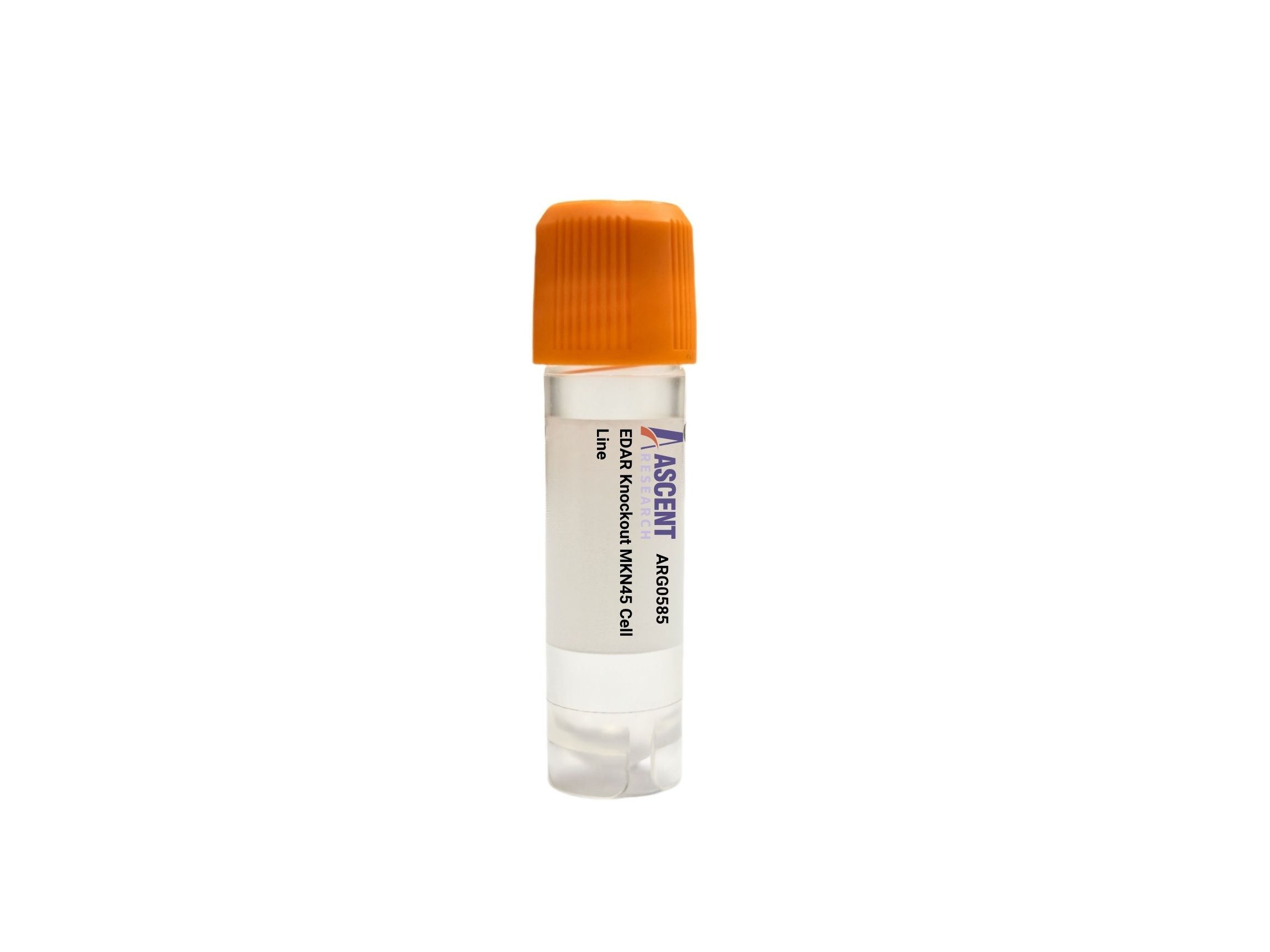
Genome-edited Cells
Stomach
The EDAR Knockout MKN45 Cell Line is a CRISPR/Cas9-edited knockout cell line derived from the human MKN45 gastric adenocarcinoma cell line, providing a robust loss-of-function model for the ectodysplasin A receptor (EDAR). EDAR signaling, mediated by the EDARADD/TRAF6 complex, activates NF-??B and JNK pathways to regulate genes such as CCND1 and BCL2, thereby influencing cell proliferation, survival, and invasive behavior. In MKN45 cells, EDAR disruption impairs these oncogenic pathways, making this model ideal for investigating EDAR??s role in gastric cancer progression. Key applications include dissection of NF-??B and JNK signaling, migration and invasion assays, and screening of EDAR-targeted therapeutic compounds.
 CHD6 Knockout A2780 Polyclonal Cells
Cat. No. ARG19040
LAMA5 Knockout jurkat Polyclonal Cells
Cat. No. ARG13365
ANKRD10 Knockout Hela Polyclonal Cells
Cat. No. ARG20825
HOMER1 Knockout MES-OV Polyclonal Cells
Cat. No. ARG24560
DMD Knockout HEK293T Polyclonal Cells
Cat. No. ARG38964
DNAJC6 Knockout huh-7 Polyclonal Cells
Cat. No. ARG39334
CHD6 Knockout A2780 Polyclonal Cells
Cat. No. ARG19040
LAMA5 Knockout jurkat Polyclonal Cells
Cat. No. ARG13365
ANKRD10 Knockout Hela Polyclonal Cells
Cat. No. ARG20825
HOMER1 Knockout MES-OV Polyclonal Cells
Cat. No. ARG24560
DMD Knockout HEK293T Polyclonal Cells
Cat. No. ARG38964
DNAJC6 Knockout huh-7 Polyclonal Cells
Cat. No. ARG39334
The EDAR Knockout MKN45 Cell Line is a CRISPR/Cas9-edited knockout cell line derived from the human MKN45 gastric adenocarcinoma line, offering a stable loss-of-function model for studying ectodysplasin A receptor (EDAR) biology. This ready-to-use live cell product enables researchers to dissect EDAR-dependent signaling without reliance on transient silencing techniques, ensuring consistent genetic ablation in all experimental replicates.
MKN45 is a poorly differentiated gastric adenocarcinoma cell line with epithelial morphology and tumorigenic properties, widely employed in gastric cancer research. Its aggressive growth characteristics and genetic background representative of advanced disease make it a suitable host for investigating genes involved in tumor progression and metastasis.
EDAR functions as the receptor for ectodysplasin A isoforms, triggering assembly of a signaling complex that includes the adaptor EDARADD and the E3 ligase TRAF6. This complex activates TAK1, which in turn stimulates both the IKK complex for NF-??B activation and the JNK kinase cascade. Downstream, NF-??B and JUN transcription factors regulate expression of genes such as CCND1, BCL2, and MMP9, linking EDAR to cell cycle, survival, and matrix remodeling. Crosstalk with Wnt/??-catenin signaling further extends the receptor??s regulatory influence.
In MKN45 cells, CRISPR/Cas9-mediated EDAR disruption eliminates receptor-mediated signal transduction, impairing activation of NF-??B and JNK pathways. This abrogates the transcriptional programs that promote proliferation, suppress apoptosis, and facilitate epithelial-to-mesenchymal transition, thereby attenuating oncogenic properties. The knockout cell line thus provides a clean genetic background to study EDAR??s contribution to gastric cancer aggressiveness and its potential as a therapeutic target.
Researchers can employ this model to perform NF-??B luciferase reporter assays, phospho-JNK ELISA, and western blotting for pathway components, alongside flow cytometry for cell cycle and apoptosis analysis. Migration and invasion can be assessed using wound healing or transwell assays. The cell line also enables co-immunoprecipitation studies to explore EDARADD/TRAF6 complex alterations and screens for EDAR-targeted agents. For additional support, please reach out to Ascent Research.