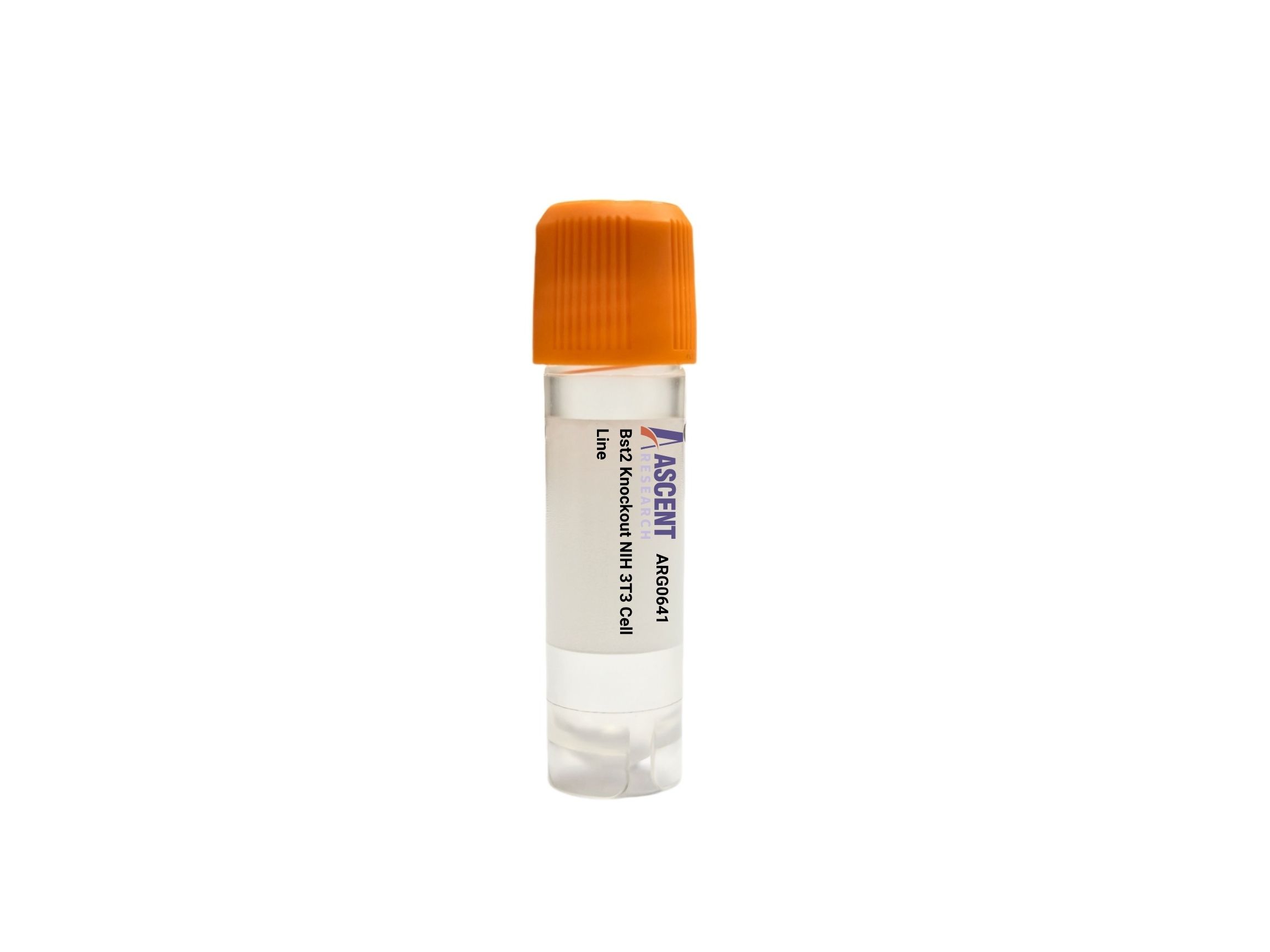
Genome-edited Cells
The Bst2 Knockout NIH 3T3 Cell Line is a CRISPR/Cas9-edited murine embryonic fibroblast line lacking functional Bst2, which encodes the viral restriction factor tetherin. Tetherin is transcriptionally induced by interferons and IRF transcription factors, and it restrains enveloped viruses while also activating NF-??B signaling through interactions with TRAF proteins and downstream cytokines such as IL-6 and TNF-??. This knockout model is ideal for dissecting innate immune pathways, viral antagonism by proteins like HIV-1 Vpu, and tetherin-dependent signaling in fibroblast cells. Representative applications include viral release assays, NF-??B reporter studies, and antiviral drug screening.
 C1orf226 Knockout MES-OV Polyclonal Cells
Cat. No. ARG24387
FLCN Knockout Lovo Polyclonal Cells
Cat. No. ARG11695
ATP11B Knockout NCI-H1299 Polyclonal Cells
Cat. No. ARG30469
JAG1 Knockout UMUC-3 Polyclonal Cells
Cat. No. ARG36945
MAN2B2 Knockout 786-O Polyclonal Cells
Cat. No. ARG5746
C1orf226 Knockout MES-OV Polyclonal Cells
Cat. No. ARG24387
FLCN Knockout Lovo Polyclonal Cells
Cat. No. ARG11695
ATP11B Knockout NCI-H1299 Polyclonal Cells
Cat. No. ARG30469
JAG1 Knockout UMUC-3 Polyclonal Cells
Cat. No. ARG36945
MAN2B2 Knockout 786-O Polyclonal Cells
Cat. No. ARG5746
 Human Umbilical Vein Endothelial Cell Medium
Cat. No. ARM0172
Human Umbilical Vein Endothelial Cell Medium
Cat. No. ARM0172
The Bst2 Knockout NIH 3T3 Cell Line is a CRISPR/Cas9-edited knockout cell line that provides a reliable loss-of-function model for investigating the biological roles of Bst2, the gene encoding tetherin. Derived from the mouse NIH 3T3 embryonic fibroblast line, this product enables precise disruption of the target gene without introducing off-target artifacts, making it suitable for mechanistic studies in innate immunity, viral restriction, and NF-??B signaling. The knockout cell line is generated using advanced genome editing technology, resulting in a stable cell population that lacks functional Bst2 expression and can be employed across a variety of biochemical, cell-based, and virological assays.
The parental NIH 3T3 line was originally established from NIH Swiss mouse embryo cultures and has become a cornerstone fibroblast model in biomedical research. These cells display adherent growth, robust proliferation, and high transfection efficiency, facilitating genetic manipulation and downstream applications such as viral infection, reporter assays, and cytokine profiling. Their embryonic origin and mesenchymal characteristics make them particularly relevant for studies of interferon responses, tumor microenvironment interactions, and viral pathogenesis, as they recapitulate features of primary fibroblasts while maintaining experimental tractability.
Bst2 encodes tetherin, a lipid raft-associated type II transmembrane protein that directly restricts the release of enveloped viruses by anchoring nascent virions to the plasma membrane. Beyond this physical tethering mechanism, tetherin also functions as an innate immune signaling adaptor: upon engagement with viral particles or via endocytosis mediated by the AP-2 complex, it activates the NF-??B pathway through interactions with TRAF proteins. Upstream, Bst2 expression is transcriptionally induced by type I interferons (IFN-?? and IFN-??) via the JAK-STAT pathway, with IRF1, IRF3, and IRF7 serving as key transcription factors. Downstream, NF-??B signaling promotes the expression of pro-inflammatory cytokines such as IL-6 and TNF-??, amplifying antiviral defenses. The pathway is regulated by components including IFNAR1, STAT1, IRF9, NFKBIA, and RELA, while viral antagonistic proteins like HIV-1 Vpu and KSHV K5 counteract tetherin by targeting it for proteasomal degradation.
In the context of NIH 3T3 cells, which are permissive to a range of murine viruses and responsive to interferon stimulation, knockout of Bst2 eliminates both the physical restriction of viral egress and the tetherin-dependent activation of NF-??B. This dual loss of function enables researchers to dissect the relative contributions of tetherin??s antiviral and signaling activities without confounding endogenous expression. The cell line thus provides a clean background for studying how viruses evade host defenses through tetherin antagonism and for evaluating the immunomodulatory consequences of tetherin deficiency in fibroblast-driven inflammatory responses.
Applications of the Bst2 Knockout NIH 3T3 Cell Line extend to viral release assays using GFP-tagged virions, Western blotting for viral and host proteins, and flow cytometric detection of viral antigens. It is also well-suited for NF-??B reporter assays to measure signaling activity, RT-qPCR profiling of interferon-stimulated genes, and high-throughput antiviral drug screening. By combining the advantages of a well-characterized fibroblast host with targeted Bst2 disruption, this product accelerates research into viral restriction mechanisms, innate immune signal transduction, and therapeutic development. For additional information or custom cell line generation, please contact Ascent Research.