Genome-edited Cells
Bone
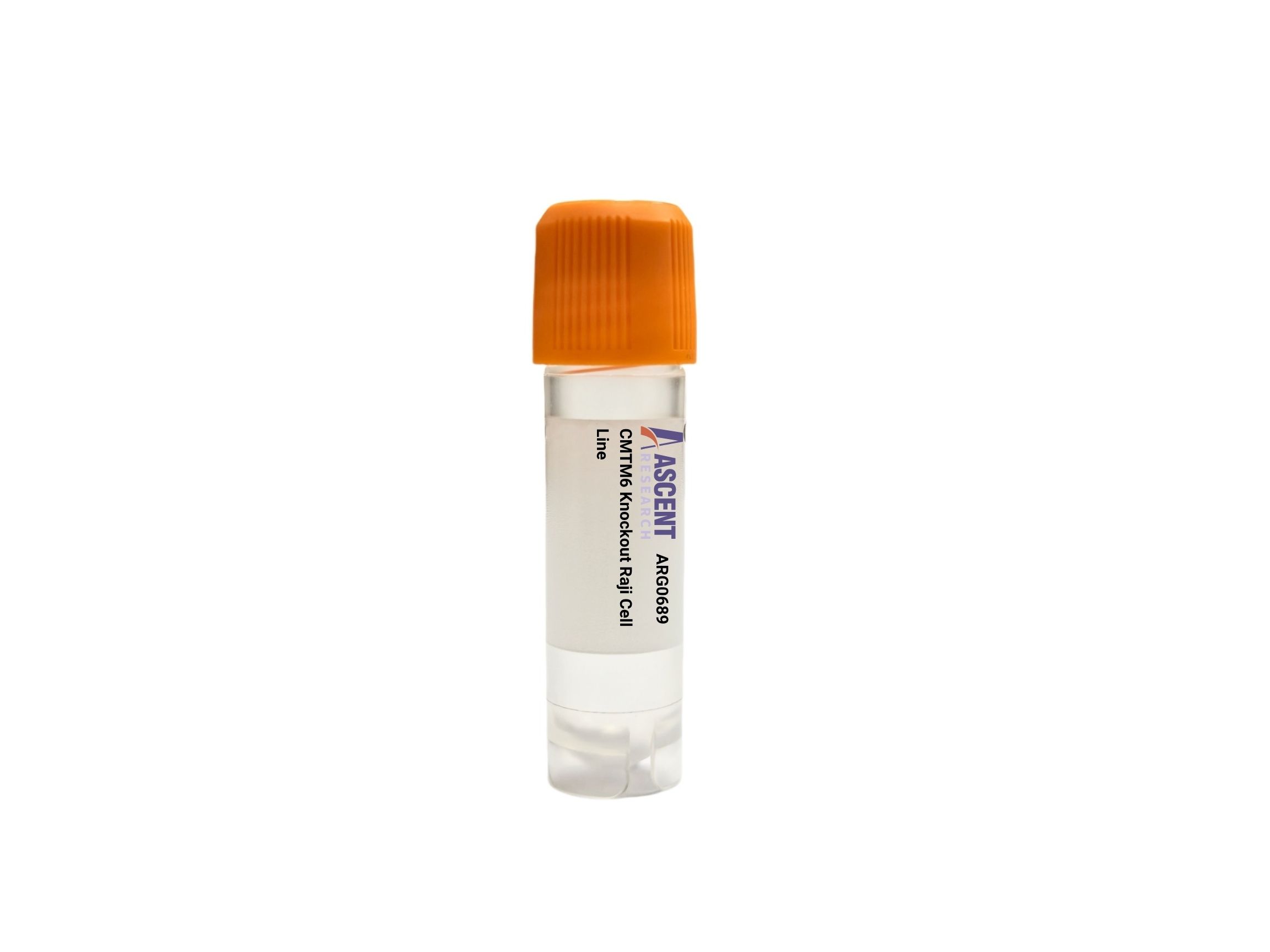
The CMTM6 Knockout Raji Cell Line is a CRISPR/Cas9-edited B lymphocyte model with disruption of the CMTM6 gene, a key stabilizer of PD-L1 and PD-L2. In the Raji Burkitt lymphoma background, loss of CMTM6 accelerates lysosomal degradation of PD-L1, impairing immune checkpoint function. This line enables direct study of PD-L1 regulation and recycling endosome dynamics. Applications include flow cytometric PD-L1 measurement, co-immunoprecipitation of PD-L1?CCMTM6 complexes, and T-cell co-culture assays. It is suitable for drug screens targeting PD-L1 stability and for investigating SHP-2 and JAK/STAT signaling downstream of PD-1.
 GBA2 Knockout A2780 Polyclonal Cells
Cat. No. ARG19177
AMPD2 Knockout 786-O Polyclonal Cells
Cat. No. ARG24895
ATOX1 Knockout NCI-H1299 Polyclonal Cells
Cat. No. ARG30467
CCDC9 Knockout HAP1 Polyclonal Cells
Cat. No. ARG43101
CASP2 Knockout SK-HEP-1 Polyclonal Cells
Cat. No. ARG42431
C6orf136 Knockout Hela Polyclonal Cells
Cat. No. ARG41527
GBA2 Knockout A2780 Polyclonal Cells
Cat. No. ARG19177
AMPD2 Knockout 786-O Polyclonal Cells
Cat. No. ARG24895
ATOX1 Knockout NCI-H1299 Polyclonal Cells
Cat. No. ARG30467
CCDC9 Knockout HAP1 Polyclonal Cells
Cat. No. ARG43101
CASP2 Knockout SK-HEP-1 Polyclonal Cells
Cat. No. ARG42431
C6orf136 Knockout Hela Polyclonal Cells
Cat. No. ARG41527
The CMTM6 Knockout Raji Cell Line is a CRISPR/Cas9-edited knockout model in which the CMTM6 gene has been disrupted, eliminating its function in PD-L1 stabilization. Derived from the Raji human B lymphocyte line, this cell line provides a defined loss-of-function system for dissecting CMTM6-dependent regulation of PD-L1 surface expression and endosomal recycling. By removing the protective interaction, researchers can study enhanced PD-L1 degradation and altered immune checkpoint output.
The Raji parental line originates from a human Burkitt lymphoma and represents a lymphoblastoid B-cell lineage. Raji cells are characterized by rapid proliferation and express key immunomodulatory molecules, making them a standard model for B-cell lymphoma and immune evasion research. This genetic background is clinically relevant for investigating PD-L1 checkpoint mechanisms in hematologic malignancies.
CMTM6 (CKLF-like MARVEL transmembrane domain containing 6) is a ubiquitously expressed protein that directly binds PD-L1 and PD-L2 at the plasma membrane and in recycling endosomes. By shielding PD-L1 from ubiquitination and subsequent lysosomal sorting, CMTM6 prolongs its half-life and increases steady-state surface levels. Elevated PD-L1 engages PD-1 on T cells, recruiting SHP-2 phosphatase and dampening ZAP70-mediated T-cell receptor signaling, thus suppressing anti-tumor immunity. The pathway integrates input from the IFN-gamma receptor and JAK/STAT activation, while CMTM6 itself lacks known upstream regulators, making its disruption a direct means to reduce PD-L1 load.
In the Raji lymphoma context, CMTM6 knockout significantly reduces PD-L1 surface expression, impairing immune evasion capacity. This model enables rigorous examination of the molecular interplay between endosomal recycling, lysosomal degradation, and checkpoint protein turnover. It serves as a platform for mapping PD-L1 degradation pathways and testing interventions that bypass CMTM6 to destabilize PD-L1, with direct relevance for B-cell lymphoma therapies.
Typical applications include flow cytometry and immunofluorescence to quantify surface PD-L1, co-immunoprecipitation to assess PD-L1?CCMTM6 interaction, and T-cell co-culture assays to measure functional immune suppression. The cell line is also suitable for drug screens targeting PD-L1 stability and for mechanistic studies on lysosomal inhibition and JAK/STAT signaling. For additional information or technical support, please contact Ascent Research.