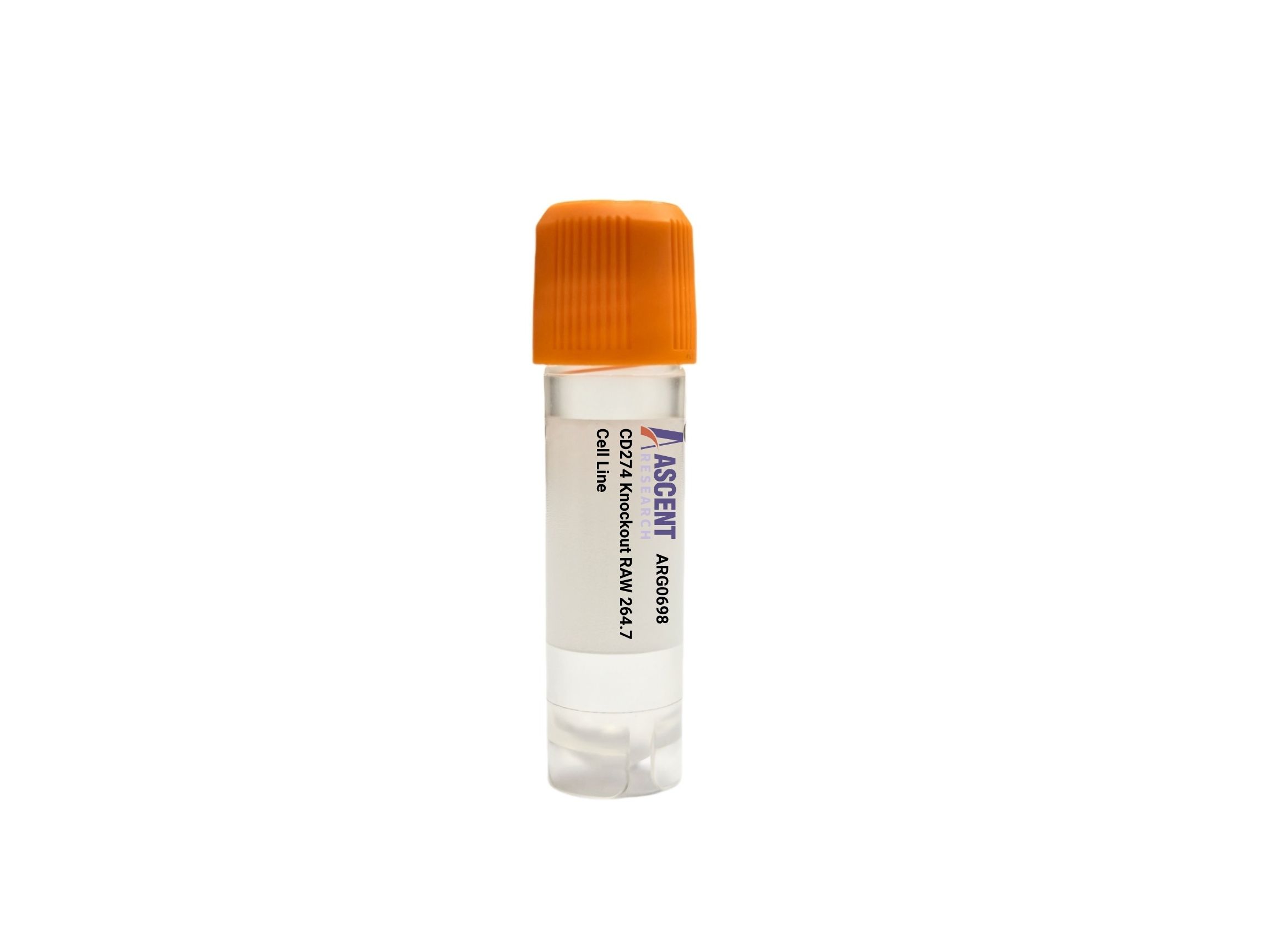
Genome-edited Cells
Ascites
The CD274 Knockout RAW 264.7 Cell Line is a CRISPR/Cas9-edited knockout cell line that ablates PD-L1 (CD274) expression in murine macrophages. PD-L1 is an immune checkpoint ligand that, upon binding PD-1 on T cells, recruits SHP-2 phosphatase to suppress TCR-mediated PI3K/AKT signaling, thereby attenuating T cell effector functions. This knockout model provides a defined genetic system to study the role of macrophage PD-L1 in immune regulation. This cell line is suitable for co-culture assays with T cells to assess cytokine production, flow cytometric validation of PD-L1 loss, and drug screening for PD-L1 inhibitors. It serves as a powerful tool for research in immuno-oncology, chronic infection, and autoimmune disease, where PD-L1-mediated immunosuppression is a key pathogenic feature.
 GOLPH3L Knockout 786-O Polyclonal Cells
Cat. No. ARG25179
ATXN3 Knockout NCI-H1299 Polyclonal Cells
Cat. No. ARG30488
CCDC167 Knockout HT29 Polyclonal Cells
Cat. No. ARG42974
CAPN14 Knockout HAP1 Polyclonal Cells
Cat. No. ARG42171
LRP1 Knockout PATU8988T Polyclonal Cells
Cat. No. ARG11349
LRRC41 Knockout 786-O Polyclonal Cells
Cat. No. ARG5274
GOLPH3L Knockout 786-O Polyclonal Cells
Cat. No. ARG25179
ATXN3 Knockout NCI-H1299 Polyclonal Cells
Cat. No. ARG30488
CCDC167 Knockout HT29 Polyclonal Cells
Cat. No. ARG42974
CAPN14 Knockout HAP1 Polyclonal Cells
Cat. No. ARG42171
LRP1 Knockout PATU8988T Polyclonal Cells
Cat. No. ARG11349
LRRC41 Knockout 786-O Polyclonal Cells
Cat. No. ARG5274
The CD274 Knockout RAW 264.7 Cell Line is a CRISPR/Cas9-edited knockout cell line generated from the murine RAW 264.7 macrophage parental line. It provides a stable loss-of-function model for CD274 (PD-L1), a key immune checkpoint ligand. By disrupting endogenous CD274 expression, this cell line enables investigation of PD-L1-dependent immune regulation without confounding effects of antibody blockade, offering a clean genetic system for functional studies.
RAW 264.7 cells are an extensively characterized mouse macrophage line derived from BALB/c mouse ascites fluid after Abelson leukemia virus transformation. They retain hallmark macrophage functions, including robust phagocytosis, LPS-inducible inflammatory cytokine production, and responsiveness to IFN-?? stimulation. These properties make RAW 264.7 cells a gold-standard model for studying macrophage biology, innate immune signaling, and host?Cpathogen interactions, and they are particularly suitable for examining the role of PD-L1 in macrophage-mediated immune modulation.
CD274 encodes programmed death-ligand 1, which upon binding to its receptor PD-1 (PDCD1) on T cells, triggers recruitment of SHP-2 phosphatase (PTPN11). SHP-2 dephosphorylates proximal TCR signaling molecules, thereby attenuating the PI3K/AKT and RAS/ERK pathways, culminating in diminished T cell proliferation, cytokine output, and cytolytic activity. CD274 expression is transcriptionally upregulated by IFN-?? via the IFNGR?CJAK1?CSTAT1 axis and by NF-??B. Additionally, PD-L1 can interact with B7-1 (CD80), providing cross-regulation of costimulatory signals. Thus, CD274 is a central node in immune checkpoint control.
In RAW 264.7 macrophages, CD274 is dynamically induced by inflammatory stimuli, mimicking the activation-induced upregulation observed in primary macrophages and tumor-associated macrophages. Knocking out CD274 eliminates PD-L1-mediated suppressive capacity, permitting precise dissection of how macrophage PD-L1 contributes to T cell exhaustion, immune tolerance, and tumor immune evasion. This model is highly relevant for studying the macrophage?CT cell interface in cancer, chronic infection, and autoimmunity, where aberrant PD-L1 expression drives immunosuppressive microenvironments.
Typical applications include flow cytometry to confirm PD-L1 ablation, western blotting for downstream effectors like phospho-AKT, and co-culture assays with T cells monitored by ELISA for cytokines such as IL-2 and IFN-??. The line is also suited for PD-1 binding assays, drug screening against PD-L1 inhibitors, and RNA-seq transcriptomic profiling. Collectively, these uses support target validation in immuno-oncology, mechanistic studies of immune checkpoint pathways, and development of macrophage-targeted immunotherapies. For further details, contact Ascent Research.