Genome-edited Cells
Ascites
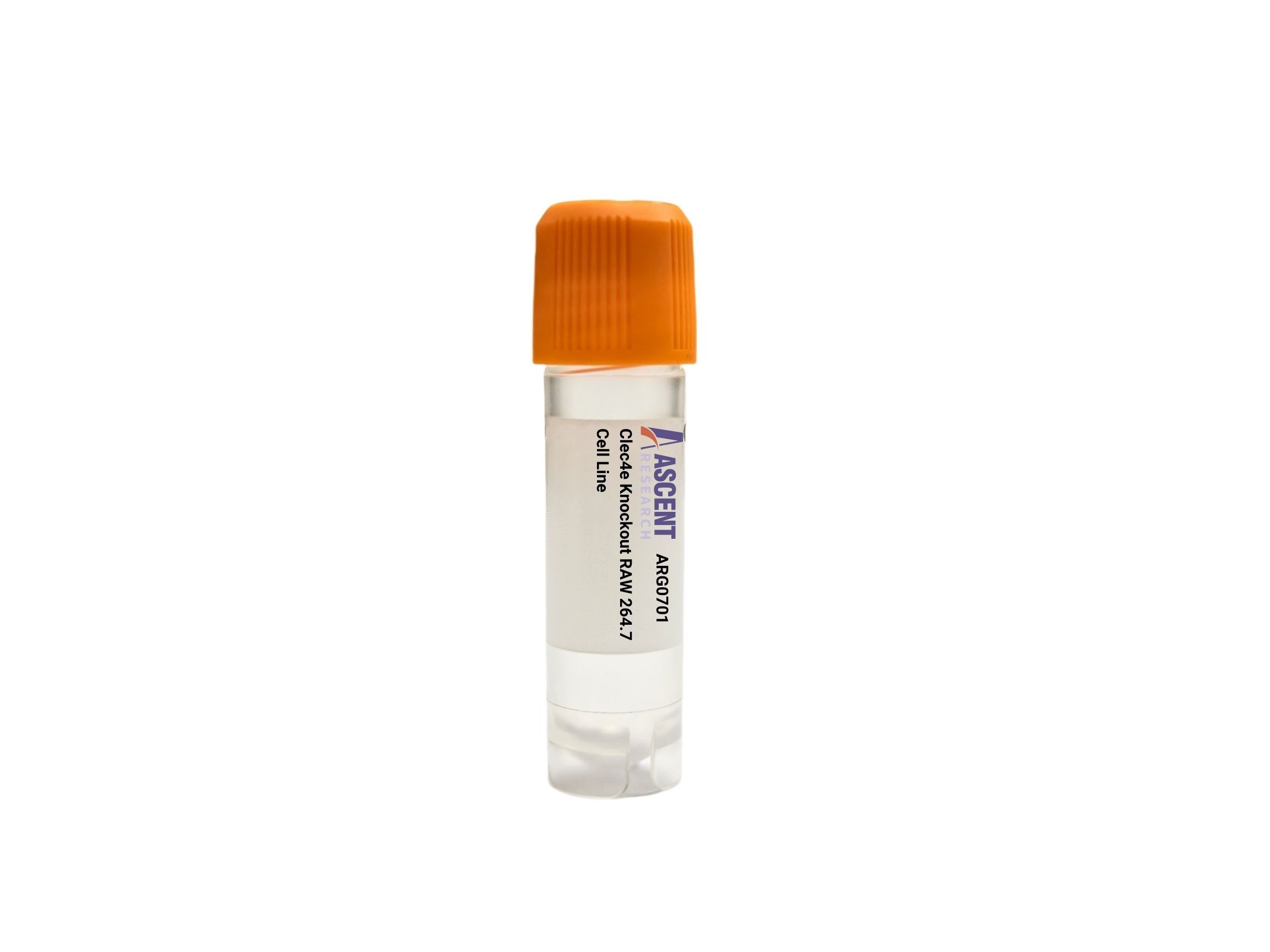
The Clec4e Knockout RAW 264.7 Cell Line is a CRISPR/Cas9-edited macrophage cell line lacking functional Mincle (Clec4e), a C-type lectin receptor critical for innate immune recognition of pathogen-derived glycolipids. This knockout line is generated on the RAW 264.7 background, a widely used Balb/c-derived macrophage model with robust phagocytic and inflammatory cytokine production capabilities. By disrupting Mincle, this cell line abrogates signaling through the FcR??-SYK-CARD9 axis, thereby impairing NF-??B-dependent expression of TNF, IL-6, IL-1??, and iNOS. It serves as a powerful tool for investigating host-pathogen interactions, macrophage activation, and inflammatory signaling in mycobacterial and fungal infection research, as well as in studies of C-type lectin receptor-mediated immunity.
 C6orf136 Knockout Hela Polyclonal Cells
Cat. No. ARG23802
KDM4B Knockout Raji Polyclonal Cells
Cat. No. ARG23897
ARHGAP5 Knockout MES-OV Polyclonal Cells
Cat. No. ARG24210
KNOP1 Knockout huh-7 Polyclonal Cells
Cat. No. ARG28503
HSPBP1 Knockout NCI-H1299 Polyclonal Cells
Cat. No. ARG30776
MTHFD2 Knockout AGS Polyclonal Cells
Cat. No. ARG3172
C6orf136 Knockout Hela Polyclonal Cells
Cat. No. ARG23802
KDM4B Knockout Raji Polyclonal Cells
Cat. No. ARG23897
ARHGAP5 Knockout MES-OV Polyclonal Cells
Cat. No. ARG24210
KNOP1 Knockout huh-7 Polyclonal Cells
Cat. No. ARG28503
HSPBP1 Knockout NCI-H1299 Polyclonal Cells
Cat. No. ARG30776
MTHFD2 Knockout AGS Polyclonal Cells
Cat. No. ARG3172
The Clec4e Knockout RAW 264.7 Cell Line is a CRISPR/Cas9-edited knockout cell line designed to disrupt expression of Clec4e (also known as Mincle) in the murine macrophage cell line RAW 264.7. This genetically modified cell line provides a loss-of-function model for investigating the role of the C-type lectin receptor Mincle in innate immune signaling, glycolipid recognition, and inflammatory responses.
RAW 264.7 is an Abelson murine leukemia virus-transformed macrophage cell line derived from a BALB/c mouse. These cells exhibit key macrophage functions including robust phagocytic activity, production of inflammatory cytokines such as TNF and IL-6, and generation of reactive nitrogen species via inducible nitric oxide synthase (iNOS). The cell line is widely employed to study macrophage activation, host-pathogen interactions, and intracellular signaling cascades.
Clec4e encodes the macrophage-inducible C-type lectin receptor Mincle, which serves as a pattern recognition receptor for pathogen-derived glycolipids. Upon binding ligands such as mycobacterial trehalose dimycolate (TDM) or fungal glycolipids, Mincle associates with ITAM-containing adaptor proteins FcR?? and DAP12. This interaction triggers phosphorylation-dependent activation of spleen tyrosine kinase (SYK), which subsequently activates protein kinase C ?? (PKC??). Active PKC?? promotes the assembly of the CARD9-BCL10-MALT1 signaling complex, leading to the activation of the transcription factor NF-??B. NF-??B drives the expression of pro-inflammatory mediators including TNF, IL-6, IL-1??, and iNOS. In addition to exogenous glycolipids, Mincle can be activated by endogenous danger signals such as SAP130. Thus, Clec4e is a critical regulator of both antimicrobial defense and sterile inflammatory pathways.
In the RAW 264.7 macrophage background, knockout of Clec4e abrogates Mincle-dependent signaling, providing a powerful tool to dissect its contribution to macrophage effector functions. This model enables researchers to examine the consequences of losing Mincle-mediated recognition of TDM and fungal cell wall components on NF-??B activation, cytokine secretion, and antimicrobial responses. Because RAW 264.7 cells retain key macrophage properties, the knockout line is highly relevant for studying the molecular basis of macrophage polarization and inflammatory gene expression programs controlled by C-type lectin receptors.
The Clec4e Knockout RAW 264.7 Cell Line is ideally suited for a broad range of experimental applications in innate immunity and infectious disease research. It can be used in assays such as western blotting to confirm loss of Mincle protein and assess SYK phosphorylation, RT-qPCR and ELISA to measure cytokine production (e.g., TNF, IL-6), NF-??B luciferase reporter assays to quantify pathway activation, and co-immunoprecipitation to study Mincle?CFcR?? interactions. Additionally, the line supports functional studies including phagocytosis assays and macrophage nitric oxide production measurements. This knockout model is a valuable resource for investigators studying mycobacterial and fungal pathogenesis, C-type lectin receptor signaling, and inflammatory disorders. For further information or to inquire about custom cell line engineering, please contact Ascent Research.