Genome-edited Cells
Ascites
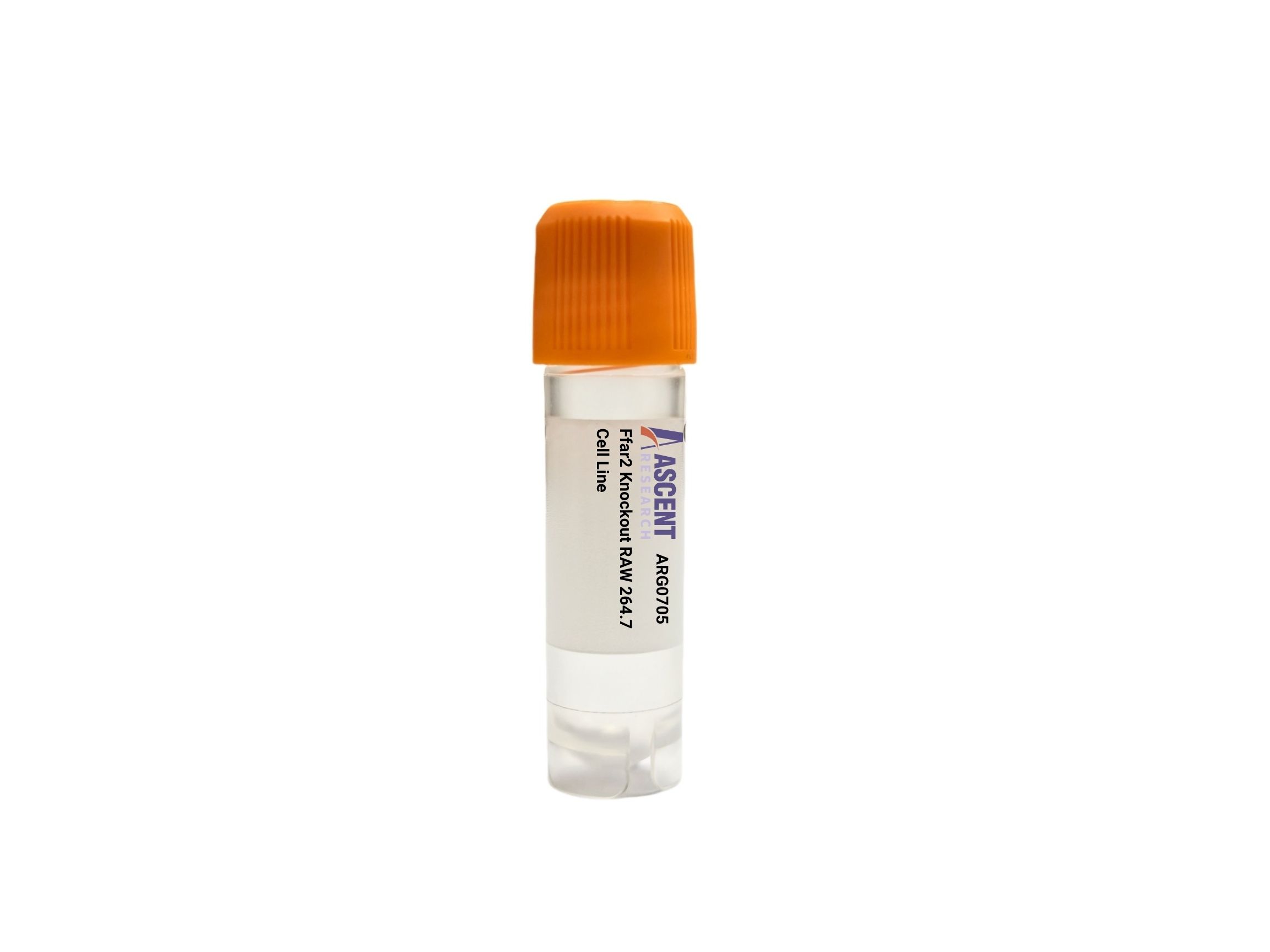
The Ffar2 Knockout RAW 264.7 Cell Line is a CRISPR/Cas9-edited mouse macrophage cell line with targeted disruption of the free fatty acid receptor 2 (FFAR2/GPR43). This loss-of-function model eliminates the receptor for short-chain fatty acids (SCFAs) such as acetate, propionate, and butyrate, which are critical microbiota-derived metabolites. In RAW 264.7 macrophages, disrupted FFAR2 blocks G??i/o-mediated cAMP inhibition and downstream MAPK/ERK and PI3K/Akt pathways, abolishing regulation of cytokines such as TNF and IL-6. This knockout model enables study of SCFA signaling in inflammation, metabolic disease, and host-microbiome interactions using assays for signaling, cytokine release, and cell function.
 ETFA Knockout HEK293T Polyclonal Cells
Cat. No. ARG4067
MCOLN1 Knockout NCI-H1703 Polyclonal Cells
Cat. No. ARG12624
ALPP Knockout A2780 Polyclonal Cells
Cat. No. ARG28676
ANKRD10 Knockout NCI-H1975 Polyclonal Cells
Cat. No. ARG31123
MAF1 Knockout Hela Polyclonal Cells
Cat. No. ARG7744
ETFA Knockout HEK293T Polyclonal Cells
Cat. No. ARG4067
MCOLN1 Knockout NCI-H1703 Polyclonal Cells
Cat. No. ARG12624
ALPP Knockout A2780 Polyclonal Cells
Cat. No. ARG28676
ANKRD10 Knockout NCI-H1975 Polyclonal Cells
Cat. No. ARG31123
MAF1 Knockout Hela Polyclonal Cells
Cat. No. ARG7744
 NCI-H226
Cat. No. ARC0620
NCI-H226
Cat. No. ARC0620
The Ffar2 Knockout RAW 264.7 Cell Line is a CRISPR/Cas9-engineered mouse macrophage cell line in which the free fatty acid receptor 2 (Ffar2) gene has been disrupted to abolish functional expression. This knockout model serves as a critical tool for investigating the receptor-mediated actions of short-chain fatty acids (SCFAs) in immune cells. The genetically disrupted cell line enables precise dissection of FFAR2-dependent signaling pathways without interference from endogenous receptor activity.
The host cell line, RAW 264.7, is an Abelson murine leukemia virus-transformed macrophage line derived from BALB/c mice. Widely used in immunology research, these cells faithfully recapitulate key macrophage functions including immune surveillance, phagocytosis, and the production of inflammatory cytokines. RAW 264.7 cells are highly responsive to microbial ligands and host-derived signals, making them an ideal system for studying innate immune mechanisms and host-microbiome crosstalk.
FFAR2, also known as GPR43, is a G??i/o-coupled receptor that recognizes SCFAs such as acetate, propionate, and butyrate produced by gut microbiota. Ligand binding triggers G??i/o-mediated inhibition of adenylate cyclase, resulting in decreased intracellular cAMP levels. This initiates downstream signaling through the MAPK/ERK and PI3K/Akt cascades, while also modulating NF-??B transcriptional activity. Beta-arrestin-1 and -2 are recruited upon receptor activation, further diversifying signal transduction. Consequently, FFAR2 controls the expression and release of key inflammatory mediators including IL-6, TNF, and IL-1??, positioning it as a central regulator of immune homeostasis.
In the RAW 264.7 macrophage background, FFAR2 integrates SCFA signals to tune inflammatory responses, chemotaxis, and phagocytic activity. Loss of Ffar2 abrogates these SCFA-dependent modulatory effects, creating a clean genetic background for evaluating the receptor??s specific contributions. This knockout cell line is particularly valuable for modeling how microbiota-derived metabolites influence macrophage function in chronic inflammatory and metabolic diseases. Comparative studies between wild-type and Ffar2-null RAW 264.7 cells can delineate receptor-dependent versus independent actions of SCFAs, thereby advancing understanding of diseases such as inflammatory bowel disease, colitis, type 2 diabetes, obesity, and arthritis.
Researchers can employ this knockout line in diverse assays including Western blot analysis of ERK1/2 and Akt phosphorylation, RT-qPCR profiling of cytokine transcripts, ELISA quantification of secreted TNF and IL-6, flow cytometry for surface receptor validation, and functional tests such as chemotaxis, phagocytosis, and intracellular cAMP measurement. The model supports drug screening for GPR43 modulators and detailed mechanistic studies of host-microbiome communication. For additional details, please contact Ascent Research.