Genome-edited Cells
Ascites
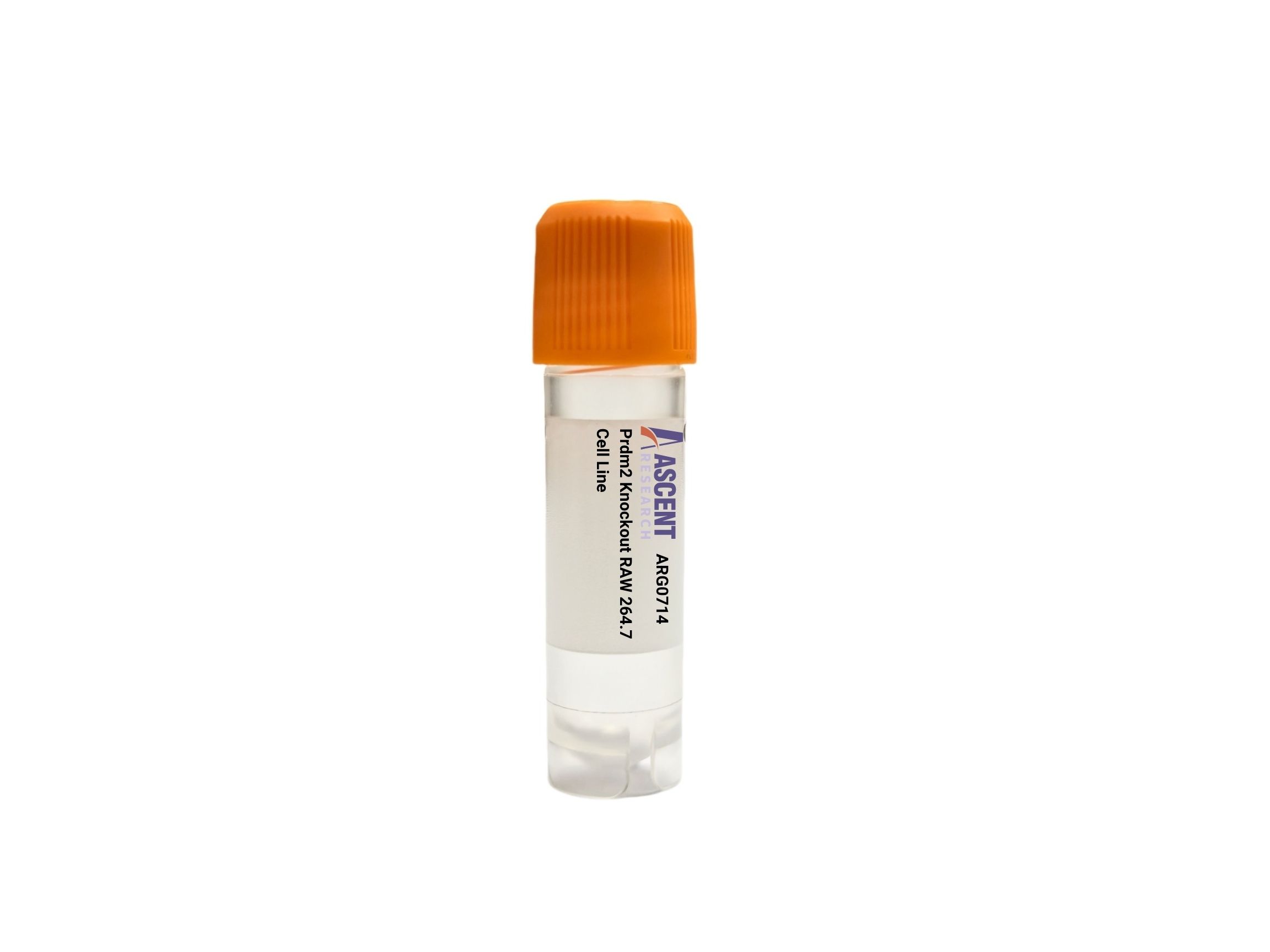
The Prdm2 Knockout RAW 264.7 Cell Line is a CRISPR/Cas9-edited loss-of-function model in a mouse macrophage background. It enables investigation of the histone methyltransferase PRDM2, a p53-interacting tumor suppressor that represses transcription of genes such as cyclin D1 and promotes apoptosis via targets like BAX and PUMA. This knockout cell line is ideal for studying macrophage apoptosis, DNA damage responses, and p53-mediated transcriptional regulation in innate immunity. Researchers can employ assays such as Annexin V flow cytometry, RT-qPCR, and RNA-seq to explore PRDM2-dependent mechanisms in inflammation and cancer.
 CALCOCO2 Knockout jurkat Polyclonal Cells
Cat. No. ARG34070
CAPNS1 Knockout Hela Polyclonal Cells
Cat. No. ARG42234
DRD5 Knockout HAP1 Polyclonal Cells
Cat. No. ARG39778
CC2D2A Knockout huh-7 Polyclonal Cells
Cat. No. ARG42850
FHOD1 Knockout Raji Polyclonal Cells
Cat. No. ARG1489
CALCOCO2 Knockout jurkat Polyclonal Cells
Cat. No. ARG34070
CAPNS1 Knockout Hela Polyclonal Cells
Cat. No. ARG42234
DRD5 Knockout HAP1 Polyclonal Cells
Cat. No. ARG39778
CC2D2A Knockout huh-7 Polyclonal Cells
Cat. No. ARG42850
FHOD1 Knockout Raji Polyclonal Cells
Cat. No. ARG1489
 Py8119
Cat. No. ARC0741
Py8119
Cat. No. ARC0741
The Prdm2 Knockout RAW 264.7 Cell Line is a CRISPR/Cas9-edited knockout cell line derived from the RAW 264.7 macrophage cell line. This product features targeted disruption of the Prdm2 gene, which encodes a histone methyltransferase involved in transcriptional repression and tumor suppression. The CRISPR/Cas9-mediated gene disruption model provides a stable loss-of-function background for studying PRDM2-dependent cellular processes, including apoptosis, DNA damage response, and tumor suppressor mechanisms.
RAW 264.7 is a BALB/c mouse (Mus musculus) macrophage cell line transformed with the Abelson murine leukemia virus. These cells exhibit characteristic macrophage functions such as phagocytosis, antigen presentation, cytokine secretion, and mediation of inflammatory responses. Their robust growth and well-characterized signaling pathways make them a widely used model for studying innate immunity, inflammation, and macrophage biology.
PRDM2 functions as a histone methyltransferase that is activated by DNA damage and p53 activation. It forms a transcriptional repressor complex with p53, HDAC1, and the mSin3A corepressor, regulating the expression of key target genes. Downstream targets include the cyclin-dependent kinase inhibitor p21/CDKN1A, the pro-apoptotic factors BAX and PUMA, and the cell cycle regulator cyclin D1, whose expression is repressed. This signaling network integrates upstream signals from the p53 pathway, including MDM2-mediated regulation, to control cell cycle arrest and apoptosis. PRDM2 thus acts as a critical node linking genotoxic stress to cellular fate decisions.
In the macrophage context, PRDM2 knockout is particularly relevant for investigating the interplay between DNA damage responses and innate immune functions. RAW 264.7 macrophages rely on apoptosis to regulate inflammation and eliminate damaged cells. Disruption of Prdm2 impairs the apoptotic response to genotoxic stress, potentially altering cytokine secretion profiles and antigen presentation capacity. This model enables dissection of PRDM2??s role in macrophage apoptosis, p53-mediated transcriptional programs, and the broader impact on inflammatory signaling pathways.
Typical research applications include tumor suppressor mechanism studies, macrophage apoptosis research, and DNA damage response investigations in innate immunity. Researchers can assess protein expression by western blotting for PRDM2, quantify target gene expression by RT-qPCR, measure apoptosis using Annexin V/PI flow cytometry, evaluate DNA damage by ??-H2AX staining, and profile global transcriptomic changes via RNA-seq. For further details or to place an order, please contact Ascent Research.