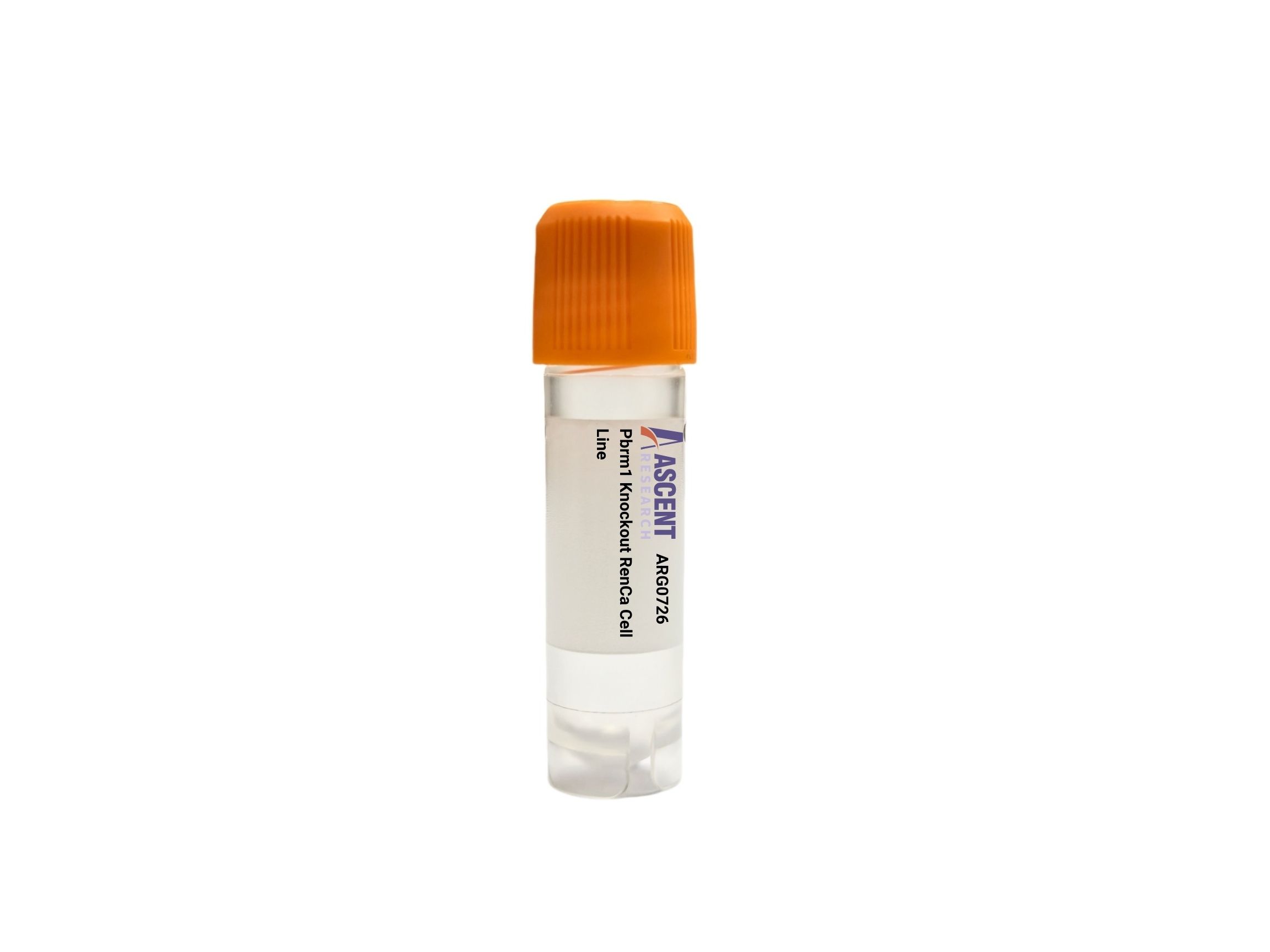
Genome-edited Cells
Kidney
The Pbrm1 Knockout RenCa Cell Line is a CRISPR/Cas9-edited murine renal cell carcinoma model with targeted disruption of the Pbrm1 gene, which encodes the BAF180 subunit of the PBAF chromatin remodeling complex. This knockout cell line enables investigation of PBRM1??s role in tumor suppression, gene regulation, and epithelial-mesenchymal transition (EMT), with connections to key factors such as HIF1A, STAT3, CDKN1A (p21), and CDH1 (E-cadherin). Derived from BALB/c mouse kidney epithelial cells, the RenCa background provides a syngeneic platform for studying renal cell carcinoma biology, drug responses, and metastasis. Applications include ChIP, migration and invasion assays, apoptosis analysis, RNA sequencing, and drug sensitivity screening.
 CDKN2A Knockout NCI-H1975 Polyclonal Cells
Cat. No. ARG16735
GPR88 Knockout HAP1 Polyclonal Cells
Cat. No. ARG22361
ADD3 Knockout jurkat Polyclonal Cells
Cat. No. ARG33750
AVEN Knockout AGS Polyclonal Cells
Cat. No. ARG26709
OTUB2 Knockout KYSE30 Polyclonal Cells
Cat. No. ARG9733
CDKN2A Knockout NCI-H1975 Polyclonal Cells
Cat. No. ARG16735
GPR88 Knockout HAP1 Polyclonal Cells
Cat. No. ARG22361
ADD3 Knockout jurkat Polyclonal Cells
Cat. No. ARG33750
AVEN Knockout AGS Polyclonal Cells
Cat. No. ARG26709
OTUB2 Knockout KYSE30 Polyclonal Cells
Cat. No. ARG9733
 Rabbit Carotid Artery Fibroblast Medium
Cat. No. ARM0695
Rabbit Carotid Artery Fibroblast Medium
Cat. No. ARM0695
The Pbrm1 Knockout RenCa Cell Line is a CRISPR/Cas9-edited knockout cell line derived from the RenCa murine renal cortical adenocarcinoma cell line. This model features targeted disruption of the Pbrm1 gene, generating a loss-of-function system for interrogating PBRM1-dependent biological processes. As a non-clonal knockout cell line, it enables population-level studies of Pbrm1 deficiency without claims of monoclonality or specific editing outcomes. The product is offered as a live cell line format, suitable for expansion and downstream functional analyses in cancer research.
The parental RenCa cell line originates from a spontaneous renal cortical adenocarcinoma in a BALB/c mouse, representing an epithelial cell type with well-characterized tumorigenic properties. RenCa cells are widely employed as a syngeneic model for renal cell carcinoma (RCC), particularly for investigating tumor growth, metastatic dissemination, and immunological interactions in immunocompetent hosts. Their epithelial origin and genetic background align closely with human clear cell RCC, making them a relevant platform for translational oncology studies.
PBRM1 (protein polybromo-1, also known as BAF180) is a defining subunit of the PBAF variant of the SWI/SNF chromatin remodeling complex. It interacts directly with core complex components SMARCA4, ARID2, and BRD7 to modulate nucleosome positioning and thereby regulate gene transcription. PBRM1 functions downstream of signals such as HIF1A, STAT3, TGF-??, and DNA damage pathways, and it transcriptionally controls key effectors including the cell cycle inhibitor CDKN1A (p21), the epithelial marker CDH1 (E-cadherin), the mesenchymal marker VIM (vimentin), the pro-apoptotic factor BAX, and the EMT regulator SNAI2 (Slug). Additionally, PBRM1 associates with tumor suppressors p53 and BCL6, integrating chromatin remodeling with critical cellular checkpoints. Disruption of Pbrm1 thus perturbs a multifaceted network that maintains genomic stability and epithelial homeostasis.
In the context of renal cell carcinoma, Pbrm1 knockout in RenCa cells recapitulates a frequent genetic alteration observed in human clear cell RCC, where PBRM1 loss-of-function mutations are associated with tumor progression and altered therapeutic responses. This model facilitates dissection of PBAF-specific functions in a kidney epithelial tumor environment, including effects on hypoxia-inducible signaling through HIF1A, TGF-??-mediated EMT, and STAT3-driven proliferation. By ablating Pbrm1, researchers can examine how loss of chromatin remodeling capacity influences tumor suppressor mechanisms, metastatic potential, and sensitivity to targeted agents, providing a physiologically relevant system for mechanistic and preclinical studies.
The Pbrm1 Knockout RenCa Cell Line is engineered for a broad spectrum of experimental applications. It supports chromatin remodeling studies via ChIP-qPCR and RNA-seq to map PBAF-dependent transcriptional programs, as well as functional assays measuring cell migration, invasion, and apoptosis. The model is suitable for drug sensitivity screening to identify compounds that selectively target PBRM1-deficient RCC cells, and for investigating EMT dynamics through expression analysis of CDH1, VIM, and SNAI2 by Western blotting and RT-qPCR. This knockout cell line thus serves as a valuable tool for oncologists and molecular biologists exploring tumor suppression, epigenetic regulation, and therapeutic vulnerabilities in renal carcinoma. For further technical specifications and ordering inquiries, please contact Ascent Research.