Genome-edited Cells
Uterus (cervix)
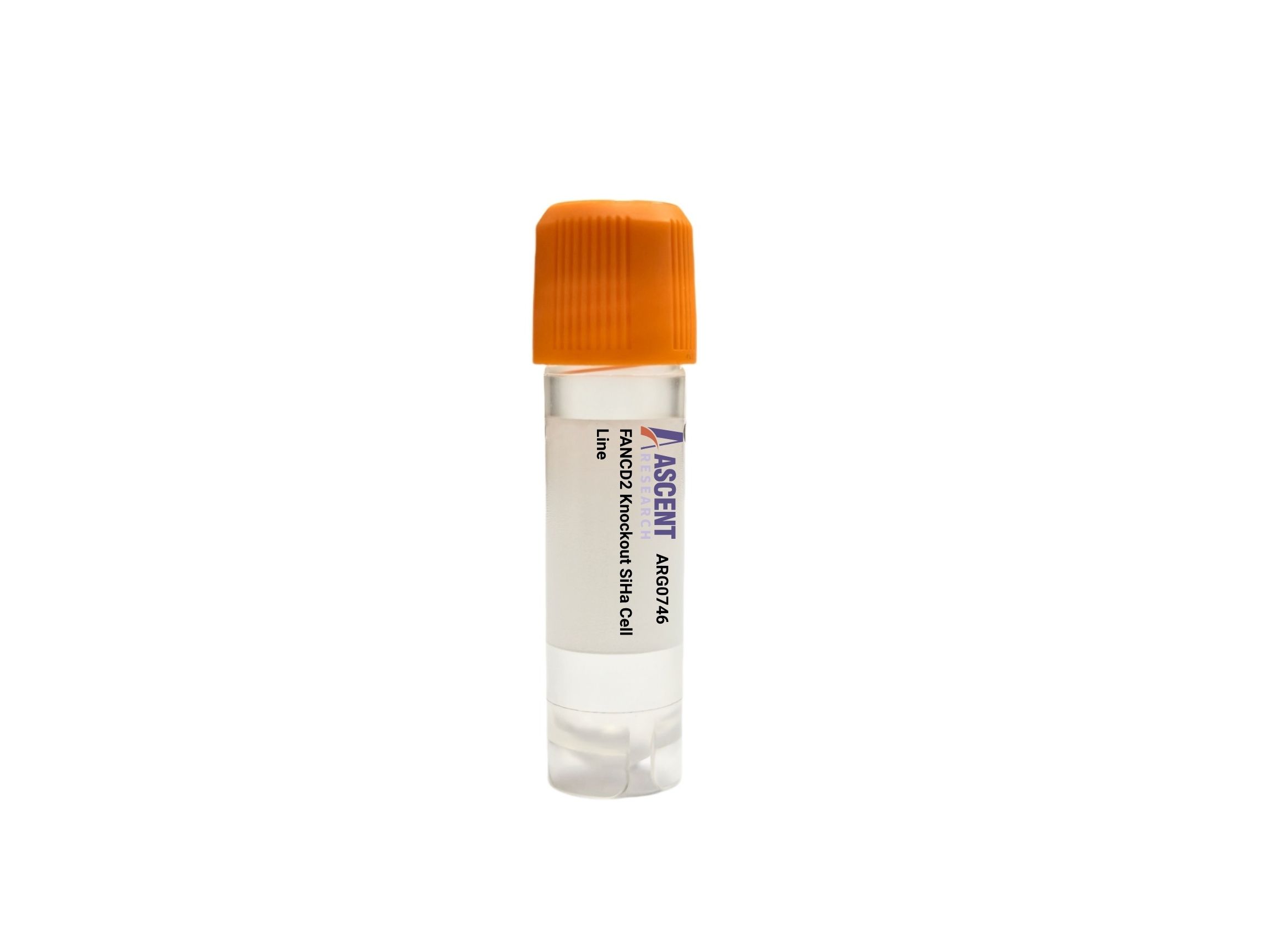
The FANCD2 Knockout SiHa Cell Line is a CRISPR/Cas9-edited knockout cell line derived from HPV16-positive cervical carcinoma SiHa cells, designed for targeted disruption of FANCD2, a pivotal mediator of interstrand crosslink repair and genomic stability. FANCD2 functions downstream of the FA core complex and ATR kinase, interacting with FANCI, BRCA1, and RAD51 to coordinate homologous recombination. This knockout model impairs DNA crosslink repair, enhancing sensitivity to agents like cisplatin and mitomycin C, and is suited for studying Fanconi anemia pathway, drug screening, synthetic lethality, and cancer biology. Applications include viability assays, immunofluorescence for repair foci, and Western blotting for monoubiquitination.
 NEXN Knockout jurkat Polyclonal Cells
Cat. No. ARG13089
PDLIM1 Knockout Hela Polyclonal Cells
Cat. No. ARG9031
MTG1 Knockout Hela Polyclonal Cells
Cat. No. ARG8309
GSR Knockout HEK293T Polyclonal Cells
Cat. No. ARG25999
ANPEP Knockout HAP1 Polyclonal Cells
Cat. No. ARG34913
NEXN Knockout jurkat Polyclonal Cells
Cat. No. ARG13089
PDLIM1 Knockout Hela Polyclonal Cells
Cat. No. ARG9031
MTG1 Knockout Hela Polyclonal Cells
Cat. No. ARG8309
GSR Knockout HEK293T Polyclonal Cells
Cat. No. ARG25999
ANPEP Knockout HAP1 Polyclonal Cells
Cat. No. ARG34913
 Rat Coronary Artery Endothelial Cells
Cat. No. ARP0195
Rat Coronary Artery Endothelial Cells
Cat. No. ARP0195
The FANCD2 Knockout SiHa Cell Line is a CRISPR/Cas9-edited knockout cell line generated through targeted disruption of the FANCD2 gene in the SiHa host cell background. This loss-of-function model provides a genetically defined system for investigating FANCD2-dependent DNA repair pathways and genome maintenance mechanisms. The knockout cell line is suitable for a wide range of functional studies, including DNA damage response assays, drug sensitivity profiling, and synthetic lethality screens.
The SiHa cell line is a well-characterized HPV16-positive cervical squamous cell carcinoma epithelial model. It is widely used for studying HPV-related oncogenesis and cellular responses to DNA damage. The presence of HPV E6 and E7 oncoproteins, which compromise p53 and Rb pathways respectively, makes SiHa cells particularly relevant for investigating genomic instability and DNA repair in a cancer context.
FANCD2 is a central effector of the Fanconi anemia pathway and functions in interstrand crosslink repair through monoubiquitination-dependent localization to DNA damage foci. Upon DNA crosslink induction, the FA core complex, in concert with the E2 enzyme Ube2T and the E3 ligase FANCL, monoubiquitinates FANCD2 in partnership with its paralog FANCI. This modification is triggered by ATR kinase signaling and enables FANCD2 to relocalize to chromatin where it interacts with BRCA1 and RAD51 to promote homologous recombination repair. Downstream, FANCD2 facilitates the assembly of repair complexes containing BRCA2 and RAD51, thereby maintaining genomic stability and tumor suppression.
In the SiHa background, FANCD2 knockout impairs the cellular capacity to resolve DNA interstrand crosslinks, leading to heightened sensitivity to crosslinking agents such as cisplatin and mitomycin C. The loss of FANCD2 disrupts repair foci formation and compromises homologous recombination efficiency, resulting in increased DNA damage accumulation and genomic instability. This phenotype is particularly pronounced in the context of HPV-driven cervical carcinoma, where compromised checkpoint controls exacerbate repair deficiencies, making this knockout model valuable for dissecting the interplay between oncogenic stress and DNA repair.
This cell line supports diverse research applications including mechanistic studies of the Fanconi anemia pathway, screening for modifiers of crosslink repair, and evaluation of synthetic lethal interactions. Typical assays include Western blotting to assess FANCD2 monoubiquitination, immunofluorescence to visualize repair foci, cell viability assays following treatment with DNA-damaging agents, homologous recombination reporter assays, and comet assays for DNA damage quantification. Additionally, flow cytometry for cell cycle and apoptosis, chromatin fractionation, and RNA-seq-based transcriptomic profiling can be employed to characterize repair deficiencies. The FANCD2 Knockout SiHa Cell Line is a powerful tool for advancing cancer biology and DNA repair research. For further technical information, please contact Ascent Research.