Genome-edited Cells
Liver
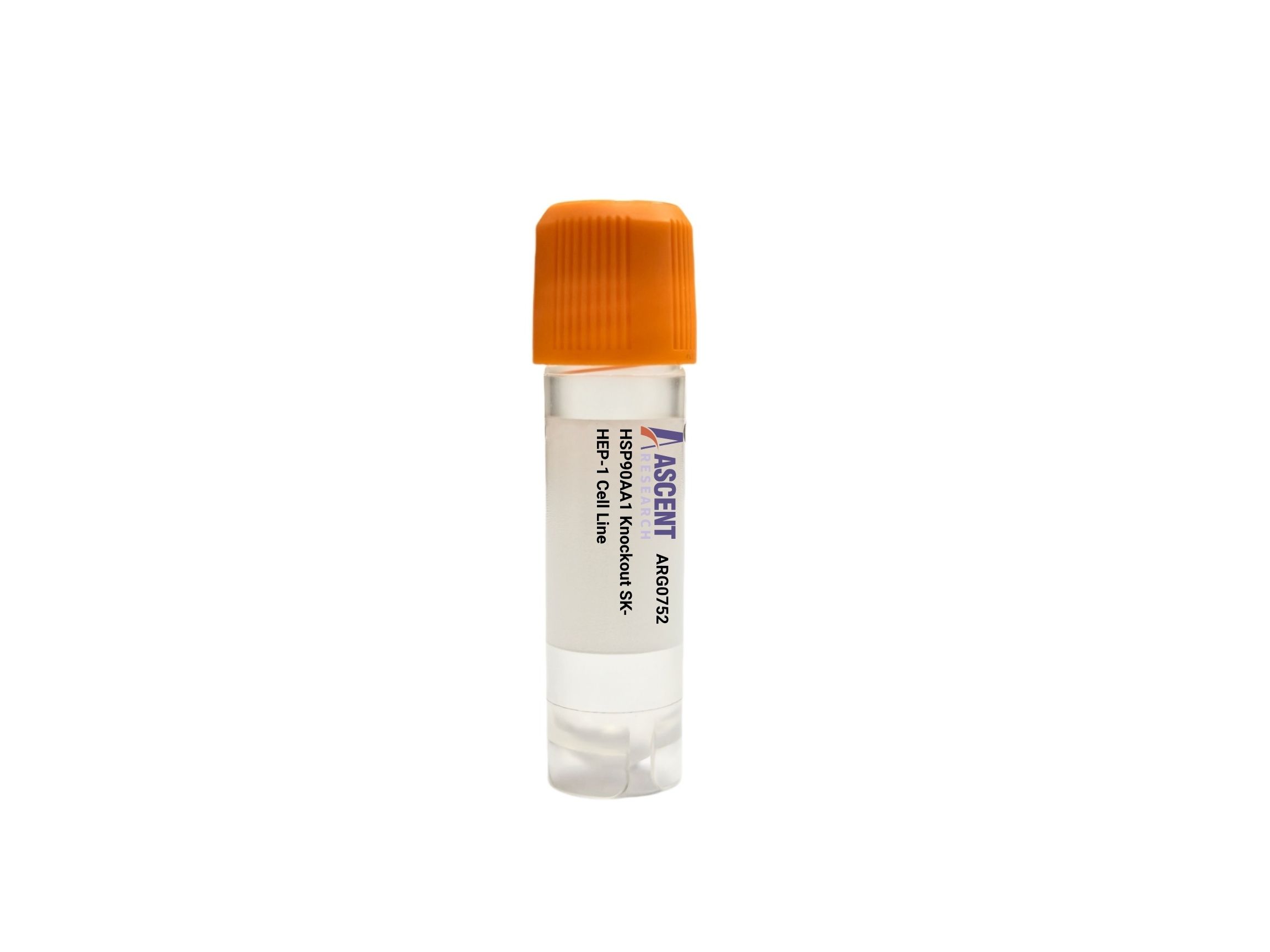
The HSP90AA1 Knockout SK-HEP-1 Cell Line is a CRISPR/Cas9-edited human hepatocellular carcinoma cell line with targeted disruption of the heat shock protein 90 alpha (Hsp90??) chaperone. This model enables sophisticated loss-of-function studies in a well-characterized liver adenocarcinoma background, offering a reliable tool for examining chaperone biology and oncogenic signaling. Hsp90?? stabilizes numerous client proteins, prominently including AKT1 and RAF1, maintaining PI3K/AKT/mTOR and MAPK/ERK pathway activation. Investigation of this knockout line supports drug target validation, preclinical evaluation of Hsp90 inhibitors, and functional genomics research in liver cancer.
 CTIF Knockout A2780 Polyclonal Cells
Cat. No. ARG18644
KIAA0319L Knockout 786-O Polyclonal Cells
Cat. No. ARG25414
HMGN5 Knockout A2780 Polyclonal Cells
Cat. No. ARG29133
GPANK1 Knockout A2780 Polyclonal Cells
Cat. No. ARG29030
IFI27 Knockout CaSki Polyclonal Cells
Cat. No. ARG35939
MKRN2 Knockout MES-OV Polyclonal Cells
Cat. No. ARG6791
CTIF Knockout A2780 Polyclonal Cells
Cat. No. ARG18644
KIAA0319L Knockout 786-O Polyclonal Cells
Cat. No. ARG25414
HMGN5 Knockout A2780 Polyclonal Cells
Cat. No. ARG29133
GPANK1 Knockout A2780 Polyclonal Cells
Cat. No. ARG29030
IFI27 Knockout CaSki Polyclonal Cells
Cat. No. ARG35939
MKRN2 Knockout MES-OV Polyclonal Cells
Cat. No. ARG6791
The HSP90AA1 Knockout SK-HEP-1 Cell Line is a CRISPR/Cas9-edited human hepatocellular carcinoma cell line engineered for targeted disruption of the HSP90AA1 gene, resulting in loss of heat shock protein 90 alpha (Hsp90??) expression. This loss-of-function model provides a defined genetic background to dissect the chaperone??s role in liver cancer cell biology without introducing pharmacological bias. The knockout cell line is supplied as a ready-to-use, well-characterized reagent for academic and pharmaceutical research, enabling reproducible interrogation of Hsp90??-dependent signaling networks and client protein stability.
Hosted by the SK-HEP-1 cell line, an epithelial-like human liver adenocarcinoma line originally derived from ascites, this model retains wild-type p53 and exhibits both epithelial and endothelial features. SK-HEP-1 cells are widely employed to study hepatocellular carcinoma progression, metastasis, and drug responses, making them a relevant chassis for examining oncogenic chaperone function. The adherent, highly proliferative nature of these cells facilitates robust experimental workflows, including RNA interference, pharmacological inhibition, and multi-omics profiling.
Hsp90?? encoded by HSP90AA1 operates as an ATP-dependent molecular chaperone that stabilizes and activates a diverse array of client proteins central to tumorigenesis. In cooperation with co-chaperones such as HOP (STIP1), p23 (PTGES3), CDC37, and AHA1, Hsp90?? facilitates conformational maturation of kinases (AKT1, RAF1, CDK4), growth factor receptors (EGFR, HER2), transcription factors (HIF-1??), and steroid hormone receptors. Expression of HSP90AA1 is induced by heat shock stress via the HSF1 transcription factor and is further upregulated by AKT and DNA damage signals. Consequently, Hsp90?? directly sustains PI3K/AKT/mTOR, MAPK/ERK, and NF-??B pathway activities, coupling cellular homeostasis to proliferative and survival cues.
Disruption of HSP90AA1 in SK-HEP-1 cells recapitulates the consequences of pharmacologic chaperone inhibition, triggering destabilization and proteasomal degradation of Hsp90?? clients. This leads to attenuation of AKT and RAF1 signaling, cell cycle arrest, and induction of apoptosis, mirroring the effects observed with Hsp90-targeted therapeutics such as 17-AAG and ganetespib. The knockout background is therefore a powerful platform to study client-specific dependencies, identify synthetic lethal interactions, and screen compounds that require functional Hsp90?? to exert their anti-cancer activity.
Typical applications include validation of Hsp90 inhibitor targets using Western blotting and co-immunoprecipitation to assess client-chaperone interactions, functional genomics screens to map pathways affected by Hsp90?? loss, and evaluation of combination therapies targeting compensatory survival mechanisms. Proliferation and apoptosis assays (MTT, BrdU, Annexin V) alongside cell cycle flow cytometry provide quantitative readouts of antitumor effects, while RT-qPCR monitors downstream transcriptional changes. Drug sensitivity profiling with this knockout line clarifies mechanistic contributions of Hsp90?? to therapeutic resistance in hepatocellular carcinoma. For additional technical information, validation data, or collaborative inquiries, please contact Ascent Research.