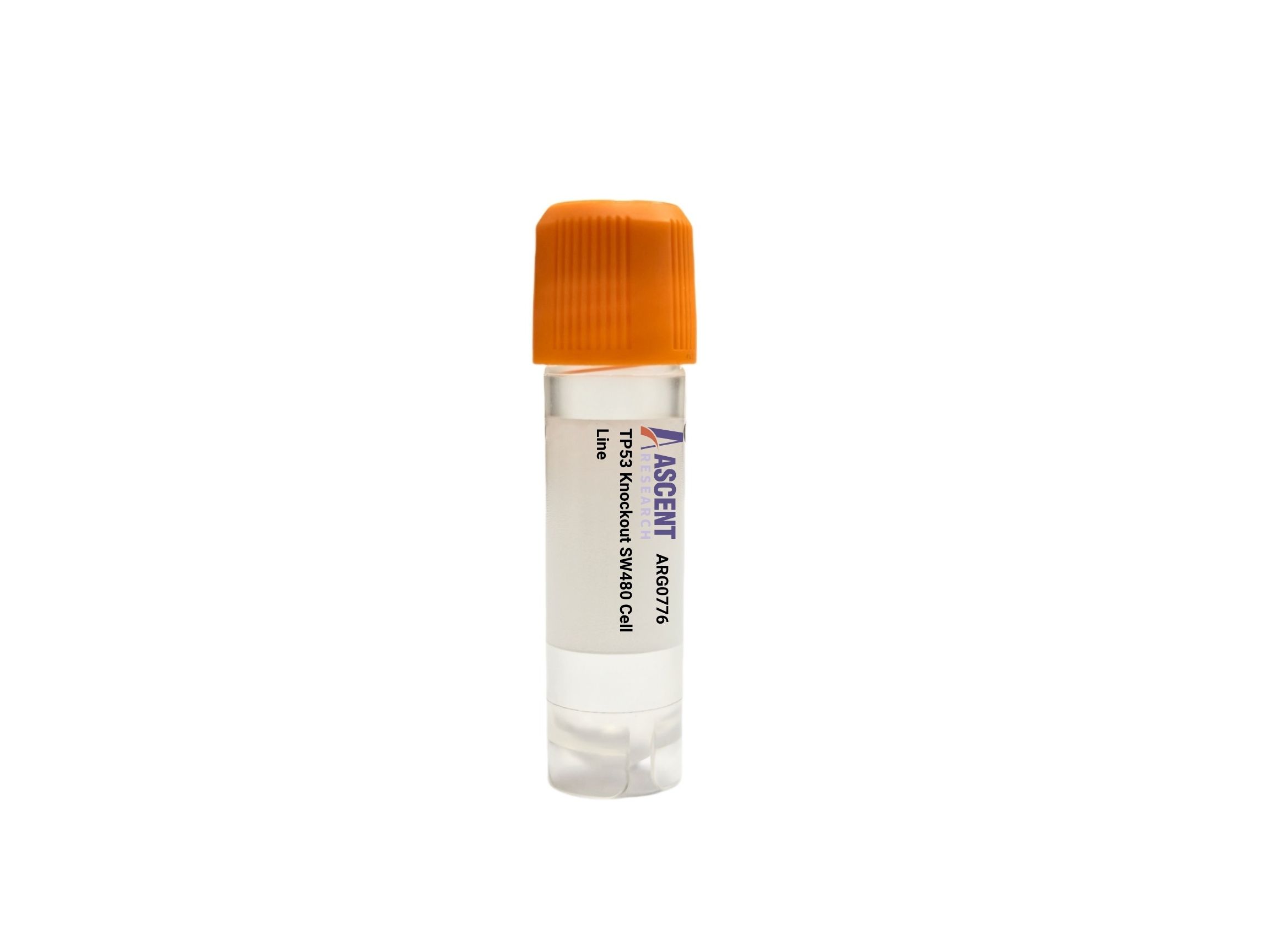
Genome-edited Cells
Large intestine (colon)
The TP53 Knockout SW480 Cell Line is a CRISPR/Cas9-edited knockout cell line derived from SW480 colorectal adenocarcinoma cells, eliminating expression of the tumor suppressor p53. It disrupts key regulatory networks involving downstream targets such as CDKN1A (p21) and BAX, which govern cell cycle arrest and apoptosis. This loss-of-function model enables precise investigation of p53-dependent signaling, DNA damage responses, and drug sensitivity in a malignant epithelial background. Common applications include western blotting, RT-qPCR, flow cytometry, and colony formation assays.
 CAPN2 Knockout HAP1 Polyclonal Cells
Cat. No. ARG37027
CAPN2 Knockout HAP1 Polyclonal Cells
Cat. No. ARG37027
 DNMT3B Knockout THP-1 Cell Line
Cat. No. ARG43822
LRRFIP2 Knockout jurkat Polyclonal Cells
Cat. No. ARG13658
FLNA Knockout DLD-1 Polyclonal Cells
Cat. No. ARG12047
KIAA0319L Knockout Raji Polyclonal Cells
Cat. No. ARG23903
ERF Knockout AGS Polyclonal Cells
Cat. No. ARG2974
DNMT3B Knockout THP-1 Cell Line
Cat. No. ARG43822
LRRFIP2 Knockout jurkat Polyclonal Cells
Cat. No. ARG13658
FLNA Knockout DLD-1 Polyclonal Cells
Cat. No. ARG12047
KIAA0319L Knockout Raji Polyclonal Cells
Cat. No. ARG23903
ERF Knockout AGS Polyclonal Cells
Cat. No. ARG2974
The TP53 Knockout SW480 Cell Line is a CRISPR/Cas9-edited knockout cell line generated by targeted disruption of the TP53 gene in the SW480 human colorectal adenocarcinoma cell line. CRISPR/Cas9-mediated gene disruption eliminates expression of the endogenous TP53 allele, creating a defined loss-of-function model for investigating p53-dependent biological processes. This engineered cell line serves as a valuable tool for dissecting p53 signaling in a malignancy-associated genetic background, providing a controlled system to study tumor suppressor pathways without variable expression artifacts.
SW480 cells are a widely utilized epithelial cell line derived from a primary Dukes’ type B colorectal adenocarcinoma. These cells retain malignant characteristics and harbor mutant p53 (R273H), a common hotspot mutation that abrogates wild-type tumor suppressive functions. The cell line exhibits adherent growth and is extensively characterized for research in colorectal cancer biology, including studies of proliferation, invasion, and drug response. Its established use in xenograft models and in vitro signaling assays makes it a relevant host for targeted gene disruption experiments.
The TP53 gene encodes the guardian of the genome, p53, a transcription factor that integrates cellular stress signals to coordinate cell cycle arrest, apoptosis, DNA repair, and senescence. Upstream DNA damage sensors ATM, ATR, CHK1, and CHK2 phosphorylate and stabilize p53, while negative regulators MDM2 and MDM4 promote its ubiquitination and degradation. Oncostress signals via CDKN2A (p14ARF) relieve MDM2-mediated inhibition. Activated p53 transcriptionally induces downstream effectors including CDKN1A (p21) for cell cycle inhibition, BAX and PUMA for mitochondrial apoptosis, TNFRSF10B (DR5) and FAS for extrinsic apoptosis, and GADD45A for DNA repair. p53 also auto-regulates MDM2 expression, forming a feedback loop. Key interacting factors such as CREBBP, EP300, SIRT1, and USP7 modulate p53 acetylation and stability, adding complexity to signaling dynamics.
In the SW480 context, knockout of the endogenous mutant TP53 (R273H) removes residual oncogenic properties associated with gain-of-function mutations, while completely eliminating any remaining wild-type-like activities. This enables precise dissection of p53-dependent and -independent signaling circuits within colorectal cancer cells. The model is particularly informative for understanding how p53 loss cooperates with other oncogenic alterations, impacts genomic instability, and alters therapeutic vulnerabilities. Compared to wild-type p53 cell lines, this knockout model highlights the functional consequences of complete p53 ablation in a clinically relevant epithelial tumor setting.
Researchers employ this knockout cell line for diverse applications requiring rigorous p53 pathway interrogation. Typical experiments include western blotting for p53, p21, and MDM2 to confirm pathway disruption; RT-qPCR analysis of CDKN1A, BAX, and PUMA transcription; flow cytometric assessment of cell cycle profiles and apoptosis via Annexin V staining; colony formation assays to evaluate proliferative capacity; and drug sensitivity testing with MDM2 inhibitors such as Nutlin-3 or DNA-damaging agents like doxorubicin. Transcriptomic profiling by RNA-seq remains feasible to map genome-wide expression changes. For further information and technical support, please contact Ascent Research.