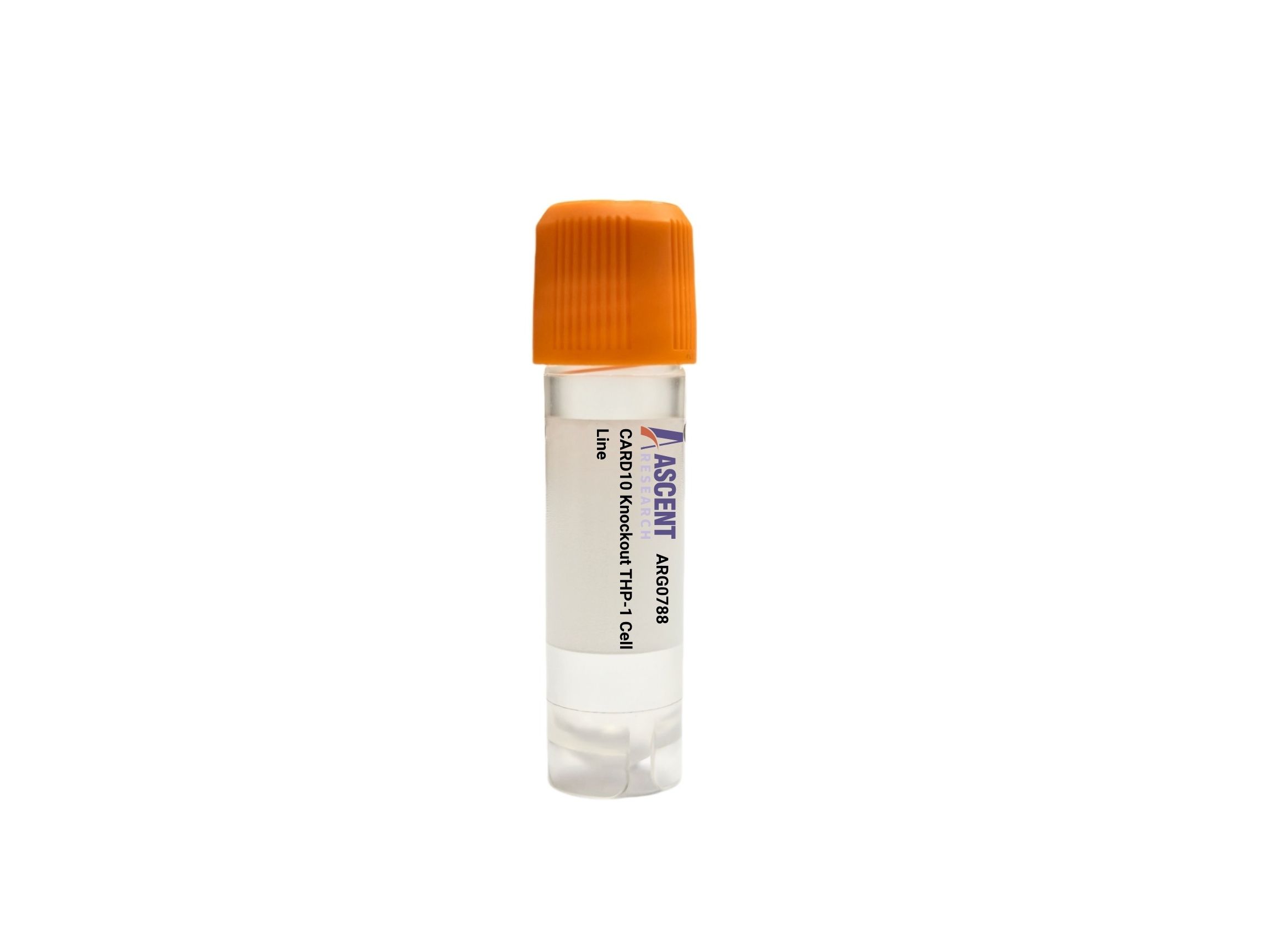
Genome-edited Cells
Blood (peripheral blood)
The CARD10 Knockout THP-1 Cell Line is a CRISPR/Cas9-edited knockout cell line with targeted disruption of the CARD10 scaffold protein in human THP-1 monocytic leukemia cells. CARD10 links GPCR signaling to NF-??B activation by assembling the BCL10-MALT1 complex, promoting transcription of pro-inflammatory cytokines such as IL-6 and TNF??. This model allows researchers to dissect CARD10-dependent signaling in monocyte and macrophage biology. Applications include studying GPCR-mediated inflammation, drug target validation, and screening CBM complex inhibitors. Supported assays encompass NF-??B reporter assays, cytokine profiling, and cell viability studies. The THP-1 background provides a relevant context for innate immunity and leukemia research.
 TMEM63A Knockout COS1 Cell Line
Cat. No. ARG44163
TMEM63A Knockout COS1 Cell Line
Cat. No. ARG44163
 FAM53C Knockout jurkat Polyclonal Cells
Cat. No. ARG13442
MPP1 Knockout jurkat Polyclonal Cells
Cat. No. ARG13361
ARMC8 Knockout HGC-27 Polyclonal Cells
Cat. No. ARG29617
DMBT1 Knockout HAP1 Polyclonal Cells
Cat. No. ARG38956
MACROD2 Knockout HEK293T Polyclonal Cells
Cat. No. ARG3598
FAM53C Knockout jurkat Polyclonal Cells
Cat. No. ARG13442
MPP1 Knockout jurkat Polyclonal Cells
Cat. No. ARG13361
ARMC8 Knockout HGC-27 Polyclonal Cells
Cat. No. ARG29617
DMBT1 Knockout HAP1 Polyclonal Cells
Cat. No. ARG38956
MACROD2 Knockout HEK293T Polyclonal Cells
Cat. No. ARG3598
The CARD10 Knockout THP-1 Cell Line is a CRISPR/Cas9-edited knockout cell line with targeted disruption of CARD10 in the THP-1 human monocytic leukemia background. This stable loss-of-function model enables investigation of CARD10-dependent signaling without reliance on transient knockdowns or pharmacological inhibitors. The line serves as a renewable resource for dissecting the role of CARD10 as a scaffold protein in pathways connecting G protein-coupled receptor (GPCR) stimulation to NF-??B activation.
THP-1 is a suspension cell line derived from an acute monocytic leukemia patient. These cells display a monocyte-like phenotype and can be differentiated into macrophage-like cells by phorbol 12-myristate 13-acetate (PMA). Widely utilized to study innate immunity and inflammation, THP-1 cells respond to various GPCR agonists, making them a relevant host for examining CARD10-mediated signaling in monocyte/macrophage biology and leukemogenesis.
CARD10 (CARMA3) is a scaffold linking PKC to the BCL10-MALT1 (CBM) complex. Upon GPCR stimulation by ligands such as LPA, thrombin, or angiotensin II, the G??q/11?CPLC?¨CDAG?CPKC axis leads to PKC-mediated phosphorylation of CARD10. This triggers assembly of the CBM complex, which engages the IKK complex (IKK??/??/??), resulting in I??B?? degradation and NF-??B p65/p50 nuclear translocation. Target genes include IL6, IL8, TNF??, Bcl-xL, and c-FLIP. CARD10 also feeds into JNK and ERK pathways to activate AP-1. Protein interactions with TRAF6 and PKC isoforms (PKC??/??) fine-tune the response.
Knockout of CARD10 in THP-1 cells eliminates GPCR??NF-??B signaling through the CBM complex, enabling direct assessment of CARD10??s role in monocyte/macrophage inflammatory responses. This model is valuable for distinguishing CARD10-dependent from -independent pathways in innate immunity and leukemia. It is particularly relevant for studying dysregulated CARD10 signaling in conditions like psoriasis, rheumatoid arthritis, and solid tumors where CARD10 is implicated.
Key applications include NF-??B luciferase reporter assays, Western blotting for I??B?? and phospho-p65, RT-qPCR of NF-??B targets, ELISA for cytokine secretion, and co-immunoprecipitation to assess CBM complex formation. The line supports phospho-flow cytometry for PKC/IKK activation status, as well as functional assays such as cell viability and migration upon PMA differentiation. This knockout model is suitable for drug target validation and inhibitor screening in inflammatory disease and cancer research. For more information, please contact Ascent Research.