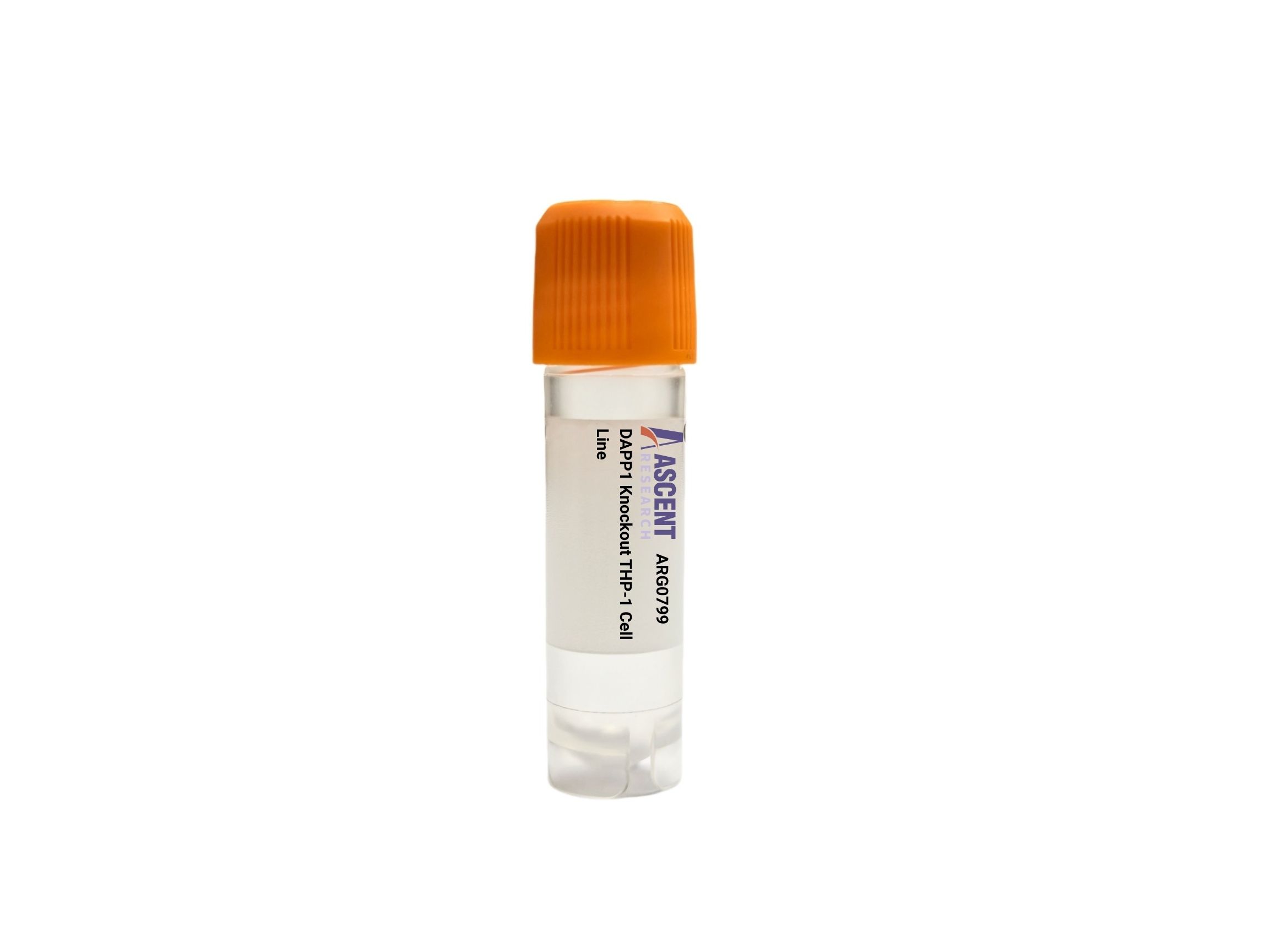
Genome-edited Cells
Blood (peripheral blood)
The DAPP1 Knockout THP-1 Cell Line is a CRISPR/Cas9-edited human monocytic model derived from the THP-1 leukemia cell line, with disrupted DAPP1 expression. DAPP1 is an adaptor linking PI3K lipid signaling to tyrosine kinase pathways, interacting with SHIP and PLC??2 to regulate AKT, ERK, and NF-??B. This knockout facilitates dissection of DAPP1??s role in immune receptor signaling, phagocytosis, and inflammatory responses. Applications include phospho-protein western blotting, calcium flux measurements, and NF-??B reporter assays, supporting research in primary immunodeficiency, autoimmune disease, and hematological malignancies.
 CaMK4 Knockout TE1 Polyclonal Cells
Cat. No. ARG12169
IGFBP7 Knockout NCI-H1299 Polyclonal Cells
Cat. No. ARG30810
CALD1 Knockout SK-HEP-1 Polyclonal Cells
Cat. No. ARG41838
C2orf42 Knockout Hela Polyclonal Cells
Cat. No. ARG41404
ECHDC1 Knockout SK-HEP-1 Polyclonal Cells
Cat. No. ARG40349
CaMK4 Knockout TE1 Polyclonal Cells
Cat. No. ARG12169
IGFBP7 Knockout NCI-H1299 Polyclonal Cells
Cat. No. ARG30810
CALD1 Knockout SK-HEP-1 Polyclonal Cells
Cat. No. ARG41838
C2orf42 Knockout Hela Polyclonal Cells
Cat. No. ARG41404
ECHDC1 Knockout SK-HEP-1 Polyclonal Cells
Cat. No. ARG40349
 Rat Neuroglial Cells
Cat. No. ARP0372
Rat Neuroglial Cells
Cat. No. ARP0372
The DAPP1 Knockout THP-1 Cell Line is a CRISPR/Cas9-edited human knockout cell line designed for loss-of-function studies of the adaptor protein DAPP1. This stable cell line provides a reproducible system for investigating DAPP1-dependent signaling in a monocytic background.
THP-1 is a human monocytic leukemia cell line derived from an acute monocytic leukemia patient. Widely used to model monocyte and macrophage function, THP-1 cells can be differentiated into adherent macrophage-like cells with phorbol esters, retaining key immune activities such as phagocytosis, cytokine secretion, and antigen presentation.
DAPP1 contains a PH domain that specifically binds phosphoinositides, notably PIP3, and an SH2 domain that engages phosphotyrosine motifs on activated receptors and adaptors. It functions as a scaffold linking PI3K-generated lipid signals to tyrosine kinase cascades downstream of immune receptors such as B cell receptors, Fc receptors, and cytokine receptors (e.g., interleukin-4). DAPP1 forms complexes with SHIP, Grb2, SOS1, and PLC??2, and collaborates with BTK to facilitate signal propagation. These interactions culminate in activation of AKT, ERK, and NF-??B, as well as modulation of intracellular calcium, thereby integrating PI3K/AKT and MAPK pathways to regulate immune cell proliferation, differentiation, and effector functions.
In the THP-1 monocytic context, DAPP1 knockout enables dissection of its role in myeloid immune receptor signaling. Since THP-1 cells express Fc?? receptors, this model is ideal for studying DAPP1 in antibody-mediated responses and inflammatory pathways. DAPP1 dysfunction is associated with primary immunodeficiencies, autoimmune disorders, and hematological cancers, highlighting the translational relevance of this knockout system.
Typical assays enabled by this knockout line include western blot detection of phosphorylated AKT and ERK following immune receptor cross-linking, flow cytometry for surface activation markers and cytokine production, and ratiometric calcium imaging to capture immediate signaling dynamics. NF-??B luciferase reporters and co-immunoprecipitation of signaling complexes provide insights into transcriptional and scaffolding mechanisms. Cell proliferation and viability assays further reveal the phenotypic consequences of DAPP1 loss. Together, these applications support research in immunology, signal transduction, drug target validation, and preclinical inflammation and cancer immunotherapy models. For further technical inquiries, please contact Ascent Research.