Genome-edited Cells
Blood (peripheral blood)
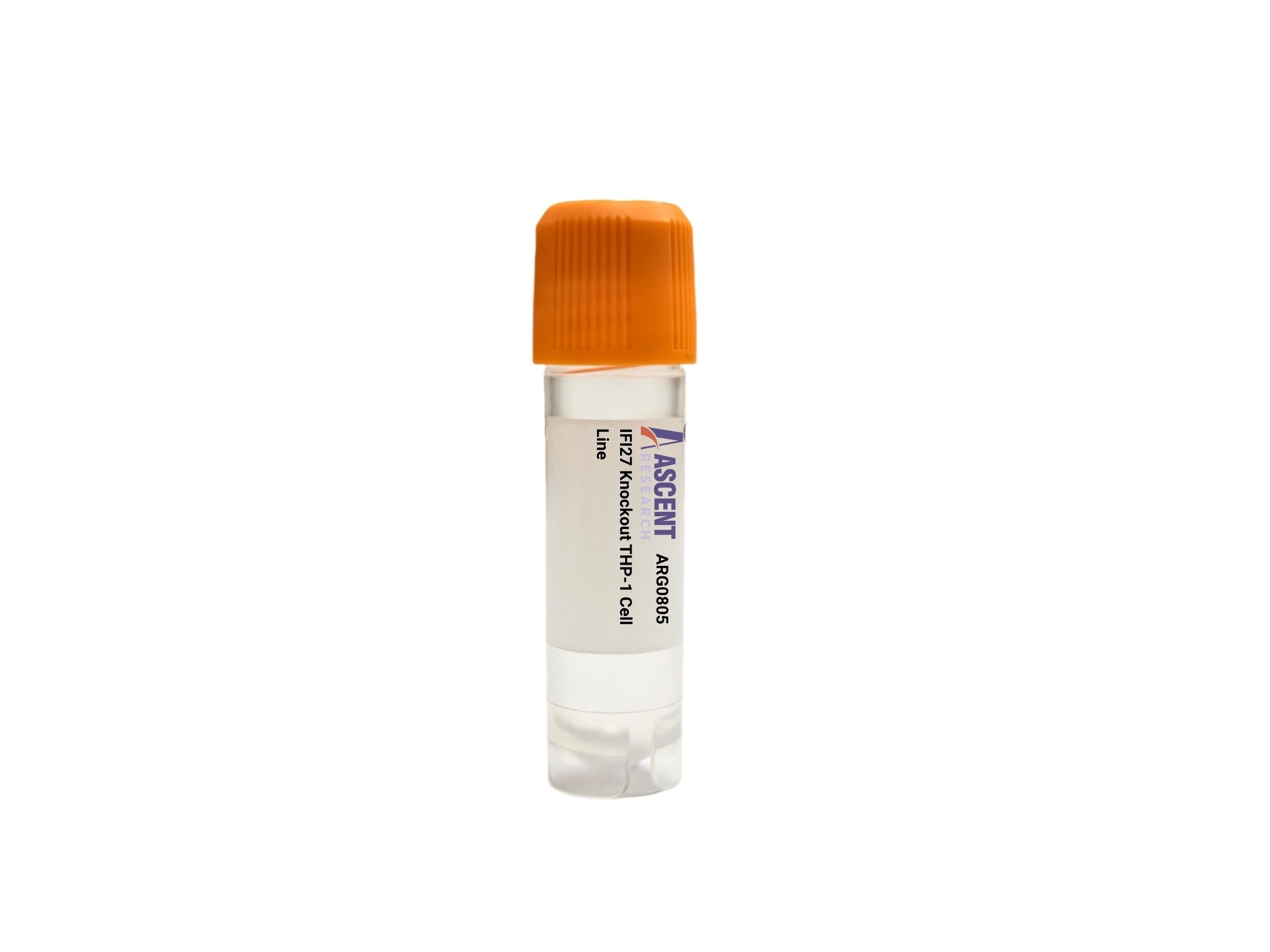
The IFI27 Knockout THP-1 Cell Line is a CRISPR/Cas9-edited human knockout cell line derived from the THP-1 acute monocytic leukemia cell line. It provides a stable loss-of-function model for studying IFI27, an interferon-inducible mitochondrial protein that regulates apoptosis through interactions with Bcl-2 family members and cytochrome c release. This model is suitable for investigating interferon signaling, innate antiviral responses, and mitochondrial apoptosis in myeloid cells. Researchers can employ western blotting, RT?qPCR, RNA?seq, flow cytometry, and viral challenge assays to dissect IFI27 function in viral infections, cancer, and inflammatory diseases. For more information, please contact Ascent Research.
 OLR1 Knockout A2780 Polyclonal Cells
Cat. No. ARG18288
MEIS1 Knockout SK-HEP-1 Polyclonal Cells
Cat. No. ARG15607
GDF2 Knockout T47D Polyclonal Cells
Cat. No. ARG11947
BLVRB Knockout NCI-H1975 Polyclonal Cells
Cat. No. ARG31356
JAG2 Knockout jurkat Polyclonal Cells
Cat. No. ARG34382
EDEM2 Knockout A549 Polyclonal Cells
Cat. No. ARG40448
OLR1 Knockout A2780 Polyclonal Cells
Cat. No. ARG18288
MEIS1 Knockout SK-HEP-1 Polyclonal Cells
Cat. No. ARG15607
GDF2 Knockout T47D Polyclonal Cells
Cat. No. ARG11947
BLVRB Knockout NCI-H1975 Polyclonal Cells
Cat. No. ARG31356
JAG2 Knockout jurkat Polyclonal Cells
Cat. No. ARG34382
EDEM2 Knockout A549 Polyclonal Cells
Cat. No. ARG40448
The IFI27 Knockout THP-1 Cell Line is a rigorously validated, CRISPR/Cas9-edited human knockout cell line derived from the THP-1 acute monocytic leukemia cell line. This product offers researchers a stable, loss-of-function model for investigating IFI27, an interferon-inducible mitochondrial protein. By providing a uniform, renewable cellular background, it circumvents the variability inherent in transient gene silencing approaches. The CRISPR/Cas9-mediated gene disruption was executed in parental THP-1 cells to generate a population with targeted ablation of IFI27 expression.
The THP-1 host cell line is a spontaneously immortalized monocytic cell line originating from the peripheral blood of an acute monocytic leukemia patient. It serves as a well-characterized in vitro model for monocyte and macrophage biology, innate immunity, and hematological malignancies. THP-1 cells display physiological responsiveness to interferons and other cytokines and can be differentiated into adherent macrophage-like cells by phorbol ester treatment, expanding their utility in apoptosis and immune signaling research.
IFI27 encodes a mitochondrial protein that is robustly induced by interferons (IFN-??, IFN-??, IFN-??) through the JAK-STAT pathway. Upon ligand binding, the receptors IFNAR1/IFNAR2 activate the associated kinases JAK1 and TYK2, which phosphorylate STAT1 and STAT2. These transcription factors then complex with IRF9 to form ISGF3 and translocate to the nucleus, where they drive IFI27 transcription. Once expressed, IFI27 integrates into mitochondria and facilitates apoptosis by interacting with adenine nucleotide translocase (ANT) and Bcl-2 family members. This interaction promotes mitochondrial outer membrane permeabilization, cytochrome c release, and cascading activation of caspase-9 and effector caspase-3 through the pro-apoptotic proteins BAX and BAK. Consequently, IFI27 serves as a critical effector of interferon-mediated innate antiviral immunity.
In the THP-1 myeloid background, IFI27 knockout provides a focused platform for interrogating the interplay between interferon signaling and mitochondrial apoptosis. Researchers can examine how loss of IFI27 perturbs mitochondrial membrane potential, shifts caspase activation kinetics, and alters cell fate upon interferon stimulation or viral challenge. This model thus supports mechanistic dissection of innate antiviral responses and inflammation directly in a monocytic lineage. Moreover, it facilitates translational studies in disease areas where IFI27 dysregulation has been documented, including viral infections, hepatocellular carcinoma, breast cancer, systemic lupus erythematosus, and other inflammatory conditions.
Typical research applications encompass the study of interferon-mediated antiviral responses, apoptotic signaling in myeloid cells, and innate immunity regulation. The knockout line is suitable for western blotting, RT?qPCR, RNA?seq, and flow cytometry (annexin V, TMRE/JC?1). Interferon stimulation, viral challenge, and caspase activity assays are also applicable. For more information or custom services, please contact Ascent Research.