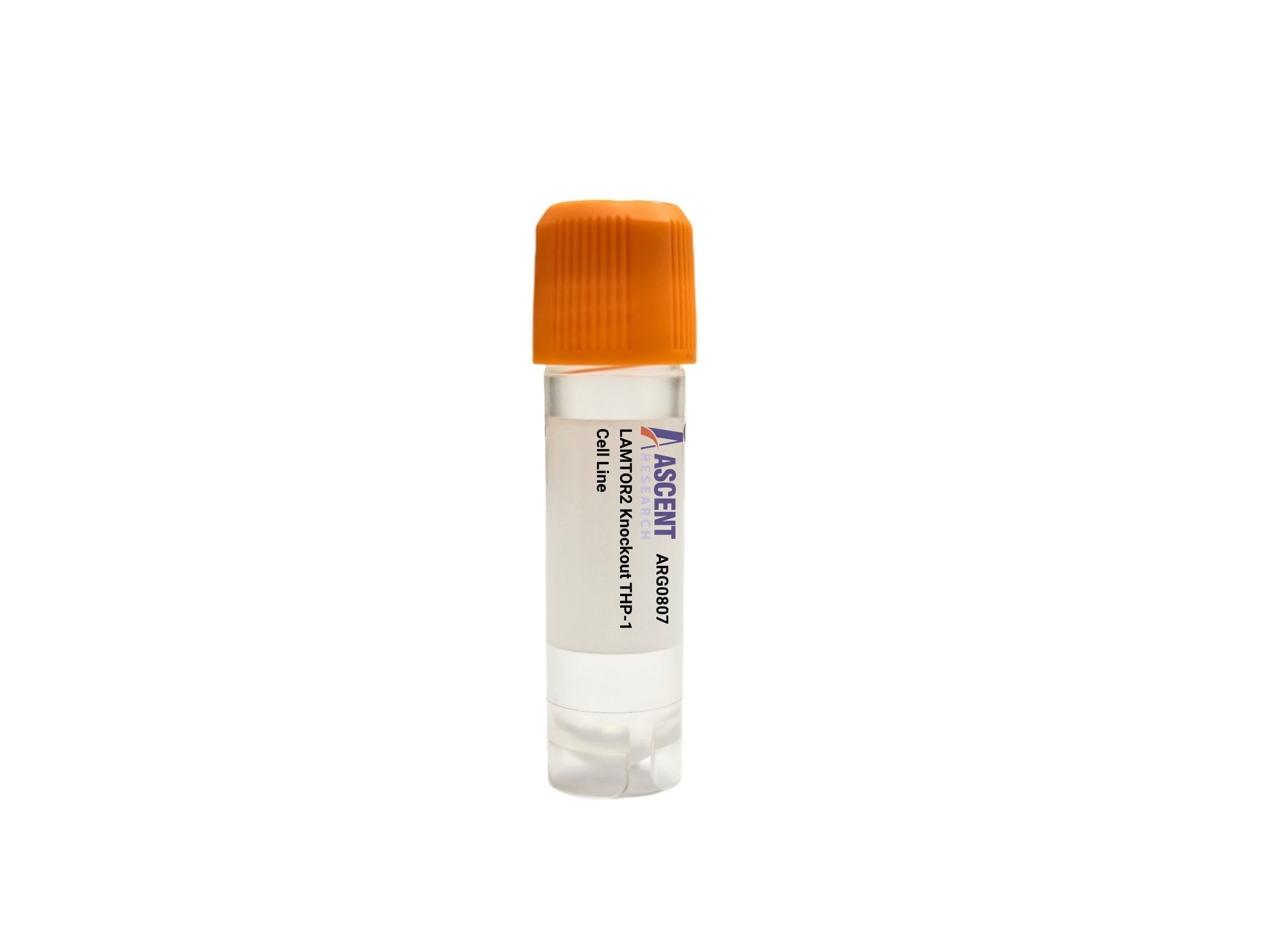
Genome-edited Cells
Blood (peripheral blood)
The LAMTOR2 Knockout THP-1 Cell Line is a CRISPR/Cas9-engineered knockout model in the THP-1 human monocytic leukemia cell line. Disruption of the LAMTOR2 gene, which encodes a scaffold subunit of the Ragulator complex, impairs lysosomal tethering of Rag GTPases and mTORC1 activation, providing a system to dissect amino acid sensing and mTORC1-driven anabolism. This line is ideal for studying primary immunodeficiency mechanisms, monocyte/macrophage biology, and autophagy regulation. Typical readouts include mTORC1 downstream targets (S6K1, 4E-BP1), lysosomal positioning, and autophagy flux.
 CSK Knockout NCI-H1975 Polyclonal Cells
Cat. No. ARG17154
BAG5 Knockout Hela Polyclonal Cells
Cat. No. ARG21254
ITPK1 Knockout NCI-H1299 Polyclonal Cells
Cat. No. ARG30865
ARHGEF12 Knockout SK-HEP-1 Polyclonal Cells
Cat. No. ARG32249
DIAPH3 Knockout MES-OV Polyclonal Cells
Cat. No. ARG38756
CSK Knockout NCI-H1975 Polyclonal Cells
Cat. No. ARG17154
BAG5 Knockout Hela Polyclonal Cells
Cat. No. ARG21254
ITPK1 Knockout NCI-H1299 Polyclonal Cells
Cat. No. ARG30865
ARHGEF12 Knockout SK-HEP-1 Polyclonal Cells
Cat. No. ARG32249
DIAPH3 Knockout MES-OV Polyclonal Cells
Cat. No. ARG38756
 Rabbit Renal Artery Smooth Muscle Cells
Cat. No. ARP0702
Rabbit Renal Artery Smooth Muscle Cells
Cat. No. ARP0702
The LAMTOR2 Knockout THP-1 Cell Line is a CRISPR/Cas9-edited knockout cell line featuring targeted disruption of the LAMTOR2 gene in the THP-1 human acute monocytic leukemia background. This engineered model provides a loss-of-function system for investigating the role of the late endosomal/lysosomal adaptor, MAPK and mTOR activator 2 (LAMTOR2), in monocyte and macrophage biology. The knockout cell line is generated via CRISPR/Cas9-mediated gene disruption, resulting in a cell population with ablated LAMTOR2 expression and enabling functional studies of the Ragulator complex and mTORC1 signaling. This stable knockout resource is suitable for a range of biochemical, cell biological, and immunological assays.
THP-1 is a human acute monocytic leukemia cell line originally derived from the peripheral blood of a one-year-old male with AML M5 subtype. These cells can be differentiated into macrophage-like cells upon treatment with phorbol esters or other stimuli, making them a widely used model for studying monocyte-to-macrophage differentiation, innate immune responses, and inflammatory signaling. The THP-1 background retains many features of primary monocytes, including the ability to undergo phagocytosis, produce cytokines, and engage pattern recognition receptor pathways, thus providing a physiologically relevant context for assessing LAMTOR2 function in immune cell biology.
LAMTOR2 (also known as p14, ROBLD3, or MAPBPIP) is an essential subunit of the Ragulator complex, which also includes LAMTOR1, LAMTOR3, LAMTOR4, and LAMTOR5. This pentameric complex tethers Rag GTPases (RagA/B and RagC/D heterodimers) to the lysosomal surface and serves as a scaffold for mTORC1 recruitment. In response to amino acid sufficiency, particularly leucine and arginine, the Ragulator facilitates the exchange of guanine nucleotides on Rag GTPases, promoting the active conformation that recruits mTORC1 to lysosomes. Upon lysosomal localization, mTORC1 is activated by Rheb, leading to phosphorylation of downstream effectors such as S6K1 and 4E-BP1, which drive anabolic processes including protein synthesis and cell growth. Additionally, LAMTOR2 is critical for lysosomal positioning and the endolysosomal pathway??s role in autophagy regulation. Disruption of LAMTOR2 impairs the assembly and lysosomal anchoring of the Ragulator, thereby attenuating mTORC1 activation and disrupting the balance between anabolism and autophagy. The complex interfaces with multiple upstream sensors, including Sestrin2 for leucine, CASTOR1 for arginine, and the GATOR1 and GATOR2 complexes, as well as the lysosomal v-ATPase, which also regulates Ragulator activity.
In the THP-1 monocytic cell line, LAMTOR2 knockout provides a powerful tool to investigate the immune-specific functions of the Ragulator-mTORC1 axis. Given that LAMTOR2 mutations in humans cause p14 deficiency, a combined immunodeficiency characterized by late-onset progressive myopathy and impaired immune responses, this model enables the study of molecular mechanisms underlying primary immunodeficiencies. THP-1 cells are inherently suited for analyzing monocyte and macrophage activation, cytokine secretion, and antigen presentation??processes that are increasingly recognized to be modulated by metabolic and lysosomal signaling. Therefore, loss of LAMTOR2 in this background allows researchers to dissect how Ragulator-dependent amino acid sensing and lysosomal positioning influence macrophage differentiation, M1/M2 polarization, and inflammatory output. Furthermore, the knockout line can be used to examine cross-talk between mTORC1 signaling and other immune-relevant pathways, including TLR and NLRP3 inflammasome activation.
The LAMTOR2 Knockout THP-1 Cell Line is optimized for a broad range of experimental applications. Researchers can employ Western blotting to monitor changes in phosphorylated S6K1 or 4E-BP1 as readouts of mTORC1 activity under amino acid starvation and re-stimulation conditions. Immunofluorescence microscopy permits visualization of mTORC1 lysosomal localization or lysosome distribution, while flow cytometry facilitates analysis of cell size and proliferation. Co-immunoprecipitation experiments can assess the integrity of the Ragulator complex and its interaction with Rag GTPases. Additionally, autophagy flux assays (e.g., LC3-II turnover) are valuable for evaluating the impact of LAMTOR2 loss on autophagic clearance. This cell line is also suitable for drug screening efforts aimed at identifying small molecules that modulate mTORC1 or restore lysosomal function. For further details, please contact Ascent Research.