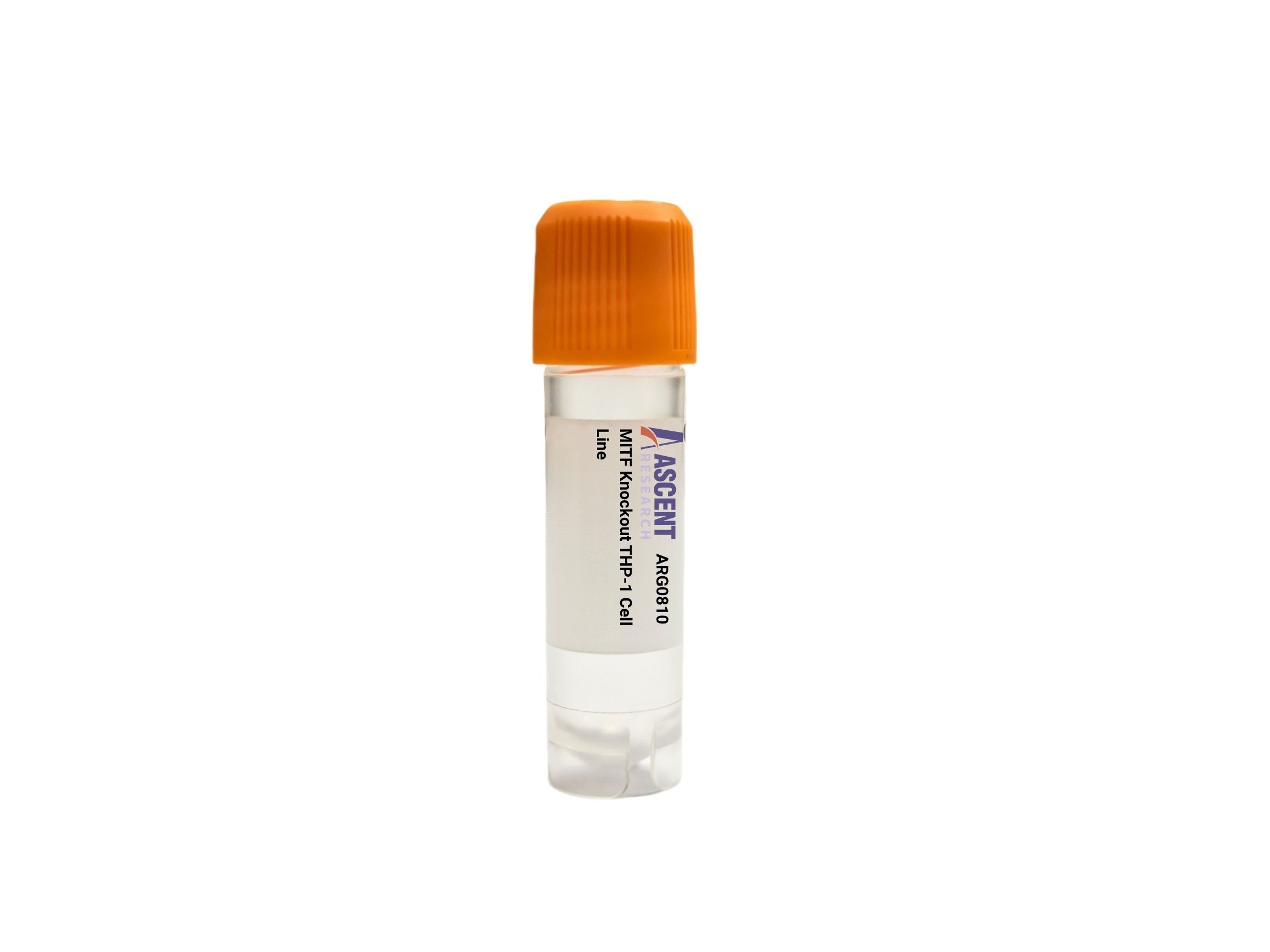
Genome-edited Cells
Blood (peripheral blood)
The MITF Knockout THP-1 Cell Line is a CRISPR/Cas9-edited human acute monocytic leukemia line with targeted disruption of the microphthalmia-associated transcription factor gene. MITF operates as a master regulator integrating signals from ??-MSH/MC1R via cAMP/PKA, MAPK/ERK, and Wnt/??-catenin pathways, with upstream activators including SOX10, PAX3, and CREB, and downstream targets such as TYR, TRP1, DCT, and BCL2. This model enables dissection of MITF-dependent transcriptional programs in melanoma research, pigmentation disorders, and differentiation studies. Utilizing the well-characterized THP-1 background, the knockout line supports assays for monocyte-to-macrophage differentiation (PMA treatment), proliferation, apoptosis, migration, and drug response profiling. It is ideal for functional genomics, signaling pathway analysis, and therapeutic screening. Contact Ascent Research for further details on implementing this loss-of-function tool in your research.
 C5orf22 Knockout HGC-27 Polyclonal Cells
Cat. No. ARG29786
PCGF6 Knockout SK-HEP-1 Polyclonal Cells
Cat. No. ARG15502
C5orf22 Knockout HGC-27 Polyclonal Cells
Cat. No. ARG29786
PCGF6 Knockout SK-HEP-1 Polyclonal Cells
Cat. No. ARG15502
 Human Chorionic Vill Mesenchymal Stem Cells
Cat. No. ARP1179
HSPBP1 Knockout 786-O Polyclonal Cells
Cat. No. ARG25301
ARID4A Knockout huh-7 Polyclonal Cells
Cat. No. ARG27979
GPT2 Knockout huh-7 Polyclonal Cells
Cat. No. ARG28233
Human Chorionic Vill Mesenchymal Stem Cells
Cat. No. ARP1179
HSPBP1 Knockout 786-O Polyclonal Cells
Cat. No. ARG25301
ARID4A Knockout huh-7 Polyclonal Cells
Cat. No. ARG27979
GPT2 Knockout huh-7 Polyclonal Cells
Cat. No. ARG28233
The MITF Knockout THP-1 Cell Line is a CRISPR/Cas9-edited knockout cell line derived from the human THP-1 acute monocytic leukemia line, engineered to disrupt the MITF gene. This loss-of-function model enables rigorous investigation of microphthalmia-associated transcription factor (MITF) signaling in a hematologic malignancy background. The knockout product format offers a stable, homogeneous population suitable for functional genomics, pathway analysis, and drug development studies. Researchers can interrogate MITF-dependent transcriptional programs without the confounding effects of wild-type protein expression, facilitating dissection of its roles in cell survival, differentiation, and therapeutic resistance.
The THP-1 parental cell line originated from the peripheral blood of a 1-year-old male with acute monocytic leukemia and has become one of the most widely used models for studying monocyte and macrophage biology. THP-1 cells can be induced by phorbol esters such as PMA to differentiate into macrophage-like cells, recapitulating key features of inflammation, phagocytosis, and cytokine production. Their genetic tractability and well-characterized signaling networks make them particularly suitable for CRISPR-mediated gene editing, enabling the creation of isogenic knockout derivatives for comparative analyses of gene function in both undifferentiated and differentiated states.
MITF encodes a basic helix-loop-helix leucine zipper transcription factor that serves as a master regulator of melanocyte development, pigmentation, and survival. It integrates extracellular cues through multiple pathways: ??-MSH binding to MC1R activates adenylyl cyclase via G??s, increasing cAMP levels and promoting PKA-mediated phosphorylation of CREB, which cooperates with SOX10 and PAX3 to drive MITF expression. MITF is further regulated by MAPK/ERK-dependent phosphorylation and by Wnt/??-catenin signaling through LEF1/TCF transcription factors. Upon activation and dimerization, MITF binds E-box motifs in target promoters, transcriptionally regulating a suite of downstream effectors including melanogenic enzymes (TYR, TRP1, DCT), anti-apoptotic factor BCL2, and metastasis-associated genes such as MET. It also interacts with related MiT family members TFE3, TFEB, and TFEC, as well as coactivators like CBP/p300 and inhibitor PIAS3, forming a complex regulatory network that controls cell cycle progression, apoptosis, and invasive behavior.
In the THP-1 context, MITF disruption provides a unique platform to explore non-canonical functions of this lineage-specific transcription factor beyond melanocytes. Although THP-1 cells are of monocytic origin, MITF is implicated in mast cell and osteoclast differentiation, and its dysregulation is linked to oncogenic processes in various tissues. The knockout line allows systematic investigation of MITF??s contribution to leukemia cell proliferation, monocyte-to-macrophage transition, and inflammatory signaling. Because MITF operates downstream of frequently dysregulated pathways such as MAPK/ERK and PI3K/AKT, this model is also valuable for studying signal transduction crosstalk and for screening therapies that target these cascades in a leukemic environment.
Typical research applications encompass melanoma biology, where MITF is a critical oncogenic driver; pigmentation disorder studies including Waardenburg and Tietz syndromes; and transcriptional regulation analyses via ChIP-qPCR and reporter assays. The knockout line is particularly suited for macrophage differentiation assays (e.g., PMA treatment followed by flow cytometry or RNA-seq) to delineate MITF-dependent gene expression changes, as well as for proliferation, apoptosis, and migration/invasion assays in the context of cancer drug resistance. Western blotting, RT-qPCR, and apoptosis assays are readily applicable for confirming disruption and functional consequences. For technical inquiries and additional experimental guidance, please contact Ascent Research.