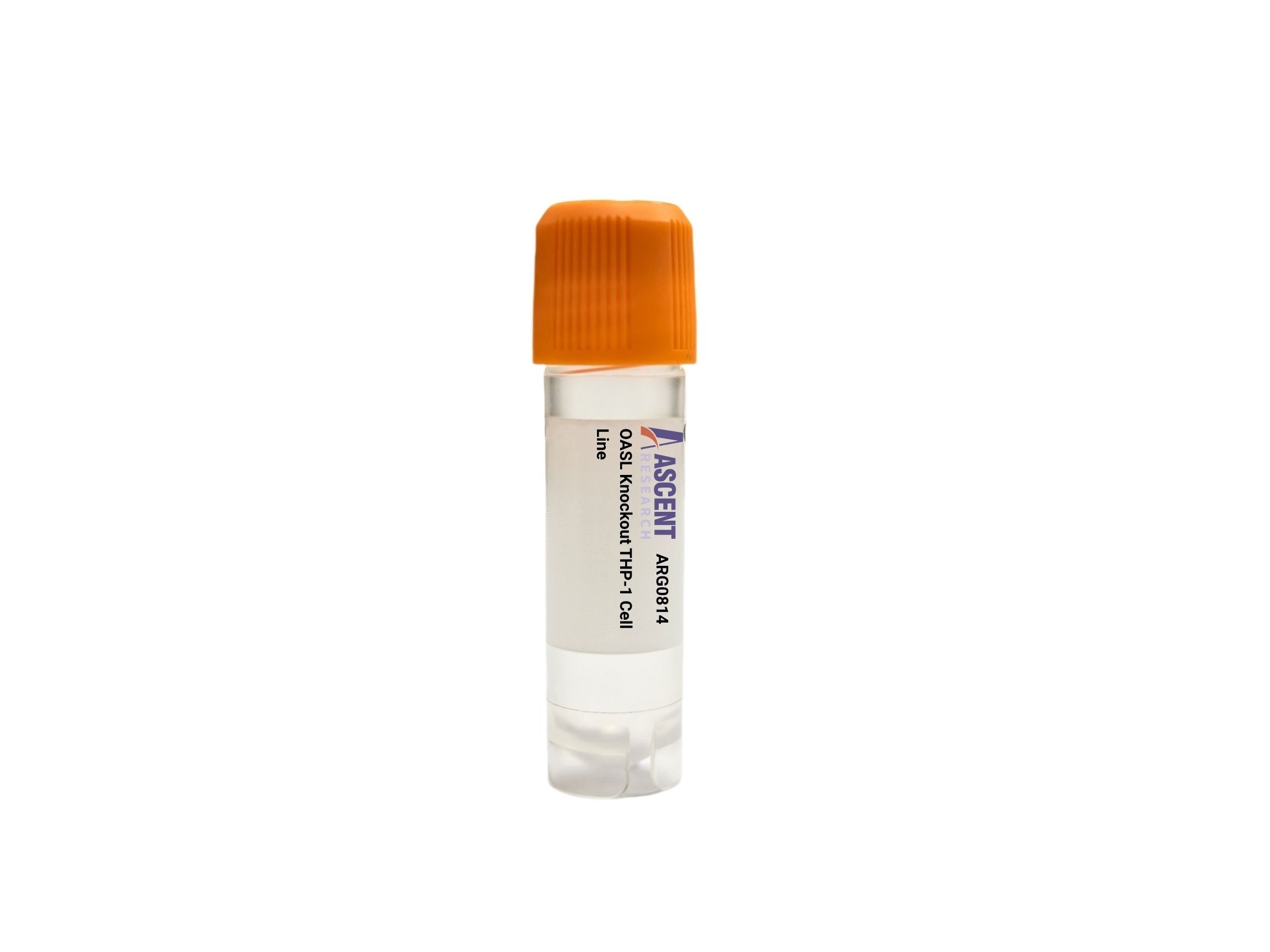
Genome-edited Cells
Blood (peripheral blood)
The OASL Knockout THP-1 Cell Line is a CRISPR/Cas9-edited knockout cell line derived from the human monocytic THP-1 cell line. This model features disruption of the OASL gene, which encodes an interferon-stimulated protein that amplifies RIG-I signaling by binding RIG-I and promoting MAVS-TBK1-IRF3-mediated IFN-?? production. OASL is upregulated by interferons in a positive feedback loop critical for antiviral innate immunity. THP-1 cells are a widely used monocyte model capable of phagocytosis, cytokine release, and differentiation into macrophage-like cells. The OASL knockout line supports research into antiviral responses and interferonopathies, with common applications including VSV-GFP antiviral assays, phospho-IRF3 detection, and transcriptome profiling.
 ABLIM3 Knockout K562 Polyclonal Cells
Cat. No. ARG19961
MYL9 Knockout 769-P Polyclonal Cells
Cat. No. ARG18194
NPR1 Knockout Hela Polyclonal Cells
Cat. No. ARG7942
BCL7B Knockout SK-HEP-1 Polyclonal Cells
Cat. No. ARG32354
APOBEC3C Knockout HEK293T Polyclonal Cells
Cat. No. ARG38005
ABLIM3 Knockout K562 Polyclonal Cells
Cat. No. ARG19961
MYL9 Knockout 769-P Polyclonal Cells
Cat. No. ARG18194
NPR1 Knockout Hela Polyclonal Cells
Cat. No. ARG7942
BCL7B Knockout SK-HEP-1 Polyclonal Cells
Cat. No. ARG32354
APOBEC3C Knockout HEK293T Polyclonal Cells
Cat. No. ARG38005
 BICR 6
Cat. No. ARC0075
BICR 6
Cat. No. ARC0075
The OASL Knockout THP-1 Cell Line is a CRISPR/Cas9-edited knockout cell line derived from the human monocytic THP-1 cell line through disruption of the OASL gene. This engineered model enables loss-of-function studies of OASL in innate immune signaling. It provides a consistent genetic background for examining OASL-dependent mechanisms without relying on transient silencing methods, making it suitable for a range of functional assays in immunology and virology.
The THP-1 cell line originates from the peripheral blood of an infant with acute monocytic leukemia and is widely used as a model for monocyte and macrophage biology. THP-1 cells display key innate immune functions such as phagocytosis, cytokine production, and differentiation into macrophage-like cells upon stimulation. Their robust type I interferon system makes them especially useful for studying antiviral responses and signal transduction pathways relevant to infectious and autoimmune diseases.
OASL is an interferon-stimulated gene that enhances RIG-I-like receptor signaling. Following viral challenge, OASL binds directly to the RNA sensor RIG-I, facilitating recognition of viral RNA and promoting the formation of a signaling complex that includes the adaptor MAVS and the E3 ligase TRIM25. This complex activates the kinases TBK1 and IKK??, which phosphorylate transcription factors IRF3 and IRF7, culminating in the transcriptional induction of type I interferons such as IFN-??. Because OASL expression is strongly induced by interferons, it establishes a positive feedback loop that amplifies antiviral responses. The pathway involves additional mediators like TRAF3, and OASL acts downstream of interferon signaling and upstream of IRF3 phosphorylation, thereby positioning it as a key amplifier of innate immunity.
Disrupting OASL in THP-1 cells ablates a critical feed-forward mechanism that enhances interferon production. This knockout model is highly relevant for dissecting RIG-I-mediated immune responses to viruses like hepatitis C, influenza, and SARS-CoV-2. Additionally, given the role of aberrant type I interferon signaling in systemic lupus erythematosus and other autoimmune conditions, the line offers a tool to explore how OASL deficiency alters immune homeostasis and may contribute to disease pathogenesis.
The OASL knockout THP-1 cell line supports diverse experimental workflows. Antiviral susceptibility can be measured using GFP-expressing vesicular stomatitis virus (VSV-GFP), while pathway activation is assessed by phospho-IRF3 western blot or IFN-?? ELISA. Gene expression changes can be profiled via RNA-seq, and protein interactions probed by co-immunoprecipitation of OASL and RIG-I. The model is also suitable for IFN-?? promoter luciferase reporter assays and intracellular cytokine staining by flow cytometry. These applications enable studies in antiviral innate immunity, macrophage infection models, interferon regulation, and autoimmune disease research. For more information, please contact Ascent Research.