Genome-edited Cells
Blood (peripheral blood)
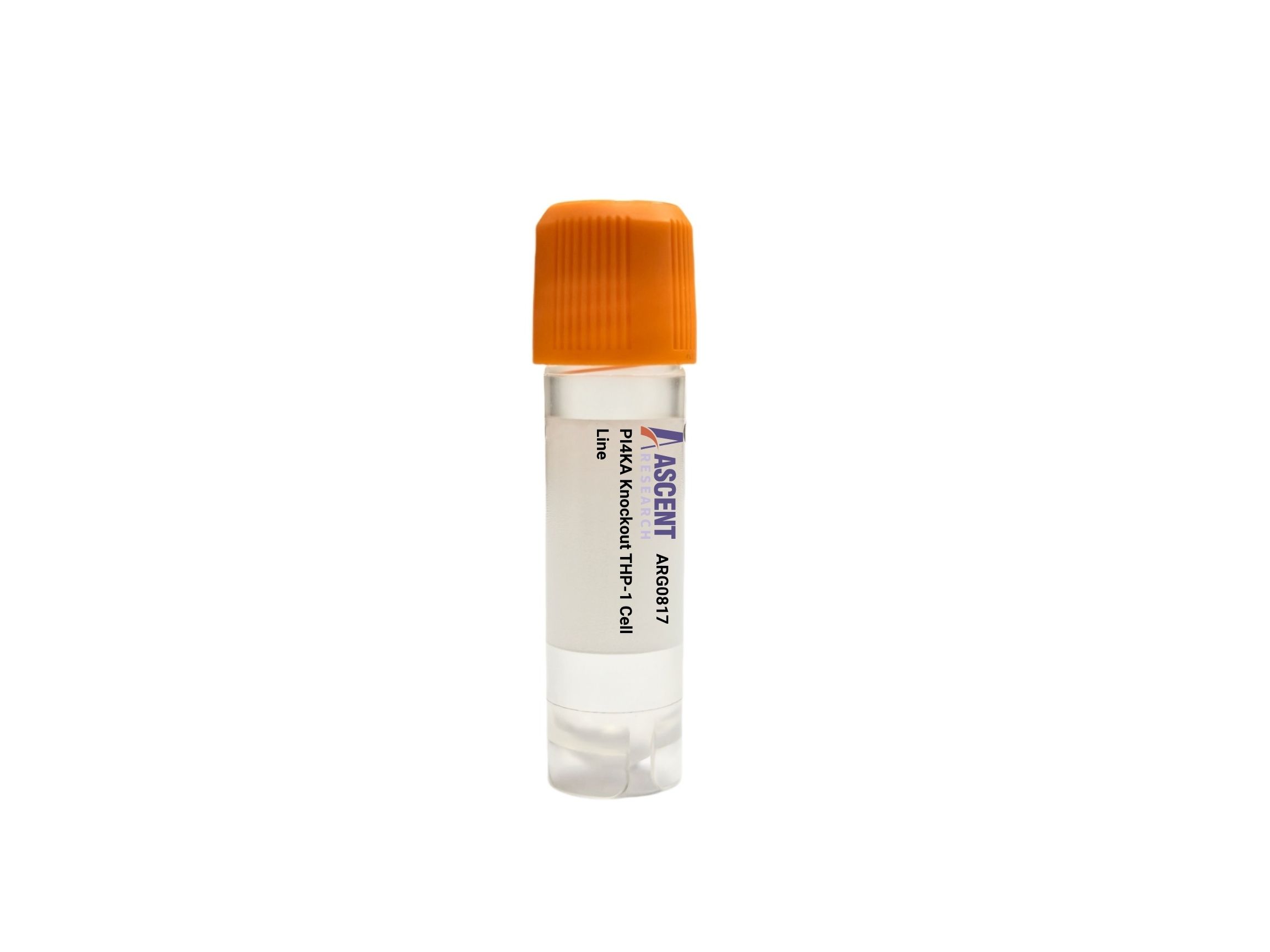
The PI4KA Knockout THP-1 Cell Line is a CRISPR/Cas9-edited human monocytic leukemia cell line with targeted disruption of the PI4KA gene. PI4KA synthesizes phosphatidylinositol 4-phosphate (PI4P) at the plasma membrane, a critical precursor for PIP2 generation and downstream calcium/PKC signaling. The enzyme functions within complexes containing EFR3A/B, TTC7A/B, and FAM126A and is regulated by protein kinase D. In THP-1 cells, PI4KA disruption impairs phosphoinositide-dependent membrane trafficking, migration, and innate immune responses. This model supports investigations of monocyte/macrophage biology, leukemic cell signaling, and drug target validation. Key assays include calcium mobilization, cell migration, co-immunoprecipitation, and PI4P quantification.
 ATF1 Knockout K562 Polyclonal Cells
Cat. No. ARG20237
ERCC5 Knockout SK-HEP-1 Polyclonal Cells
Cat. No. ARG15737
FAT1 Knockout NCI-H1975 Polyclonal Cells
Cat. No. ARG17253
MAPK6 Knockout HEK293 Polyclonal Cells
Cat. No. ARG12768
CCDC22 Knockout HGC-27 Polyclonal Cells
Cat. No. ARG42991
ATF1 Knockout K562 Polyclonal Cells
Cat. No. ARG20237
ERCC5 Knockout SK-HEP-1 Polyclonal Cells
Cat. No. ARG15737
FAT1 Knockout NCI-H1975 Polyclonal Cells
Cat. No. ARG17253
MAPK6 Knockout HEK293 Polyclonal Cells
Cat. No. ARG12768
CCDC22 Knockout HGC-27 Polyclonal Cells
Cat. No. ARG42991
 APOD Knockout U-87MG Cell Line
Cat. No. ARG0855
APOD Knockout U-87MG Cell Line
Cat. No. ARG0855
The PI4KA Knockout THP-1 Cell Line is a CRISPR/Cas9-edited human cell line that features targeted disruption of the phosphatidylinositol 4-kinase alpha (PI4KA) gene. This knockout model eliminates functional PI4KA expression, providing a defined loss-of-function system to investigate the enzyme’s roles in phosphoinositide metabolism and signal transduction. The cell line was generated from the THP-1 host line and is supplied as a stable, viable knockout product suitable for downstream molecular and cellular assays.
THP-1 cells are a widely used human acute monocytic leukemia line originally isolated from the peripheral blood of a 1-year-old male. These suspension cells exhibit phagocytic properties and can be differentiated into a macrophage-like phenotype upon treatment with phorbol esters or other stimuli, making them a model for monocyte-to-macrophage maturation and innate immune responses. Their genetic and functional features closely recapitulate key aspects of myeloid cell biology, including cytokine production, adhesion, and pathogen recognition, providing a physiologically relevant background for studying genetic perturbations.
PI4KA catalyzes the phosphorylation of phosphatidylinositol to generate phosphatidylinositol 4-phosphate (PI4P) primarily at the plasma membrane. PI4P serves as the obligate precursor for phosphatidylinositol 4,5-bisphosphate (PIP2) synthesis by phosphatidylinositol-4-phosphate 5-kinase (PIP5KI), and PIP2 hydrolysis by phospholipase C (PLC??/??) yields second messengers inositol 1,4,5-trisphosphate (IP3) and diacylglycerol (DAG), which mobilize intracellular calcium and activate protein kinase C (PKC), respectively. The PI4KA enzyme operates within a multi-protein complex that includes EFR3A/B, TTC7A/B, and FAM126A, and is regulated upstream by protein kinase D and palmitoyltransferases. Additionally, PI4P directly interacts with oxysterol-binding protein (OSBP), ceramide transfer protein (CERT), and VAPA/B to mediate non-vesicular lipid transport at membrane contact sites. Thus, PI4KA coordinates plasma membrane and Golgi trafficking, calcium signaling, and lipid homeostasis.
In the THP-1 monocytic leukemia context, PI4KA-dependent phosphoinositide signaling is integral to membrane trafficking events that underpin phagocytosis, cell migration, and receptor-mediated activation. By disrupting PI4KA, this cell line enables dissection of how PI4P and PIP2 pools control cytoskeletal remodeling, calcium fluxes, and PKC-driven transcriptional programs in myeloid cells. The knockout phenotype is expected to impair macrophage differentiation, migration, and innate immune signaling, making it a powerful tool for investigating the intersection of lipid kinase signaling and leukemic cell biology.
This PI4KA knockout model is well-suited for a wide range of research applications, including functional studies of phosphoinositide signaling in myeloid leukemia, drug target validation, and analysis of monocyte/macrophage physiology. Typical experimental approaches include western blotting and RT-qPCR for expression profiling, immunofluorescence and flow cytometry for protein localization and surface marker analysis, calcium mobilization assays to monitor second messenger dynamics, cell migration and phagocytosis assays, co-immunoprecipitation to assess protein complex integrity, RNA-seq for transcriptomic profiling, and PI4P lipid quantification via mass spectrometry or immuno-based detection. For further technical information or custom inquiries, please contact Ascent Research.