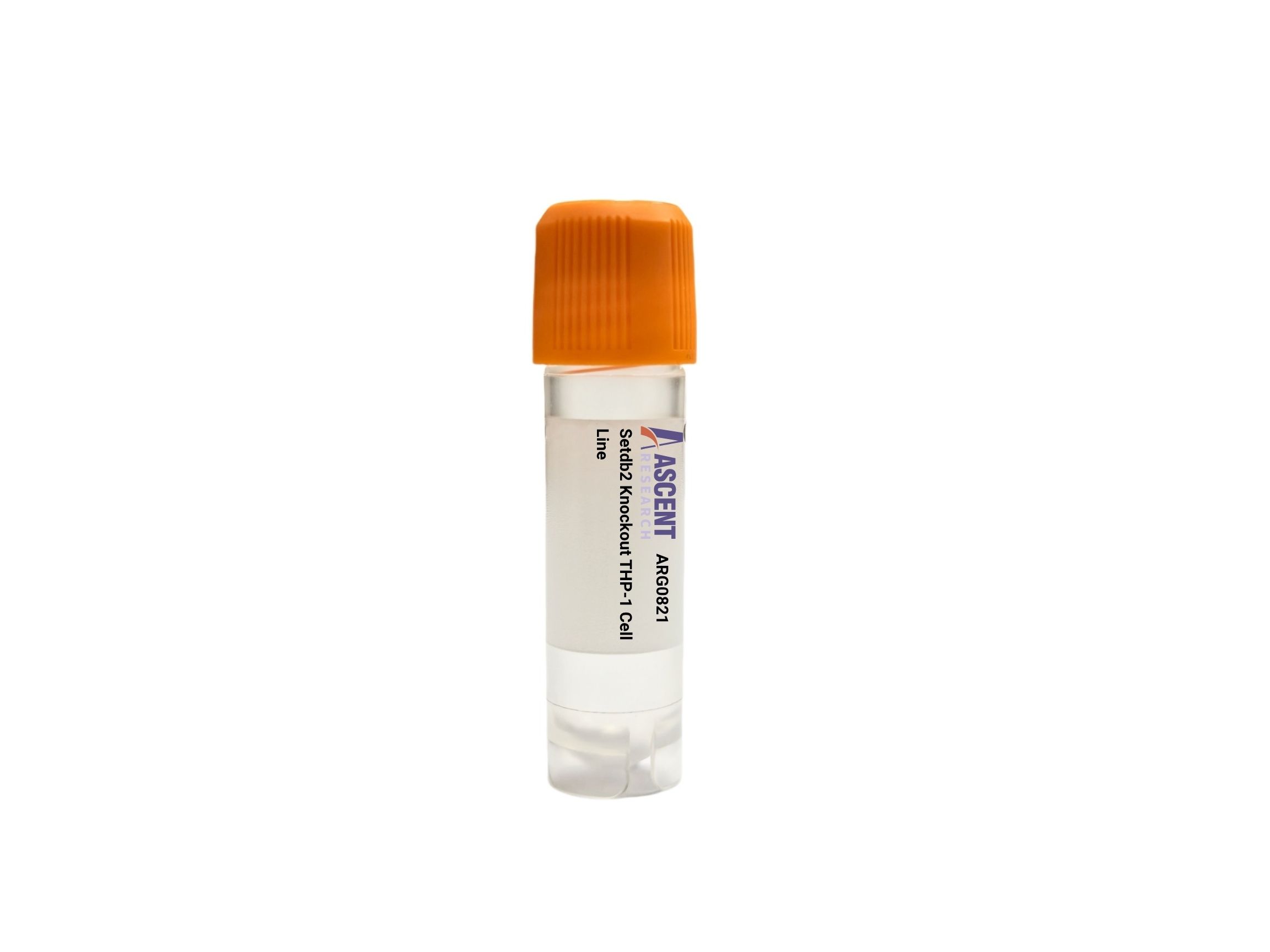
Genome-edited Cells
Blood (peripheral blood)
The Setdb2 Knockout THP-1 Cell Line is a CRISPR/Cas9-edited human monocytic leukemia cell line with targeted disruption of the Setdb2 gene, a histone H3K9 methyltransferase that mediates transcriptional repression. Derived from THP-1 cells, this model is optimized for epigenetic studies of macrophage biology and innate immunity, where Setdb2 silencing occurs via STAT6-dependent induction and H3K9me3 deposition at pro-inflammatory gene promoters like TNF. This knockout cell line enables investigation of chromatin remodeling, macrophage polarization, and inflammatory signaling pathways. Applications include ChIP-qPCR for H3K9me3 profiling, cytokine ELISA, and PMA-induced differentiation assays, supporting research in leukemia, chronic inflammation, and autoimmune diseases. Contact Ascent Research for additional technical details.
 GCC1 Knockout SK-HEP-1 Polyclonal Cells
Cat. No. ARG15245
GCC1 Knockout SK-HEP-1 Polyclonal Cells
Cat. No. ARG15245
 NLRP3 Knockout Marc-145 Cell Line
Cat. No. ARG44000
ACOT8 Knockout NCI-H1299 Polyclonal Cells
Cat. No. ARG30214
BAIAP2L1 Knockout SK-HEP-1 Polyclonal Cells
Cat. No. ARG32326
HLTF Knockout jurkat Polyclonal Cells
Cat. No. ARG34254
NLRP3 Knockout Marc-145 Cell Line
Cat. No. ARG44000
ACOT8 Knockout NCI-H1299 Polyclonal Cells
Cat. No. ARG30214
BAIAP2L1 Knockout SK-HEP-1 Polyclonal Cells
Cat. No. ARG32326
HLTF Knockout jurkat Polyclonal Cells
Cat. No. ARG34254
 Mouse Renal Artery Smooth Muscle Cells
Cat. No. ARP0457
Mouse Renal Artery Smooth Muscle Cells
Cat. No. ARP0457
The Setdb2 Knockout THP-1 Cell Line is a CRISPR/Cas9-edited human monocytic leukemia cell line carrying a targeted disruption of the Setdb2 gene, offering a precise loss-of-function model for epigenetic research. This knockout cell line is generated by CRISPR/Cas9-mediated gene disruption, resulting in abrogation of Setdb2 expression and its associated histone methyltransferase activity, without altering the overall THP-1 genomic background. Designed for advanced biomedical studies, it provides a consistent and scalable platform to investigate Setdb2-dependent regulatory mechanisms in immune cell biology.
THP-1 is a widely utilized human acute monocytic leukemia cell line that serves as a robust model for monocyte and macrophage biology. Upon treatment with phorbol 12-myristate 13-acetate (PMA), these suspension cells differentiate into adherent, macrophage-like cells, recapitulating key features of innate immune cells such as phagocytosis and cytokine secretion. The THP-1 background is particularly valued for studies on inflammation, immune signaling, and leukemic cell behavior, making it an ideal host for exploring epigenetic modifiers like Setdb2 in both undifferentiated and differentiated states.
Setdb2 encodes a histone H3K9 methyltransferase that specifically catalyzes trimethylation of histone H3 lysine 9 (H3K9me3), a repressive mark central to chromatin compaction and gene silencing. In macrophages, Setdb2 is transcriptionally induced by IL-4 and IL-13 via STAT6 signaling, linking anti-inflammatory cytokine pathways to epigenetic regulation. Setdb2 functions upstream of heterochromatin protein 1 homologs HP1?? (CBX5) and HP1?? (CBX1), which recognize H3K9me3 and propagate chromatin condensation, and interacts with TRIM28/KAP1 and CoREST complex components to enforce transcriptional repression. Its catalytic activity targets promoters of pro-inflammatory genes, including TNF and IL6, and interferon-stimulated genes, thereby dampening innate immune responses.
Disruption of Setdb2 in the THP-1 background provides a powerful tool to dissect its role in macrophage polarization and inflammatory gene expression. Given the association of Setdb2 with acute myeloid leukemia, chronic inflammation, and autoimmune disorders, this knockout cell line facilitates examination of epigenetic mechanisms underlying immune dysregulation. Researchers can explore how loss of H3K9 trimethylation at specific loci alters macrophage responses to polarizing stimuli, contributing to a deeper understanding of the interplay between chromatin modifiers and immune cell function.
This knockout model supports diverse experimental approaches, including chromatin immunoprecipitation followed by quantitative PCR (ChIP-qPCR) to map H3K9me3 alterations, quantitative RT-PCR and ELISA for quantifying TNF and IL-6 expression under LPS stimulation, and Western blotting to monitor histone modification dynamics. PMA-induced differentiation assays coupled with flow cytometry for macrophage markers enable functional characterization of Setdb2 in macrophage maturation. Additional applications encompass small-molecule screening to identify modulators of epigenetic silencing and co-culture systems to investigate tumor-immune interactions. For further technical information or to discuss customized applications, please contact Ascent Research.