Genome-edited Cells
Blood (peripheral blood)
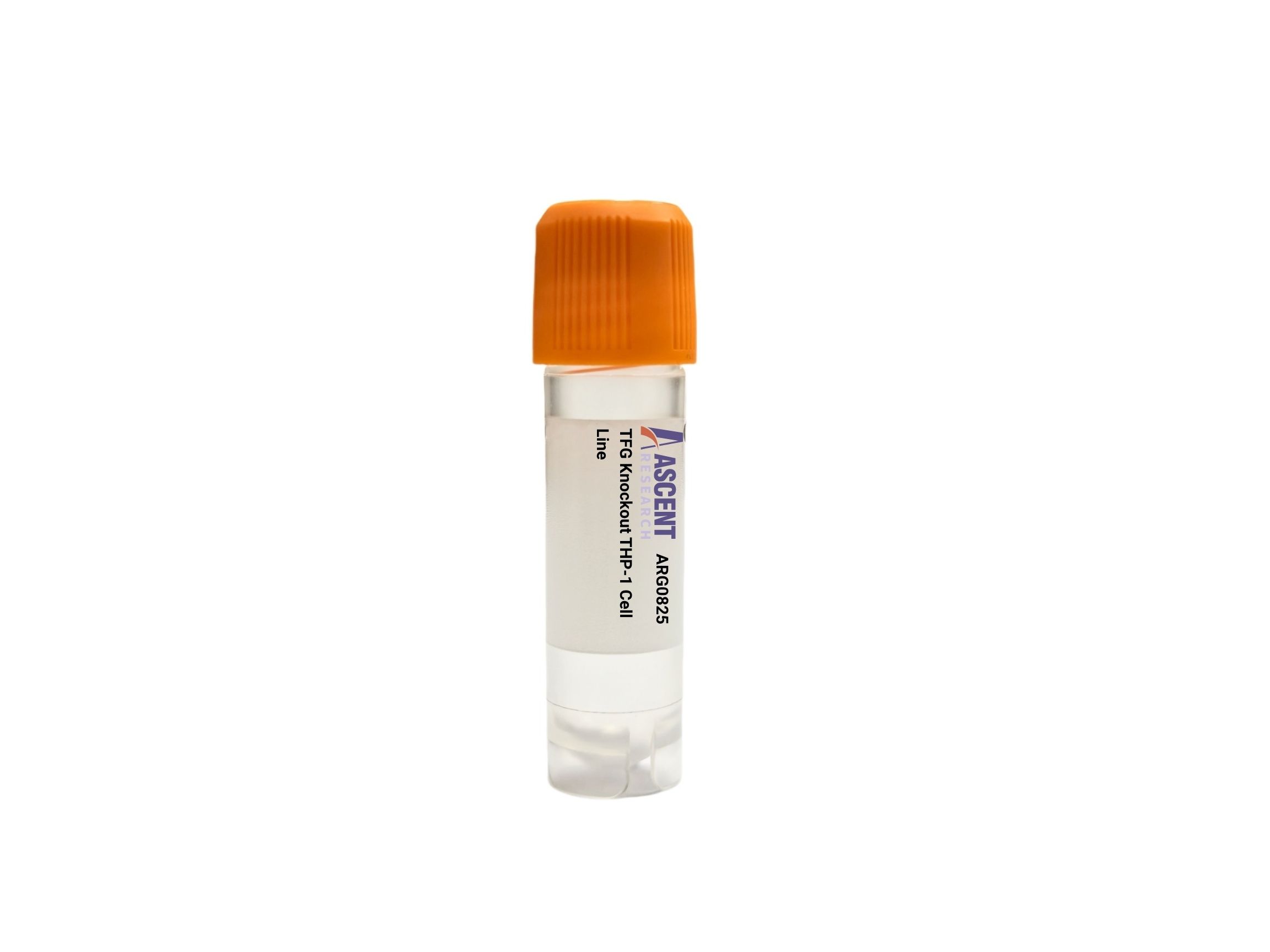
The TFG Knockout THP-1 Cell Line is a CRISPR/Cas9-edited human monocytic leukemia line with TFG gene disruption, which encodes a scaffold linking COPII trafficking to NF-??B signaling. TFG binds TANGO1, SEC16, and COPII components for large cargo secretion, and associates with TRAF2 and IKBKG to regulate inflammatory responses. This model enables pathway dissection in PMA-differentiable macrophages. Applications include investigating secretion defects, ER stress, UPR, and NF-??B-driven cytokines via COPII immunofluorescence, ELISA, luciferase reporters, and drug sensitivity assays, supporting cancer, immunology, and secretory disease research.
 OSTF1 Knockout SK-HEP-1 Polyclonal Cells
Cat. No. ARG15735
MFGE8 Knockout UMUC-3 Polyclonal Cells
Cat. No. ARG11226
MBOAT7 Knockout A549 Polyclonal Cells
Cat. No. ARG10683
IRGQ Knockout A2780 Polyclonal Cells
Cat. No. ARG29240
ARL6IP1 Knockout HEK293T Polyclonal Cells
Cat. No. ARG37851
OSTF1 Knockout SK-HEP-1 Polyclonal Cells
Cat. No. ARG15735
MFGE8 Knockout UMUC-3 Polyclonal Cells
Cat. No. ARG11226
MBOAT7 Knockout A549 Polyclonal Cells
Cat. No. ARG10683
IRGQ Knockout A2780 Polyclonal Cells
Cat. No. ARG29240
ARL6IP1 Knockout HEK293T Polyclonal Cells
Cat. No. ARG37851
 Saos-2
Cat. No. ARC0792
Saos-2
Cat. No. ARC0792
The TFG Knockout THP-1 Cell Line is a CRISPR/Cas9-edited knockout cell line derived from the human monocytic leukemia THP-1 cell line, in which the TFG gene has been disrupted to generate a permanent loss-of-function model. This cell line provides a stable human monocytic background for studying TFG-dependent mechanisms without the need for transient knockdown approaches. Researchers can use this model to dissect ER-Golgi trafficking and inflammatory signaling pathways.
The parental THP-1 line originates from the peripheral blood of an acute monocytic leukemia patient and serves as a standard system for monocyte/macrophage differentiation, inflammation, and leukemia research. Upon PMA treatment, THP-1 cells differentiate into adherent macrophage-like cells, suitable for functional assays examining cytokine secretion, phagocytosis, and stress responses. This versatility allows investigation of TFG function in both undifferentiated leukemic and macrophage-like states.
TFG is a scaffold protein that coordinates COPII vesicle assembly at ER exit sites, interacting with TANGO1/MIA3 and SEC16A/B to recruit SEC23/SEC24 and SEC13/SEC31 coat components for cargo selection and vesicle budding. It is especially critical for secretion of large cargoes such as procollagen. In parallel, TFG modulates NF-??B signaling by binding TRAF2 and IKBKG/NEMO, thereby regulating IKK complex activation and downstream transcription of inflammatory cytokines. TFG is transcriptionally induced by ATF4 and XBP1 under ER stress, linking protein trafficking to cellular stress and survival pathways.
Knocking out TFG in THP-1 cells enables examination of how secretory pathway defects influence monocyte and macrophage biology. Impaired COPII function may induce ER stress and UPR activation, while disrupted NF-??B regulation can alter inflammatory cytokine profiles and apoptotic responses. This model is particularly valuable for studying the dual role of TFG in protein secretion and immune signaling, and for exploring its involvement in cancers harboring TFG gene fusions, such as thyroid, lung, and hematopoietic malignancies.
Applications include Western blotting and immunofluorescence for COPII components, ER stress markers (CHOP, BiP), and NF-??B pathway targets; ELISA-based cytokine quantification; NF-??B luciferase reporter assays; flow cytometry for apoptosis; and migration/invasion and drug sensitivity tests. The line supports research into secretory pathway diseases, inflammation, and cancer. For technical inquiries, please contact Ascent Research.