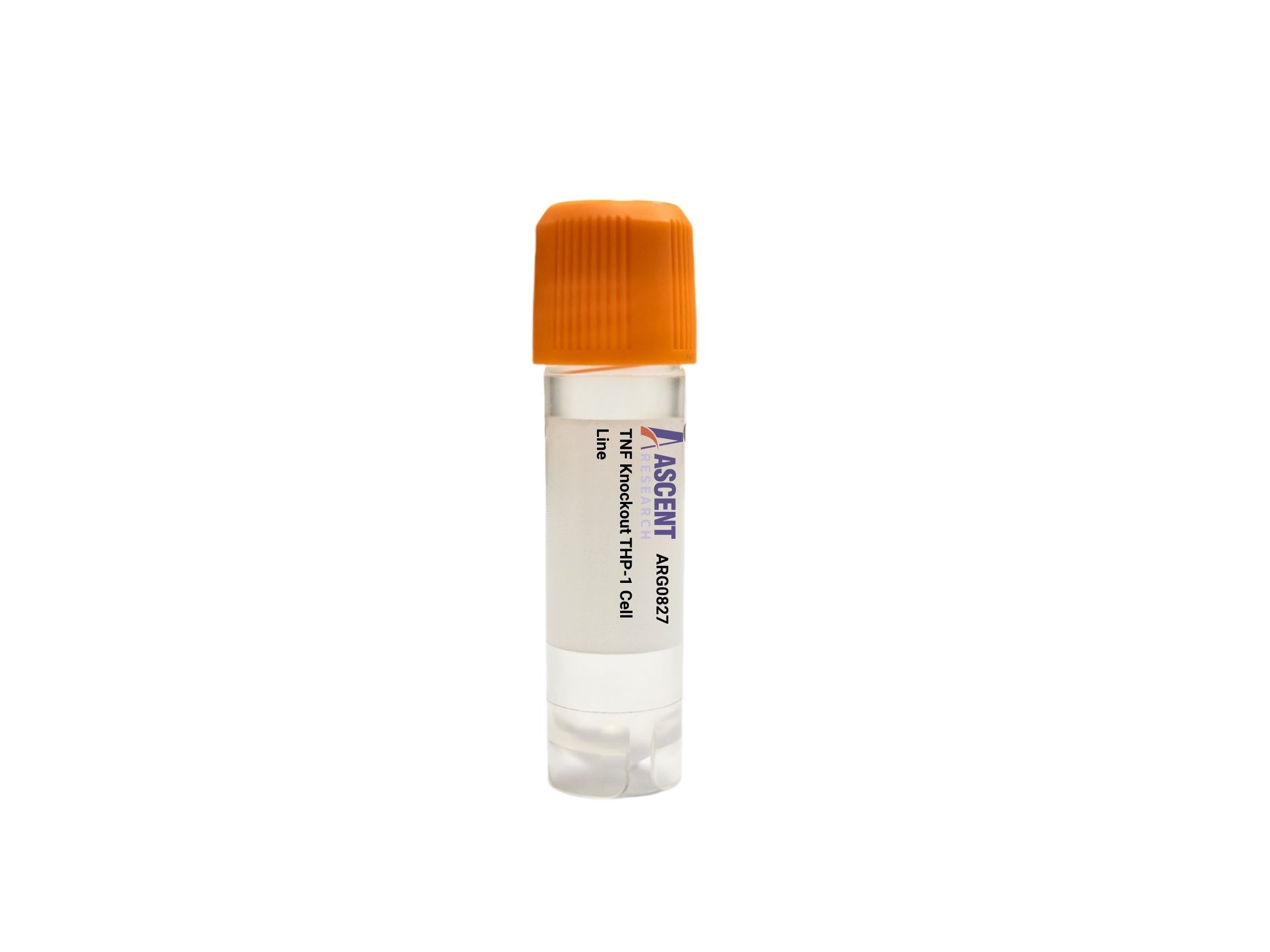
Genome-edited Cells
Blood (peripheral blood)
The TNF Knockout THP-1 Cell Line is a CRISPR/Cas9-edited human monocytic leukemia cell line lacking tumor necrosis factor (TNF) expression. Derived from THP-1 cells??a model of monocyte-macrophage differentiation??this cell line eliminates autocrine/paracrine TNF signaling, disrupting key inflammatory and cell death pathways mediated by TNFR1, NF-??B, and caspase-8. This loss-of-function model is designed for mechanistic studies of TNF-dependent signaling, cytokine network analysis, and drug screening for TNF inhibitors. Typical applications include ELISA, qPCR, Western blotting, flow cytometry, and functional macrophage assays, enabling precise dissection of inflammatory responses in a well-characterized human cellular system.
 PBDC1 Knockout A2780 Polyclonal Cells
Cat. No. ARG19123
PBRM1 Knockout Jurkat Polyclonal Cells
Cat. No. ARG13073
IRAK3 Knockout HEK293 Polyclonal Cells
Cat. No. ARG23265
ACSS2 Knockout HGC-27 Polyclonal Cells
Cat. No. ARG29415
DNAJC21 Knockout SK-HEP-1 Polyclonal Cells
Cat. No. ARG39261
MBD2 Knockout 786-O Polyclonal Cells
Cat. No. ARG5261
PBDC1 Knockout A2780 Polyclonal Cells
Cat. No. ARG19123
PBRM1 Knockout Jurkat Polyclonal Cells
Cat. No. ARG13073
IRAK3 Knockout HEK293 Polyclonal Cells
Cat. No. ARG23265
ACSS2 Knockout HGC-27 Polyclonal Cells
Cat. No. ARG29415
DNAJC21 Knockout SK-HEP-1 Polyclonal Cells
Cat. No. ARG39261
MBD2 Knockout 786-O Polyclonal Cells
Cat. No. ARG5261
The TNF Knockout THP-1 Cell Line is a CRISPR/Cas9-edited human monocytic leukemia cell line in which the gene encoding tumor necrosis factor (TNF) has been disrupted. This loss-of-function model is generated using CRISPR/Cas9-mediated gene editing to abrogate TNF expression, providing a defined platform for dissecting TNF-dependent signaling mechanisms and inflammatory responses. The cell line is derived from the THP-1 host cell, a widely used model for monocyte-macrophage biology.
THP-1 cells were originally isolated from the peripheral blood of a 1-year-old male patient with acute monocytic leukemia and retain many characteristics of native monocytes. Upon stimulation with phorbol esters such as PMA, they differentiate into macrophage-like cells, recapitulating key features of macrophage maturation, including enhanced phagocytic capacity and cytokine release. This property makes THP-1 an indispensable tool for studying monocyte differentiation, innate immune activation, and the molecular circuitry governing inflammatory phenotypes in a genetically tractable human cell line.
TNF is a master pro-inflammatory cytokine that signals primarily through TNF receptor 1 (TNFR1). Ligand binding triggers the recruitment of adaptor proteins TRADD, TRAF2, and RIPK1, which orchestrate the activation of the IKK complex, leading to I??B?? phosphorylation and subsequent nuclear translocation of the NF-??B transcription factor. Parallel signaling through the MAPK cascade??including JNK and p38??further amplifies inflammatory gene expression programs. Under certain conditions, TNFR1 can also assemble a cytosolic death-inducing complex with FADD and caspase-8, initiating extrinsic apoptosis. TNF thereby controls the expression of multiple downstream targets such as IL-6, IL-8, and COX-2, and its activity is modulated by upstream regulators including LPS/TLR4 engagement, IL-1??, and transcription factors NF-??B and AP-1.
In the THP-1 background, TNF knockout eliminates both autocrine and paracrine TNF signaling, profoundly altering the cell’s inflammatory repertoire. Because THP-1 macrophages produce significant amounts of TNF during lipopolysaccharide (LPS) stimulation, ablation of the cytokine blocks feed-forward activation of NF-??B and MAPK pathways, resulting in diminished secretion of pro-inflammatory mediators and an attenuated immune response. Moreover, loss of TNF disrupts the balance between survival signaling and apoptosis induction, sensitizing the cells to death stimuli that normally engage the TNFR1 pathway. This model thus uniquely illuminates the dual role of TNF in sustaining chronic inflammation and governing cell fate decisions within a macrophage-like context.
Researchers can employ the TNF Knockout THP-1 Cell Line in a wide array of functional studies. It is particularly suited for dissecting the TNF/TNFR1 axis using techniques such as ELISA-based cytokine profiling, quantitative PCR analysis of NF-??B target genes, and Western blotting for phospho-p65 and I??B?? degradation kinetics. The line is also valuable in drug discovery programs screening for TNF inhibitors, as well as in assays measuring apoptosis via flow cytometry (e.g., Annexin V staining) and macrophage differentiation after PMA treatment. Additional applications include phagocytosis assays to assess the role of TNF in innate immune effector functions and NF-??B luciferase reporter studies to quantify pathway activity. For additional information, please contact Ascent Research.