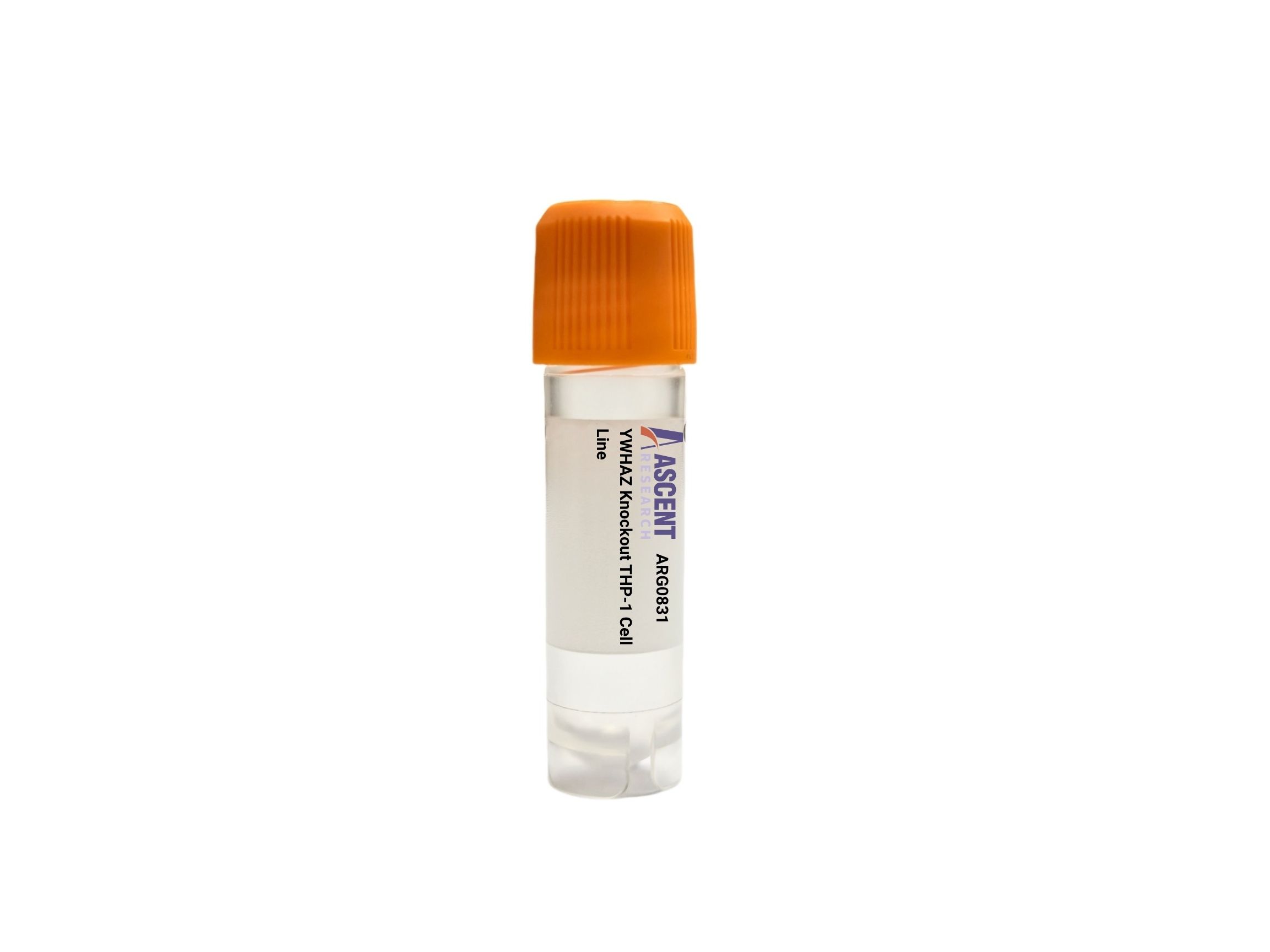
Genome-edited Cells
Blood (peripheral blood)
The YWHAZ Knockout THP-1 Cell Line is a CRISPR/Cas9-edited human acute monocytic leukemia cell line with targeted disruption of the YWHAZ gene. This loss-of-function model enables study of 14-3-3 zeta, a phosphoserine/phosphothreonine-binding adapter that scaffolds critical signaling networks including PI3K/AKT, MAPK, and Hippo pathways. Key interacting partners include Bad, Raf-1, and YAP. Applications span leukemia cell signaling, apoptosis analysis, drug resistance investigation, and monocyte/macrophage differentiation studies. The knockout line is validated for assays such as Western blotting, flow cytometry, and co-immunoprecipitation, making it a versatile tool for dissecting YWHAZ-dependent mechanisms in cancer and immune biology.
 MBD2 Knockout SK-HEP-1 Polyclonal Cells
Cat. No. ARG15747
NEIL2 Knockout Hela Polyclonal Cells
Cat. No. ARG8233
EHMT1 Knockout SK-HEP-1 Polyclonal Cells
Cat. No. ARG40864
DYNLT1 Knockout HEK293T Polyclonal Cells
Cat. No. ARG40175
JADE3 Knockout HAP1 Polyclonal Cells
Cat. No. ARG27646
MBD2 Knockout SK-HEP-1 Polyclonal Cells
Cat. No. ARG15747
NEIL2 Knockout Hela Polyclonal Cells
Cat. No. ARG8233
EHMT1 Knockout SK-HEP-1 Polyclonal Cells
Cat. No. ARG40864
DYNLT1 Knockout HEK293T Polyclonal Cells
Cat. No. ARG40175
JADE3 Knockout HAP1 Polyclonal Cells
Cat. No. ARG27646
 H4-II-E
Cat. No. ARC0232
H4-II-E
Cat. No. ARC0232
The YWHAZ Knockout THP-1 Cell Line is a CRISPR/Cas9-edited knockout cell line featuring targeted disruption of the YWHAZ gene in the human THP-1 acute monocytic leukemia background. This loss-of-function model enables precise investigation of 14-3-3 zeta adapter protein function without pharmacological artifacts. The stable knockout cell line is generated via CRISPR/Cas9-mediated gene disruption, providing a defined platform for dissecting YWHAZ-dependent mechanisms in leukemia and immune cell biology.
THP-1 cells were originally derived from the peripheral blood of a 1-year-old male with acute monocytic leukemia and grow as a nonadherent suspension. These cells are a classical monocyte/macrophage model that can be induced to differentiate into macrophage-like cells, retaining critical signaling pathways such as PI3K/AKT, MAPK/ERK, and Hippo. Their leukemic origin and immune cell characteristics make THP-1 an ideal host for studying YWHAZ??s role in proliferation, survival, and differentiation in a disease-relevant context.
14-3-3 zeta (YWHAZ) functions as a phosphoserine/phosphothreonine-binding scaffold that integrates signals from upstream kinases including PI3K, AKT, ERK, and p90RSK. It physically interacts with a broad network of effectors??Bad, Bax, Raf-1, MEK1, Chk1, YAP, TAZ, LATS1, MST1, and FOXO transcription factors??to regulate apoptosis, cell cycle progression, and metabolism. YWHAZ knockout disrupts key signaling axes: the PI3K-AKT-Bad/FOXO survival pathway, the Ras-Raf-MEK-ERK proliferative cascade, and the Hippo-MST-LATS-YAP growth pathway. This disruption tips the balance of pro- and anti-apoptotic signaling, alters cell cycle checkpoints, and reprograms cellular metabolism.
In the THP-1 leukemic context, YWHAZ knockout provides a powerful tool to dissect 14-3-3 zeta??s contributions to acute monocytic leukemia pathogenesis and macrophage differentiation. The model is particularly suited for studying how 14-3-3 zeta-mediated regulation of Bad and FOXO influences apoptosis resistance, or how its interactions with YAP/TAZ affect proliferation and contact inhibition. Researchers can explore drug resistance mechanisms by comparing responses to chemotherapeutics or kinase inhibitors between wild-type and knockout lines. Additionally, the inducible differentiation capacity allows analysis of YWHAZ??s role in monocyte-to-macrophage transition and innate immune function.
The YWHAZ Knockout THP-1 Cell Line supports diverse experimental workflows, including Western blotting, RT-qPCR, flow cytometry, apoptosis and proliferation assays, co-immunoprecipitation, signaling pathway analysis, and migration/invasion assays. This model enables in-depth molecular dissection of 14-3-3 zeta function in leukemia, immune response, and drug resistance, serving as a versatile resource for cancer biology and signal transduction research. For additional technical details or ordering information, please contact Ascent Research.