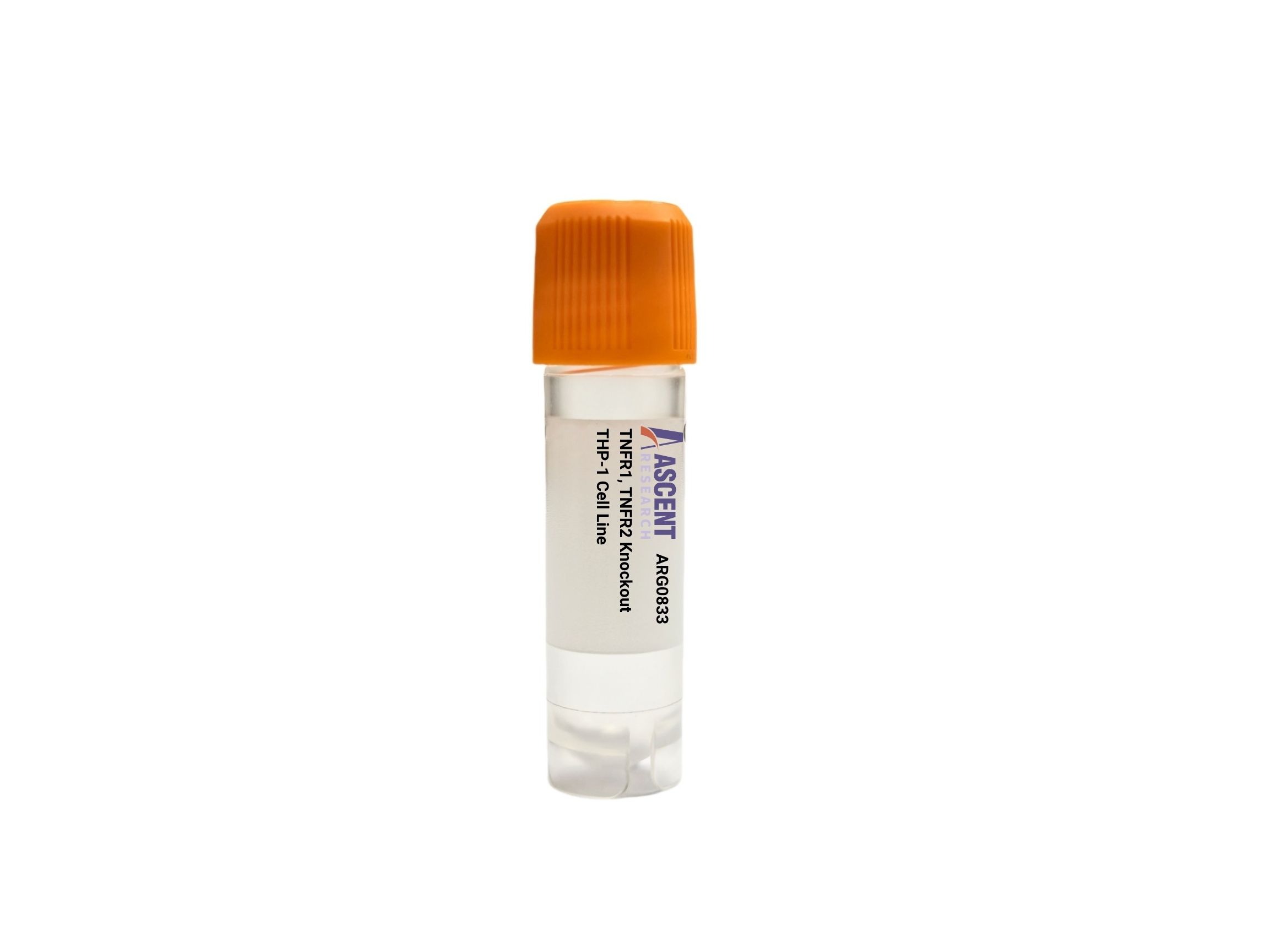
Genome-edited Cells
Blood (peripheral blood)
The TNFR1, TNFR2 Knockout THP-1 Cell Line is a CRISPR/Cas9-edited human monocytic knockout model with dual gene disruption of TNFR1 and TNFR2. Derived from the THP-1 acute monocytic leukemia cell line, it abolishes TNF-alpha responsiveness by deleting both receptors, thereby silencing downstream signaling through adaptors TRADD and TRAF2, kinase RIPK1, and transcription factor NF-kB. This product is tailored for investigation of TNF-alpha-driven inflammation, apoptosis, and macrophage biology. Applications include phospho-signaling analysis, cytokine profiling, and drug screening for pathway inhibitors, supporting research into rheumatoid arthritis, inflammatory bowel disease, and sepsis.
 PEX14 Knockout NCI-H1299 Polyclonal Cells
Cat. No. ARG17917
PHC2 Knockout Hela Polyclonal Cells
Cat. No. ARG8597
F11R Knockout Hela Polyclonal Cells
Cat. No. ARG8170
BICD1 Knockout HT29 Polyclonal Cells
Cat. No. ARG33145
ETV4 Knockout HEK293T Polyclonal Cells
Cat. No. ARG3535
EPHB3 Knockout HEK293T Polyclonal Cells
Cat. No. ARG3469
PEX14 Knockout NCI-H1299 Polyclonal Cells
Cat. No. ARG17917
PHC2 Knockout Hela Polyclonal Cells
Cat. No. ARG8597
F11R Knockout Hela Polyclonal Cells
Cat. No. ARG8170
BICD1 Knockout HT29 Polyclonal Cells
Cat. No. ARG33145
ETV4 Knockout HEK293T Polyclonal Cells
Cat. No. ARG3535
EPHB3 Knockout HEK293T Polyclonal Cells
Cat. No. ARG3469
The TNFR1, TNFR2 Knockout THP-1 Cell Line is a CRISPR/Cas9-edited knockout cell line featuring dual disruption of the TNFR1 (TNFRSF1A) and TNFR2 (TNFRSF1B) genes in a human monocytic background. This loss-of-function model enables comprehensive ablation of tumor necrosis factor-alpha (TNF-alpha) receptor-mediated signaling, providing a genetically defined system to dissect receptor-specific contributions to inflammatory, survival, and apoptotic pathways. By eliminating both TNF receptors simultaneously, researchers can investigate TNFR-dependent and -independent responses with high stringency, making this product suitable for advanced studies in innate immunity and cytokine biology.
THP-1 is a widely used human monocyte-like acute monocytic leukemia cell line originally derived from the peripheral blood of an acute monocytic leukemia patient. THP-1 cells exhibit a suspension lymphoblast-like morphology and retain the capacity to differentiate into macrophage-like cells upon treatment with phorbol esters, recapitulating key features of monocyte-to-macrophage maturation. This host cell line is inherently responsive to inflammatory stimuli, including lipopolysaccharide and TNF-alpha, and serves as a robust model for examining monocyte/macrophage differentiation, cytokine production, and signal transduction. Its established utility in immunology and oncology research makes it an ideal background for targeted disruption of TNF receptor genes.
TNFR1 and TNFR2 are cognate receptors for the pleiotropic cytokine TNF-alpha and the related ligand lymphotoxin-alpha. TNFR1, via its intracellular death domain, recruits the adaptor TRADD and the kinase RIPK1 to activate the NF-kB and MAPK pathways??including JNK and p38??or to trigger apoptosis through caspase-8 activation when survival signals are insufficient. TNFR2 lacks a death domain and primarily enhances TNFR1-driven signaling while independently activating NF-kB through TRAF2-dependent mechanisms, promoting cell proliferation and survival. Both receptors interact with TRAF2, cIAP1, and cIAP2, and their downstream targets include transcription factor NF-kB, interleukin-6 (IL-6), and interleukin-8 (IL-8). The simultaneous knockout of TNFR1 and TNFR2 eliminates proximal TNF-alpha binding and downstream signal initiation, effectively silencing the cascade from receptor engagement to transcriptional and apoptotic outputs.
In the THP-1 monocytic lineage, this double knockout provides a critical tool for distinguishing TNFR-mediated effects from other TNF-alpha-induced pathways, such as those potentially involving reverse signaling or alternative receptors. The cell line allows researchers to study the consequences of lost TNF-alpha sensitivity on macrophage differentiation, pro-inflammatory gene expression, and programmed cell death decisions, including apoptosis and necroptosis. By using differentiation protocols, investigators can examine how the absence of TNF receptor signaling reshapes the macrophage phenotype and its response to secondary stimuli, offering insights into the role of TNF-alpha in chronic inflammatory diseases and immune cell function.
Key applications of this knockout cell line include Western blotting for NF-kB p65 phosphorylation, RT-qPCR profiling of TNF-alpha target genes (e.g., IL-6 and IL-8), flow cytometric analysis of apoptosis via Annexin V/PI staining, co-immunoprecipitation of receptor-associated complexes, NF-kB luciferase reporter assays, ELISA-based cytokine secretion profiling, and phospho-signaling analysis of ERK, JNK, and p38. The model is well suited for drug screening campaigns aimed at identifying TNF-alpha pathway inhibitors, investigation of TNF receptor-associated periodic syndrome, and validation of therapeutic targets in rheumatoid arthritis, inflammatory bowel disease, and sepsis. It also facilitates the study of TNFR-independent TNF-alpha effects and the engineering of exogenous receptor variants. For further information, please contact Ascent Research.