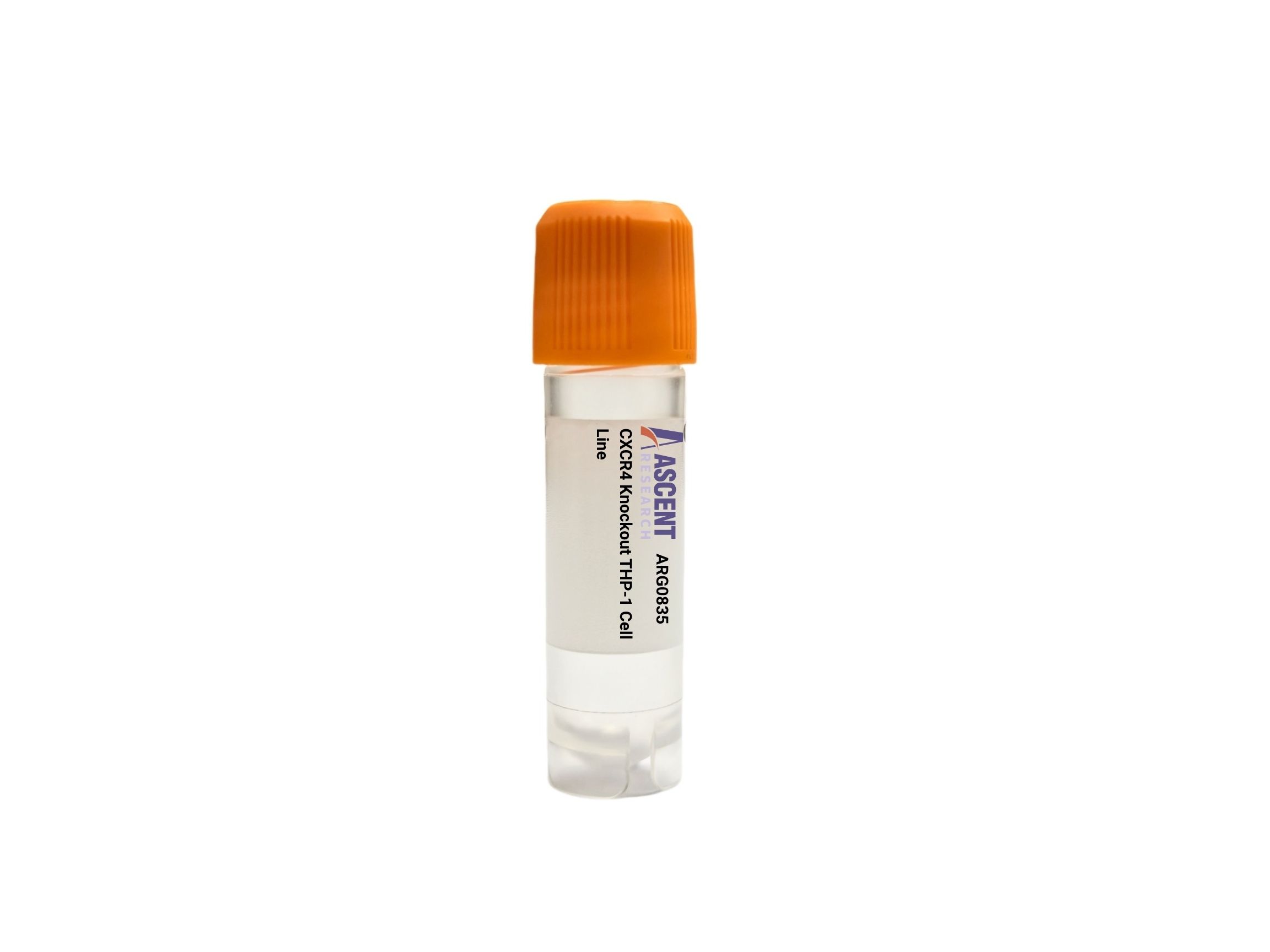
Genome-edited Cells
Blood (peripheral blood)
The CXCR4 Knockout THP-1 Cell Line is a CRISPR/Cas9-edited knockout line derived from THP-1 human acute monocytic leukemia cells. It provides a stable loss-of-function model lacking the CXCL12 receptor CXCR4, a chemokine receptor that drives PI3K-AKT and ERK1/2 signaling pathways. In THP-1 cells, CXCR4 knockout eliminates CXCL12-induced chemotaxis and downstream activation of AKT and ERK, making it ideal for HIV entry studies, migration assays, and CXCR4 antagonist screening. This model is valuable for dissecting chemokine signaling in leukemia and inflammation research.
 MCCC2 Knockout A2780 Polyclonal Cells
Cat. No. ARG18997
BRMS1L Knockout NCI-H1975 Polyclonal Cells
Cat. No. ARG31367
CCNT2 Knockout NCI-H1299 Polyclonal Cells
Cat. No. ARG43276
DNAJC13 Knockout K562 Polyclonal Cells
Cat. No. ARG39201
DTWD2 Knockout A2780 Polyclonal Cells
Cat. No. ARG39933
Nsun2 Knockout HCT116 Polyclonal Cells
Cat. No. ARG7295
MCCC2 Knockout A2780 Polyclonal Cells
Cat. No. ARG18997
BRMS1L Knockout NCI-H1975 Polyclonal Cells
Cat. No. ARG31367
CCNT2 Knockout NCI-H1299 Polyclonal Cells
Cat. No. ARG43276
DNAJC13 Knockout K562 Polyclonal Cells
Cat. No. ARG39201
DTWD2 Knockout A2780 Polyclonal Cells
Cat. No. ARG39933
Nsun2 Knockout HCT116 Polyclonal Cells
Cat. No. ARG7295
The CXCR4 Knockout THP-1 Cell Line is a CRISPR/Cas9-edited knockout cell line derived from the human acute monocytic leukemia THP-1 cell line. It provides a stable loss-of-function model for targeted disruption of the CXCR4 gene, which encodes the C-X-C chemokine receptor type 4. By eliminating CXCR4 expression, this cell line enables detailed investigation of CXCR4-dependent signaling and cellular processes in a well-characterized monocytic background. The knockout was achieved through CRISPR/Cas9-mediated gene disruption, yielding a heritable null background for CXCL12/CXCR4 axis studies.
THP-1 is a widely used monocytic leukemia cell line isolated from a 1-year-old male patient. It retains key features of native monocytes and can be differentiated into macrophage-like cells upon phorbol ester treatment. THP-1 cells are broadly employed as a model for inflammation, innate immunity, and hematologic malignancies. Their monocytic lineage and leukemic origin make them particularly relevant for exploring chemokine receptor functions in leukemia progression and immune cell trafficking.
CXCR4 is the receptor for CXCL12 (SDF-1) and mediates chemotaxis, hematopoiesis, immune cell trafficking, and HIV-1 entry. Upon CXCL12 binding, CXCR4 couples to G??i proteins to activate PI3K-AKT, RAS-RAF-MEK-ERK1/2, JNK/p38 MAPK, and JAK2-STAT3 pathways. Expression is regulated by upstream factors including TNF-??, IL-1??, TGF-??, HIF-1??, and VEGF. Downstream targets encompass ERK1/2, AKT, STAT3, FAK, MMP9, and BCL2 family members. CXCR4 also interacts with ??-arrestins, CXCR7/ACKR3, and CD4, and signaling modulates cell survival, migration, and transcriptional programs.
In THP-1 cells, knockout of CXCR4 abrogates CXCL12-induced chemotactic migration, impairs phosphorylation of AKT and ERK, and disrupts STAT3-dependent transcription. This deficiency highlights CXCR4 contributions to leukemic cell dissemination, survival, and inflammatory signaling. As aberrant CXCR4 signaling is linked to WHIM syndrome, HIV/AIDS pathology, and cancer metastasis, this model offers a controlled platform for evaluating therapeutic strategies targeting the CXCL12/CXCR4 axis.
Key applications include HIV entry and replication studies, transwell migration assays, and phospho-protein profiling via western blot or flow cytometry. The cell line supports RT-qPCR analysis of CXCL12-responsive genes, calcium mobilization measurements, and proliferation or apoptosis assays. These applications enable CXCR4 antagonist drug screening, GPCR and kinase pathway dissection, and functional studies of chemokine-dependent immune responses. For further information, please contact Ascent Research.