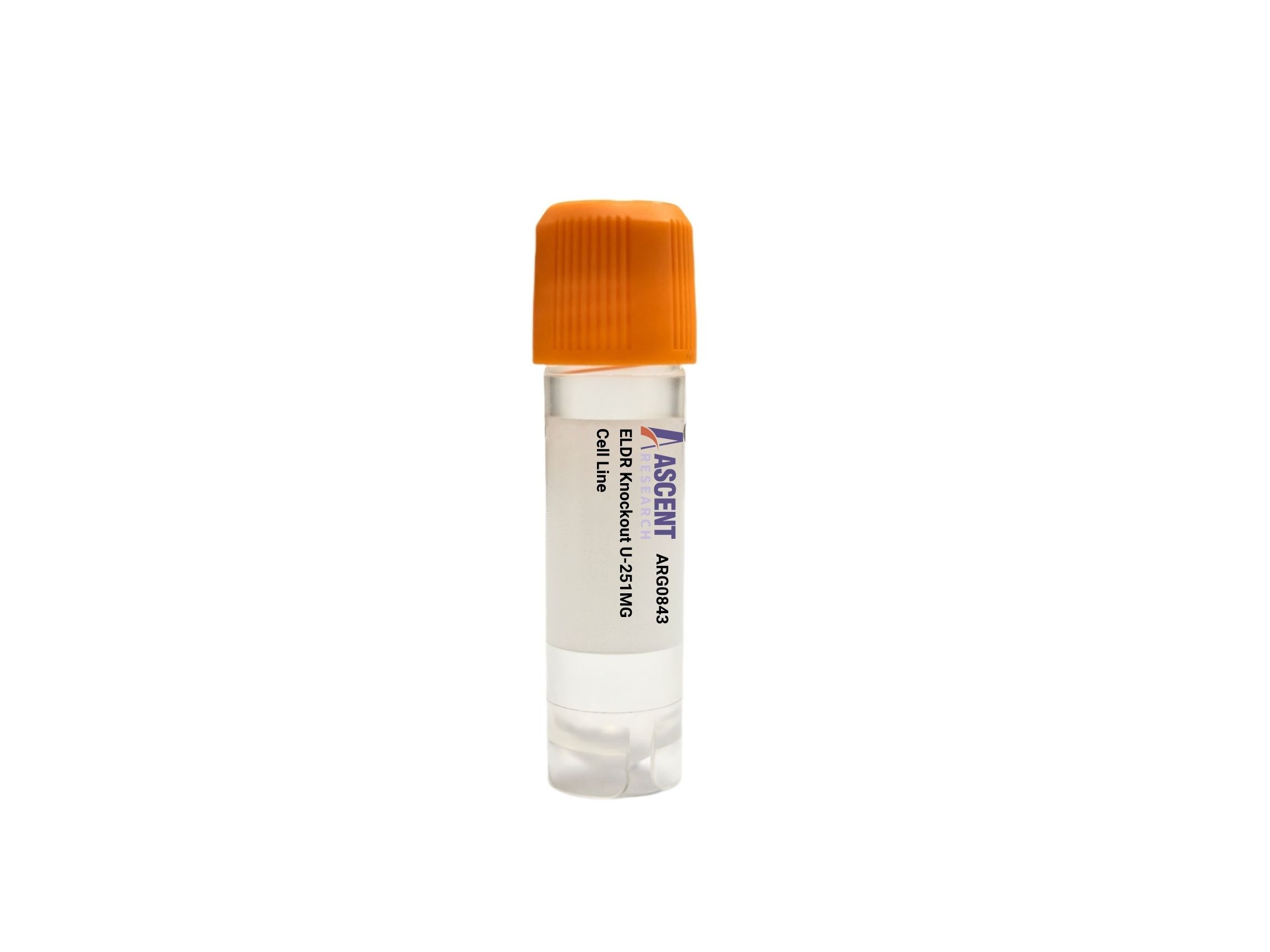
Genome-edited Cells
Brain (parietal lobe)
The ELDR Knockout U-251MG Cell Line is a CRISPR/Cas9-edited knockout model in the human U-251MG glioblastoma cell line, engineered to eliminate expression of the oncogenic lncRNA ELDR. ELDR is a critical regulator of EGFR-driven tumor progression, functioning as a ceRNA that sponges miR-744-5p and miR-31-5p to derepress targets such as MYC and cyclin D1, thereby activating PI3K/AKT and MAPK pathways. This knockout cell line provides a definitive loss-of-function system for dissecting ELDR's role in glioblastoma proliferation, migration, invasion, and drug resistance. It is ideal for functional genomics, pathway analysis, and therapeutic target validation, and can be used in assays including RT-qPCR, western blotting, proliferation assays, Transwell assays, and xenograft models.
 ASF1A Knockout NCI-H1299 Polyclonal Cells
Cat. No. ARG30435
AGPAT1 Knockout NCI-H1299 Polyclonal Cells
Cat. No. ARG30263
GTPBP1 Knockout HGC-27 Polyclonal Cells
Cat. No. ARG29884
ASF1A Knockout NCI-H1299 Polyclonal Cells
Cat. No. ARG30435
AGPAT1 Knockout NCI-H1299 Polyclonal Cells
Cat. No. ARG30263
GTPBP1 Knockout HGC-27 Polyclonal Cells
Cat. No. ARG29884
 Immortalized Human Pulmonary Artery Endothelial Cell
Cat. No. ARI0156
Immortalized Human Pulmonary Artery Endothelial Cell
Cat. No. ARI0156
 MKN7
Cat. No. ARC0525
MKN7
Cat. No. ARC0525
 Rat Osteoblasts
Cat. No. ARP0313
Rat Osteoblasts
Cat. No. ARP0313
The ELDR Knockout U-251MG Cell Line is a CRISPR/Cas9-edited knockout cell line designed for functional studies of the long non-coding RNA ELDR in glioblastoma. This product features targeted disruption of the ELDR gene in the U-251MG human glioblastoma cell line, resulting in loss of ELDR expression. The knockout model serves as a powerful tool for investigating ELDR-dependent molecular mechanisms without off-target interference from transient silencing approaches.
The parental U-251MG cell line is a well-characterized glioblastoma model derived from a male patient, widely employed in neuro-oncology research. These cells retain key genetic and phenotypic characteristics of primary glioblastoma, including aggressive growth and invasive potential. Their established background makes them a reliable platform for dissecting signaling pathways that drive glioblastoma progression and therapeutic resistance.
ELDR is a long non-coding RNA upregulated by EGFR signaling and the transcription factor STAT3. Mechanistically, ELDR acts as a competing endogenous RNA (ceRNA) that sponges tumor-suppressive microRNAs, such as miR-744-5p and miR-31-5p, thereby relieving repression of oncogenic targets. This leads to enhanced expression of downstream effectors including MYC, cyclin D1, MMP2, and MMP9, and activation of the PI3K-AKT and MAPK-ERK pathways. Consequently, ELDR integrates signals from EGFR, RAS, PI3K, AKT, mTOR, and ERK1/2 to promote glioblastoma cell proliferation, migration, and invasion.
Disruption of ELDR in the U-251MG background enables precise dissection of its contributions to glioblastoma pathogenesis. This model is particularly suited for examining how ELDR loss affects EGFR-driven signaling networks, cell cycle progression, and invasive properties. Researchers can directly assess the functional impact of ELDR ablation on downstream targets and pathway activity, providing insights into resistance mechanisms and potential therapeutic vulnerabilities in glioblastoma.
The ELDR Knockout U-251MG Cell Line supports a broad range of applications, including glioblastoma mechanistic studies, drug resistance profiling, and validation of lncRNA-targeted therapies. Standard assays such as RT-qPCR and western blotting confirm ELDR knockout and downstream impact, while MTT/CCK-8, Transwell migration/invasion, and xenograft models enable functional phenotyping. RNA immunoprecipitation (RIP) can be used to explore ELDR-miRNA interactions. For additional information, please contact Ascent Research.