Genome-edited Cells
Bone
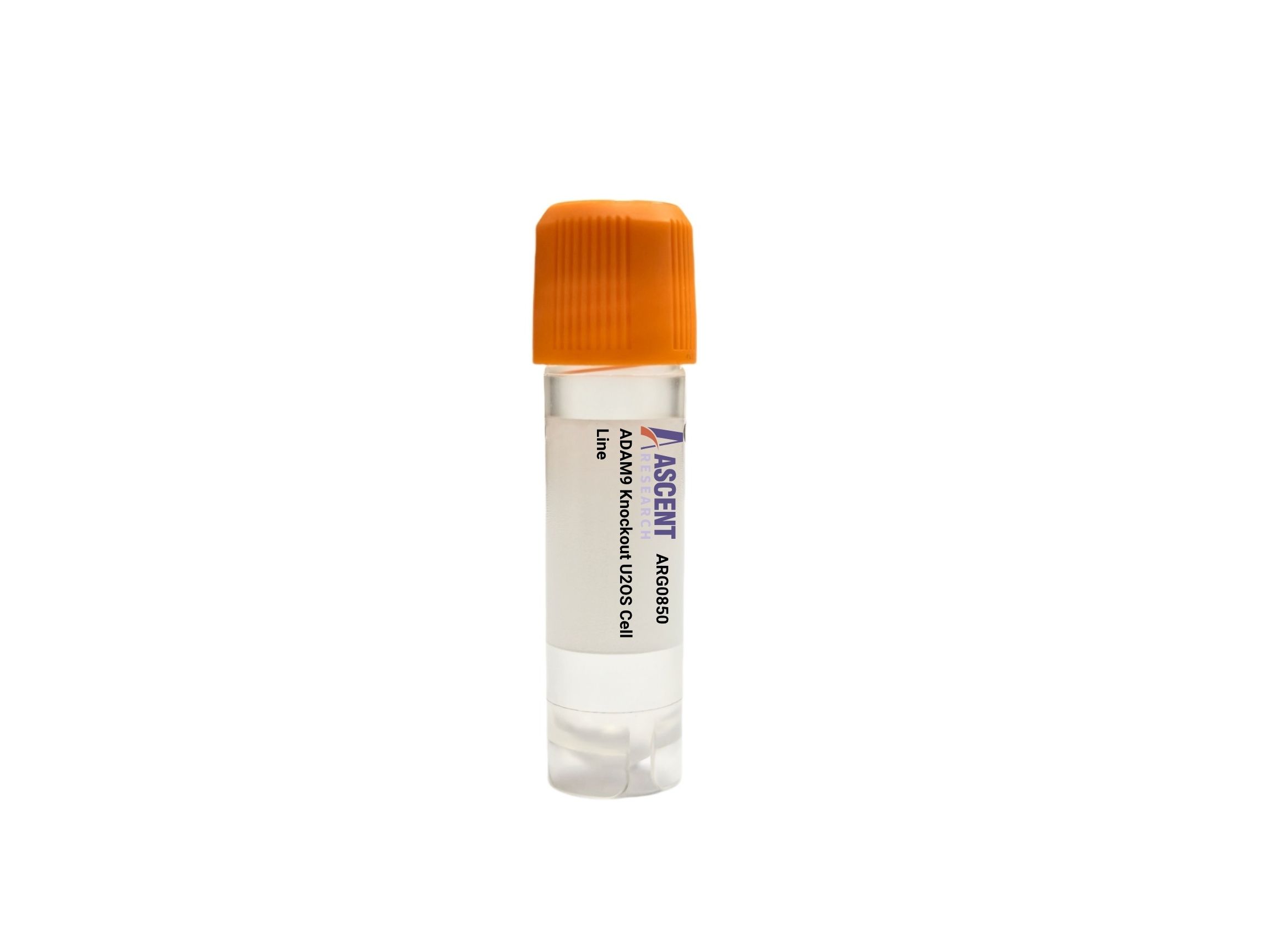
The ADAM9 Knockout U2OS Cell Line is a CRISPR/Cas9-edited knockout cell line in which ADAM9 gene disruption creates a loss-of-function model in human osteosarcoma U2OS cells. ADAM9 is a sheddase that activates EGFR and Notch signaling by cleaving substrates such as HB-EGF and Delta-like 1, and interacts with integrin alpha-v beta-3 and CD9. By eliminating ADAM9 function, this model impairs key oncogenic pathways, reducing proliferation, migration, and invasion. It is ideal for studying osteosarcoma metastasis mechanisms, signaling crosstalk, and for validating ADAM9 as a drug target using assays such as Western blotting, transwell invasion, and qPCR.
The ADAM9 Knockout U2OS Cell Line is a CRISPR/Cas9-edited knockout cell line with disrupted ADAM9 gene function, providing a loss-of-function model for investigating ADAM9-dependent processes. This product offers a genetically defined system in a human osteosarcoma background, supplied in a ready-to-use format for direct application in functional assays. Researchers can use this model to dissect ADAM9 roles in signal transduction, cell migration, and tumor progression with high reproducibility.
The U2OS host cell line is a human osteosarcoma cell line derived from a 15-year-old female patient, widely used in cancer biology and drug discovery. U2OS cells exhibit epithelial morphology and robust growth, retaining key features of osteosarcoma including aberrant signaling and metastatic potential. The ADAM9 knockout in this context allows examination of metalloprotease-mediated regulation of oncogenic pathways in a clinically relevant model.
ADAM9 is a transmembrane metalloprotease that functions as a sheddase, cleaving ectodomains of cell surface proteins to regulate adhesion, migration, and signaling. It is activated by EGF, TGF-beta, and TNF-alpha, and is transcriptionally regulated by AP-1. Key substrates include HB-EGF and Delta-like 1, which upon cleavage activate EGFR and Notch pathways, respectively. ADAM9 interacts with integrin alpha-v beta-3 and tetraspanin CD9, and cooperates with ADAM10 in Notch processing. Downstream, ADAM9-mediated shedding activates ERK and RhoA cascades and induces Notch target genes such as Hes1, driving proliferation, migration, and extracellular matrix remodeling.
In U2OS cells, ADAM9 knockout impairs EGFR and Notch signaling, reducing proliferation, migration, and invasion. This model captures key tumor cell behaviors dependent on sheddase activity, enabling dissection of molecular mechanisms underlying osteosarcoma progression. It is valuable for studying crosstalk between adhesion and growth factor-driven signals in metastasis, and for identifying novel ADAM9 substrates and therapeutic targets.
Applications include Western blotting for ADAM9 and cleaved substrates, wound healing and transwell assays for migration/invasion, and viability assays. Immunofluorescence reveals integrin localization changes, while ELISA and qPCR quantify shed ligands and Hes1 expression. Co-immunoprecipitation identifies ADAM9 complexes with CD9 and integrin beta-3. This model supports signaling crosstalk studies, osteosarcoma metastasis research, and ADAM9-targeted drug validation. For technical information, contact Ascent Research.