Genome-edited Cells
Kidney
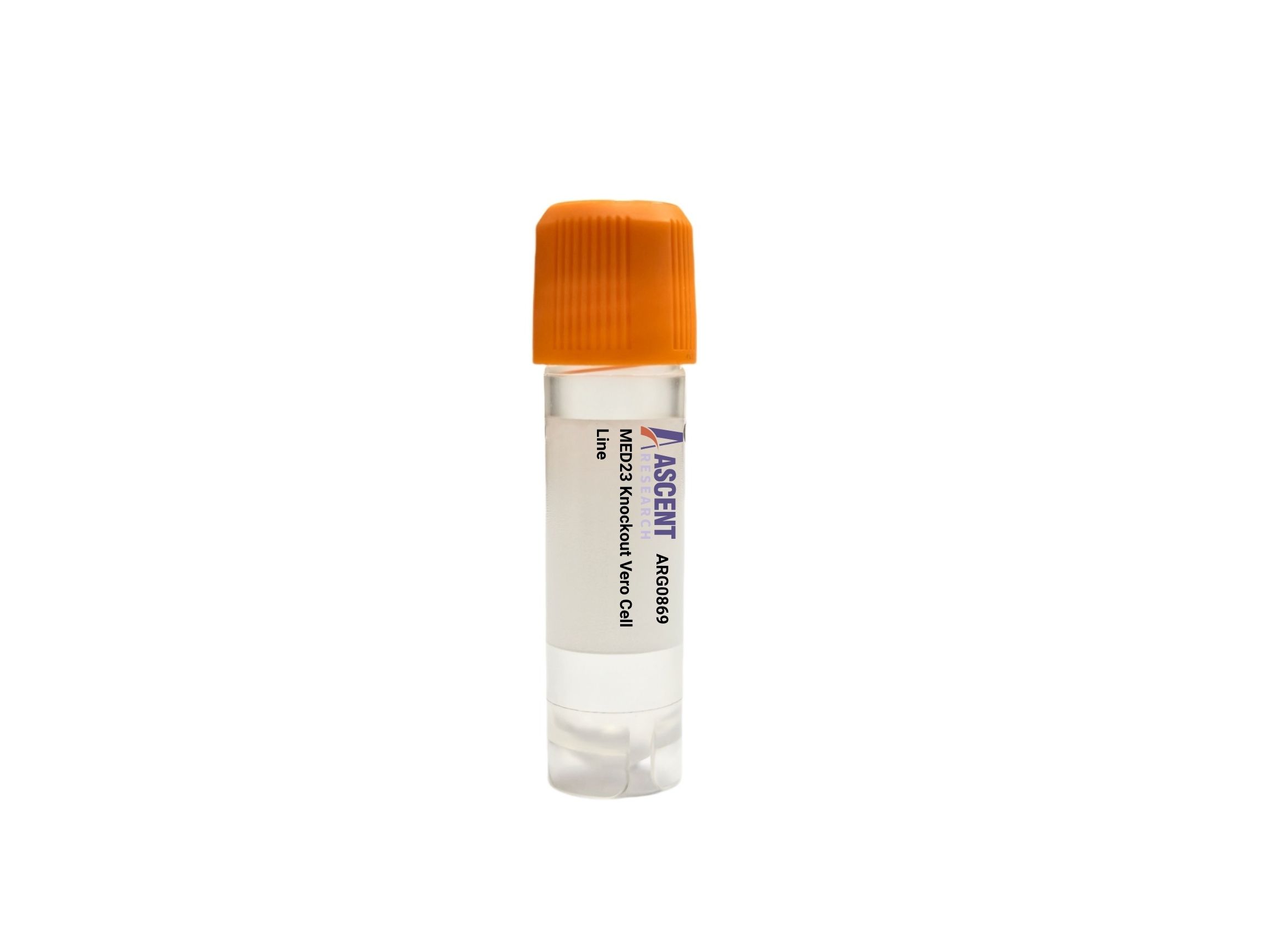
The MED23 Knockout Vero Cell Line is a CRISPR/Cas9-edited knockout cell line derived from the interferon-deficient Vero kidney epithelial line (Chlorocebus sabaeus). Disruption of MED23, a Mediator complex subunit, abolishes signal-dependent transcription downstream of insulin, MAPK, and TGF-?? pathways. This model enables dissection of transcriptional coactivation, immediate early gene regulation, and viral?Chost interactions in a defined genetic background. Researchers can employ this cell line for mechanistic studies involving EGR1, FOS, and MYC targets, as well as metabolic and antiviral drug screening. It offers a robust platform for examining Mediator function without interferon confounding effects.
 CERS5 Knockout A2780 Polyclonal Cells
Cat. No. ARG18560
PHACTR2 Knockout jurkat Polyclonal Cells
Cat. No. ARG13509
ACTR1B Knockout CAL27 Polyclonal Cells
Cat. No. ARG35328
EEF1A2 Knockout Hela Polyclonal Cells
Cat. No. ARG40546
IL6ST Knockout huh-7 Polyclonal Cells
Cat. No. ARG28383
CERS5 Knockout A2780 Polyclonal Cells
Cat. No. ARG18560
PHACTR2 Knockout jurkat Polyclonal Cells
Cat. No. ARG13509
ACTR1B Knockout CAL27 Polyclonal Cells
Cat. No. ARG35328
EEF1A2 Knockout Hela Polyclonal Cells
Cat. No. ARG40546
IL6ST Knockout huh-7 Polyclonal Cells
Cat. No. ARG28383
 CX-1
Cat. No. ARC0158
CX-1
Cat. No. ARC0158
The MED23 Knockout Vero Cell Line is a CRISPR/Cas9-edited knockout cell line derived from the Vero host, an immortalized kidney epithelial line from the African green monkey (Chlorocebus sabaeus). This product constitutes a loss-of-function model for the MED23 gene, which encodes a critical subunit of the Mediator transcriptional coactivator complex. By disrupting MED23 expression, researchers can interrogate Mediator-dependent gene regulation in a well-characterized, interferon-deficient cellular environment. The knockout cell line is supplied as a heterogeneous population and is optimized for functional genomics, signal transduction studies, and drug screening applications requiring targeted gene ablation.
Vero cells are an established, non-tumorigenic cell line originating from the kidney epithelium of an African green monkey. These cells are inherently deficient in interferon production, rendering them highly permissive to a broad range of viruses, including emerging pathogens and vaccine strains. Consequently, Vero cells represent a standard platform for virology research, vaccine development, and antiviral compound screening. The immortalized yet contact-inhibited phenotype ensures reproducible growth characteristics and suitability for high-throughput assays. In the MED23 knockout context, the Vero background facilitates examination of host?Cvirus interactions and transcriptional responses to infection without confounding interferon-mediated effects.
MED23 functions as an indispensable subunit of the multi-protein Mediator complex that bridges gene-specific transcription factors with the RNA polymerase II general transcription machinery. It is critical for signal-dependent transcriptional activation, receiving inputs from the insulin receptor (INSR) via IRS1, AKT, and MAPK cascade (MAPK3/1) to regulate immediate early genes such as EGR1 and FOS. MED23 also transduces TGF-?? signals through interaction with SMAD2/3, and participates in Wnt/??-catenin-dependent transcription by associating with CTNNB1. Key genomic targets include JUN, MYC, and CDK1, which govern cell growth and differentiation. The subunit interfaces with CDK8, MED1, and MED12, forming a dynamic scaffold that integrates multiple upstream pathways.
In the Vero kidney epithelial background, MED23 knockout provides a tractable system to dissect Mediator-dependent transcription without interferon-induced antiviral responses. This facilitates examination of how viral pathogens exploit host transcriptional machinery, as many viruses co-opt Mediator to activate viral and host genes. Moreover, the epithelial origin of Vero cells makes them relevant for studying MED23??s role in insulin signaling and metabolic gene networks. By abolishing MED23 function, researchers can directly assess coactivator contributions to immediate early gene induction and responses to growth factors, offering insights into mechanisms underlying developmental disorders and cancer vulnerabilities.
The MED23 Knockout Vero Cell Line supports a broad array of experimental workflows. Transcriptional responses are monitored by RT-qPCR and RNA-seq profiling of immediate early genes (e.g., FOS, EGR1) after stimulation with insulin, serum, or growth factors. Western blotting and co-immunoprecipitation of Mediator subunits (MED1, MED12) assess complex integrity, while ChIP-qPCR quantifies RNA polymerase II occupancy at target promoters. Dual-luciferase reporter assays for MAPK-responsive or insulin-responsive elements provide functional readouts. Cell-based assays include proliferation, viability, and glucose uptake measurements. For specialized cell culture conditions or target-specific validation, please contact Ascent Research.