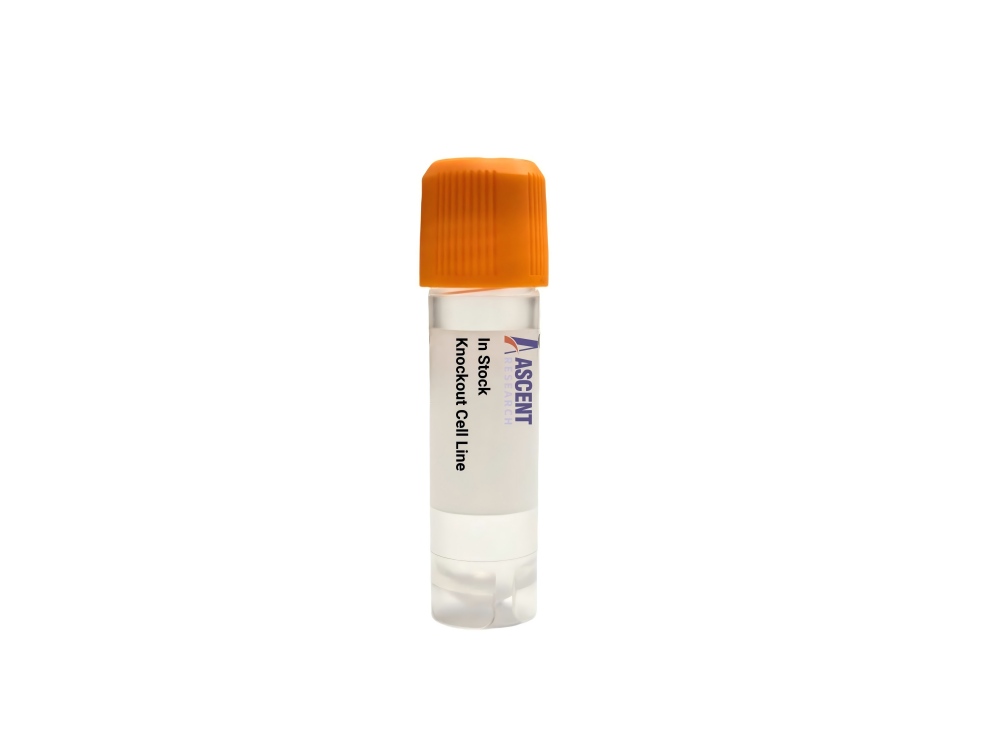
In Stock Cell Lines
Homo sapiens (Human)
Liver
Adherent
The BMI1 Knockout Huh-7 Cell Line is a CRISPR/Cas9-edited human hepatocellular carcinoma knockout model that eliminates BMI1, a core PRC1 component. This cell line enables investigation of BMI1??s role in repressing the INK4a/ARF locus (CDKN2A) and controlling cell cycle progression, senescence, and cancer stem cell biology. Suitable for applications in epigenetic drug discovery, HCC progression studies, and senescence research, this robust cell model supports Western blotting, ChIP, and xenograft assays. By disrupting PRC1-mediated gene silencing, it provides a powerful platform for exploring targeted therapies in liver cancer.
 ACYP1 Knockout Hela Polyclonal Cells
Cat. No. ARG20426
PAK4 Knockout T47D Polyclonal Cells
Cat. No. ARG12009
ALPP Knockout MES-OV Polyclonal Cells
Cat. No. ARG24121
ATP11B Knockout HEK293T Polyclonal Cells
Cat. No. ARG25789
PACS1 Knockout Hela Polyclonal Cells
Cat. No. ARG7814
ACYP1 Knockout Hela Polyclonal Cells
Cat. No. ARG20426
PAK4 Knockout T47D Polyclonal Cells
Cat. No. ARG12009
ALPP Knockout MES-OV Polyclonal Cells
Cat. No. ARG24121
ATP11B Knockout HEK293T Polyclonal Cells
Cat. No. ARG25789
PACS1 Knockout Hela Polyclonal Cells
Cat. No. ARG7814
 Human Skeletal Muscle Satellite Cell Medium
Cat. No. ARM0161
Human Skeletal Muscle Satellite Cell Medium
Cat. No. ARM0161
The BMI1 Knockout Huh-7 Cell Line is a CRISPR/Cas9-edited knockout cell line derived from the Huh-7 hepatocellular carcinoma line, designed for loss-of-function studies of the polycomb group protein BMI1. This model provides a stable, genome-edited cell population lacking BMI1 expression, validated for target-gene disruption by immunoblotting and sequencing.
Huh-7 is a well-differentiated hepatocellular carcinoma cell line established from a liver tumor of a 57-year-old Japanese male. As a hepatic epithelial cell line, it serves as a widely used in vitro model for HCC biology, drug metabolism, and viral hepatitis, offering a clinically relevant host for knockout studies.
BMI1 is a core component of PRC1, where it partners with RING1B and other subunits to catalyze H2AK119ub and repress transcription. It directly silences the INK4a/ARF locus (CDKN2A), encoding p16INK4a and p14ARF, thereby promoting cell cycle progression through Rb phosphorylation and inhibiting p53-mediated senescence and apoptosis. Upstream regulators include c-Myc, E2F1, and Twist1; interacting factors encompass RING1A, CBX4/8, HDAC1, and DNMT1. Downstream targets such as CDKN1A (p21), CDH1 (E-cadherin), PTEN, and BIM are also influenced by BMI1 loss, offering multiple axes for mechanistic dissection.
In hepatocellular carcinoma, BMI1 overexpression is associated with cancer stemness, tumor progression, and drug resistance. The BMI1 Knockout Huh-7 Cell Line allows direct exploration of these features, enabling the study of BMI1’s role in epigenetic silencing, senescence bypass, and CSC maintenance in a relevant HCC setting.
This cell line is suitable for Western blotting of BMI1 and downstream effectors, ChIP-qPCR for H2AK119ub at INK4a/ARF, flow cytometry for cell cycle analysis, and senescence assays. It also supports functional assays like soft agar colony formation and xenograft tumor growth, aiding drug screening and target validation. For further information, contact Ascent Research.