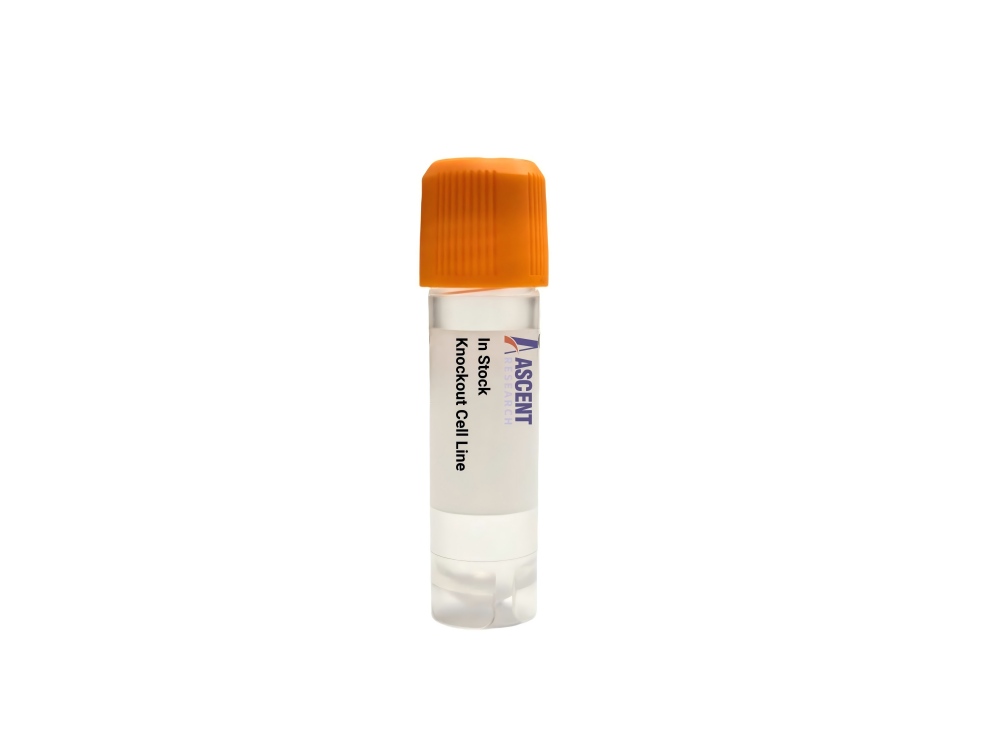
In Stock Cell Lines
Homo sapiens (Human)
Prostate
Adherent
The CD274 Knockout PC-3 Cell Line is a CRISPR/Cas9-edited prostate cancer model with targeted disruption of the CD274 gene, which encodes the immune checkpoint ligand PD-L1. Derived from the androgen-independent PC-3 bone metastasis cell line, it serves as a loss-of-function tool for studying PD-L1-driven T cell inhibition and tumor immune evasion. PD-L1 engages PD-1 and CD80 to recruit SHP2, suppressing TCR signaling molecules such as ZAP70 and LCK, and is regulated by IFN-??, STAT3, and NF-??B. This knockout cell line is ideal for immune checkpoint antibody validation, T cell co-culture assays, and investigating PD-L1-dependent signaling pathways in prostate cancer.
 METAP1D Knockout NCI-H1299 Polyclonal Cells
Cat. No. ARG17600
CSNK1D Knockout HEK293 Polyclonal Cells
Cat. No. ARG12700
C19orf47 Knockout SK-HEP-1 Polyclonal Cells
Cat. No. ARG32413
EHD2 Knockout MES-OV Polyclonal Cells
Cat. No. ARG40792
CCAR2 Knockout NCI-H1975 Polyclonal Cells
Cat. No. ARG42865
METAP1D Knockout NCI-H1299 Polyclonal Cells
Cat. No. ARG17600
CSNK1D Knockout HEK293 Polyclonal Cells
Cat. No. ARG12700
C19orf47 Knockout SK-HEP-1 Polyclonal Cells
Cat. No. ARG32413
EHD2 Knockout MES-OV Polyclonal Cells
Cat. No. ARG40792
CCAR2 Knockout NCI-H1975 Polyclonal Cells
Cat. No. ARG42865
 Huh-7 Luciferase Stable Cell Line
Cat. No. ARG0445
Huh-7 Luciferase Stable Cell Line
Cat. No. ARG0445
The CD274 Knockout PC-3 Cell Line is a precisely engineered CRISPR/Cas9-edited knockout cell line derived from the PC-3 prostate adenocarcinoma model. This product features a targeted disruption of the CD274 gene, which encodes the immune checkpoint ligand PD-L1. The resulting loss-of-function model enables researchers to dissect the role of PD-L1 in tumor-immune interactions without interference from endogenous gene expression. The knockout cell line retains the core characteristics of the parental PC-3 cells while lacking functional PD-L1 protein, as confirmed by standard validation assays. This tool is designed for applications in immuno-oncology, signal transduction, and drug discovery research.
PC-3 cells were originally isolated from a bone metastasis of a grade IV prostate adenocarcinoma in a 62-year-old Caucasian male. These cells are androgen-independent and exhibit an epithelial morphology, making them a widely used model for advanced, hormone-refractory prostate cancer. PC-3 cells do not express androgen receptor and are characterized by aggressive growth properties, both in vitro and in vivo. Their metastatic origin renders them particularly relevant for studying the molecular mechanisms of bone metastasis and tumor progression. The knockout of CD274 in this background provides a unique system to investigate immune checkpoint regulation in a metastatic prostate cancer context.
CD274 encodes PD-L1, a transmembrane immune checkpoint ligand that engages the PD-1 receptor on activated T cells and the co-stimulatory molecule B7-1 (CD80), delivering inhibitory signals that attenuate T cell receptor (TCR) activity. Upon ligand binding, PD-1 recruits SHP2 phosphatase, which dephosphorylates key TCR signaling components including ZAP70 and LCK, thereby impairing downstream PI3K/AKT and MAPK/ERK pathways. This results in reduced T cell proliferation, cytokine production, and cytotoxic function, ultimately promoting T cell exhaustion and immune tolerance. PD-L1 expression is transcriptionally regulated by multiple upstream factors, including IFN-??, TNF-??, IL-6, STAT3, NF-??B, and HIF-1??, and can be driven by oncogenic pathways such as RAS and MYC. Consequently, CD274 knockout in PC-3 cells disrupts this checkpoint axis, providing a clean platform to dissect PD-L1-mediated signaling events and their impact on tumor?Cimmune crosstalk.
In the PC-3 prostate cancer model, PD-L1 expression contributes to immune evasion, particularly in the bone metastatic niche where immune surveillance is critical. By eliminating CD274 function, this knockout cell line allows researchers to evaluate tumor-cell-intrinsic roles of PD-L1 signaling, independent of its immune-inhibitory function, and to probe interactions with the JAK-STAT, PI3K/AKT, and NF-??B pathways. The androgen-independent nature of PC-3 cells also makes this model suitable for studying PD-L1 modulation in hormone-therapy-resistant disease. Co-culture experiments with primary T cells or engineered T cell lines can reveal how loss of PD-L1 affects T cell activation, cytotoxicity, and cytokine secretion profiles, shedding light on resistance mechanisms to immune checkpoint inhibitors.
This knockout cell line supports a broad range of research applications, including validation of anti-PD-L1 therapeutic antibodies, investigation of PD-L1-mediated T cell exhaustion in tumor?Cimmune co-culture assays, and functional studies using cytotoxicity and cytokine release assays. It is also valuable for western blotting and flow cytometry analysis of PD-L1 expression levels, as a negative control or for generating isogenic comparisons. Combined with RNA-sequencing, researchers can characterize PD-L1-dependent transcriptomic changes in prostate cancer cells. Drug sensitivity assays with immune checkpoint inhibitors can be performed to assess response modifiers in the absence of endogenous PD-L1. For further details or to discuss custom projects, please contact Ascent Research.