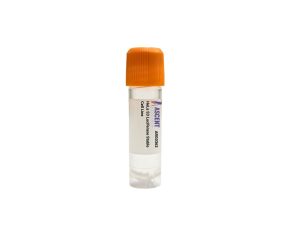
In Stock Cell Lines
Homo sapiens (Human)
Connective tissue
Adherent
The CD9 Knockout HT-1080 Cell Line is a CRISPR/Cas9-edited knockout model derived from the human fibrosarcoma cell line HT-1080. This loss-of-function system disrupts expression of the tetraspanin CD9, a regulator of integrin-mediated cell adhesion and signaling. CD9 interacts with ITGB1 and CD81 to modulate FAK/PI3K/AKT pathway activation, and its loss is associated with enhanced tumor cell motility. Suitable for wound healing, transwell migration, and co-immunoprecipitation assays, this model enables detailed study of CD9's metastasis suppressor role in mesenchymal tumors and supports drug discovery targeting tetraspanin networks.
 NAT8L Knockout UMUC-3 Polyclonal Cells
Cat. No. ARG11190
GATA3 Knockout NCI-H1299 Polyclonal Cells
Cat. No. ARG18089
N4BP1 Knockout jurkat Polyclonal Cells
Cat. No. ARG13603
DNAJB9 Knockout NCI-H1975 Polyclonal Cells
Cat. No. ARG39157
NAT8L Knockout UMUC-3 Polyclonal Cells
Cat. No. ARG11190
GATA3 Knockout NCI-H1299 Polyclonal Cells
Cat. No. ARG18089
N4BP1 Knockout jurkat Polyclonal Cells
Cat. No. ARG13603
DNAJB9 Knockout NCI-H1975 Polyclonal Cells
Cat. No. ARG39157
 Rat Coronary Artery Smooth Muscle Cells
Cat. No. ARP0196
Rat Coronary Artery Smooth Muscle Cells
Cat. No. ARP0196
 GPX8 Knockout Hep-G2 Cell Line
Cat. No. ARG0386
GPX8 Knockout Hep-G2 Cell Line
Cat. No. ARG0386
The CD9 Knockout HT-1080 Cell Line is a CRISPR/Cas9-edited knockout cell line generated from the human fibrosarcoma cell line HT-1080. This product provides a loss-of-function model for studying the tetraspanin CD9 in a mesenchymal tumor context. The cell line has undergone CRISPR/Cas9-mediated gene disruption at the CD9 locus, leading to abrogation of CD9 protein expression and enabling functional dissection of CD9-dependent cellular processes.
The HT-1080 cell line is derived from a human fibrosarcoma and harbors an activated N-ras oncogene. These cells display fibroblastic morphology and are widely employed as a model for mesenchymal tumors, particularly in investigations of cell adhesion, migration, invasion, and tumorigenesis. HT-1080 cells are known to express a range of integrins and extracellular matrix components, making them suitable for studying tetraspanin-mediated regulation of cell?Cmatrix interactions.
CD9 is a member of the tetraspanin superfamily that organizes specialized membrane microdomains, often referred to as the tetraspanin web, to modulate integrin-dependent cell adhesion and migration. CD9 interacts with integrins such as ITGB1 and ITGA6, as well as other tetraspanins including CD81 and CD63, to regulate integrin clustering and downstream signaling. Mechanistically, CD9 is activated by growth factors like EGF and TGFB1, and it controls focal adhesion kinase (FAK/PTK2) phosphorylation, which in turn influences PI3K/AKT and MAPK/ERK pathways. Through these interactions, CD9 functions as a metastasis suppressor in several solid tumors by restraining cell motility and invasion.
In the context of HT-1080 cells, CD9 is thought to act as a brake on tumor cell motility and invasion. The loss of CD9 in this cell line is anticipated to disrupt tetraspanin web organization, leading to altered integrin clustering and hyperactivation of FAK/PI3K/AKT and MAPK/ERK signaling axes. Consequently, the CD9 Knockout HT-1080 Cell Line serves as a valuable model for investigating the molecular mechanisms underlying increased migratory and invasive phenotypes, and for evaluating therapeutic strategies aimed at restoring metastasis suppressor function or targeting downstream effectors.
This knockout cell line is ideally suited for a broad spectrum of experimental applications, including wound healing assays, transwell migration and invasion assays, and cell adhesion assays to quantify CD9-dependent changes in cell motility and substrate attachment. Additionally, researchers can employ co-immunoprecipitation to study CD9?Cintegrin interactions, phospho-FAK and phospho-ERK analysis to profile signaling alterations, and gelatin zymography to assess matrix metalloproteinase activity. The model supports drug discovery programs targeting the tetraspanin web and investigations into the role of CD9 in mesenchymal tumor biology. For further information, please contact Ascent Research.