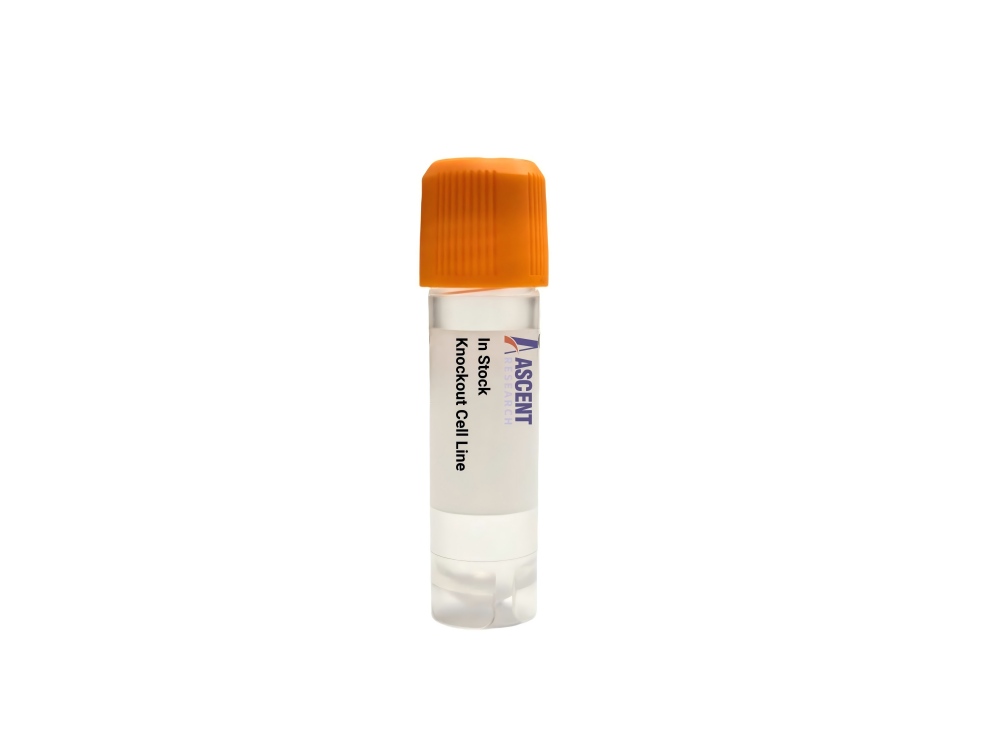
In Stock Cell Lines
Homo sapiens (Human)
Lung
Adherent
The FTO Knockout A549 Cell Line is a CRISPR/Cas9-edited loss-of-function model in A549 lung adenocarcinoma cells. FTO encodes an mRNA m6A demethylase that controls transcript stability and translation, impacting metabolic and oncogenic pathways through targets like MYC and PPARG. Knockout of FTO disrupts m6A modification, enabling studies of epitranscriptomic regulation in NSCLC. Researchers can employ MeRIP-seq, western blotting, and functional assays such as proliferation, migration, and drug sensitivity testing to explore FTO biology and screen inhibitors.
 NRP1 Knockout DLD-1 Polyclonal Cells
Cat. No. ARG12117
ADAMTS4 Knockout HAP1 Polyclonal Cells
Cat. No. ARG21646
BAD Knockout 143B Polyclonal Cells
Cat. No. ARG35012
LAMB2 Knockout Raji Polyclonal Cells
Cat. No. ARG1093
NRP1 Knockout DLD-1 Polyclonal Cells
Cat. No. ARG12117
ADAMTS4 Knockout HAP1 Polyclonal Cells
Cat. No. ARG21646
BAD Knockout 143B Polyclonal Cells
Cat. No. ARG35012
LAMB2 Knockout Raji Polyclonal Cells
Cat. No. ARG1093
 Mouse Abdominal Aortic Smooth Muscle Cell Medium
Cat. No. ARM0443
Mouse Abdominal Aortic Smooth Muscle Cell Medium
Cat. No. ARM0443
 MFC
Cat. No. ARC0511
MFC
Cat. No. ARC0511
The FTO Knockout A549 Cell Line is a CRISPR/Cas9-edited knockout cell line derived from A549 human lung adenocarcinoma alveolar basal epithelial cells. This product provides a loss-of-function model in which the FTO gene has been disrupted using CRISPR/Cas9-mediated gene disruption, enabling functional studies of the RNA N6-methyladenosine (m6A) demethylase FTO in a non-small cell lung cancer (NSCLC) context.
The parental A549 cell line harbors a KRAS G12S mutation and wild-type TP53, reflecting a common genetic profile in NSCLC. These cells, originally isolated from a 58-year-old Caucasian male, serve as a model for alveolar type II epithelium and are widely employed in cancer biology and drug response studies.
FTO catalyzes oxidative demethylation of m6A in mRNA, governing transcript stability and translation. It interacts with the m6A writer complex (METTL3/METTL14) and reader proteins YTHDF2 and YTHDC1; FTO dimerization and interaction with ALKBH5 further modulate m6A eraser activity. FTO activity is regulated by upstream signals including C/EBP??, ATF4, and nutrient deprivation, and influences expression of targets such as ASB2, RARA, MYC, PPARG, and UCP1, thereby linking m6A dynamics to oncogenic and metabolic pathways including mTOR and AMPK signaling.
In A549 cells, FTO knockout disrupts m6A modification profiles on transcripts relevant to lung adenocarcinoma progression. Given the KRAS mutation, this perturbation likely alters signaling through AMPK and mTOR, affecting processes such as proliferation, migration, and chemosensitivity. Furthermore, the interplay between FTO and metabolic stress regulators such as AMPK and ULK1 may influence energy homeostasis in these cells. This model thus provides a platform for dissecting how epitranscriptomic control via FTO contributes to NSCLC malignancy and metabolic adaptation.
Applications include m6A epitranscriptomic profiling by MeRIP-seq or RNA dot blot, validation of target expression by RT-qPCR and western blotting, and functional analyses using MTT/CCK-8 proliferation, Transwell migration/invasion, and flow cytometry apoptosis assays. The cell line is also suited for FTO inhibitor screening and drug sensitivity assessment (IC50). For further details, please contact Ascent Research.