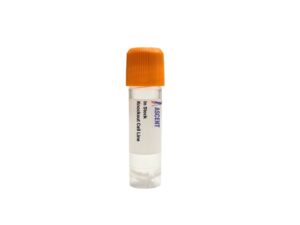
In Stock Cell Lines
Homo sapiens (Human)
Liver
Adherent
The HNRNPA2B1 Knockout Hep-G2 Cell Line is a CRISPR/Cas9-edited human hepatocellular carcinoma model with targeted disruption of the HNRNPA2B1 gene. HNRNPA2B1 is an RNA-binding protein that acts as an m6A reader and regulates alternative splicing, mRNA metabolism, and translation, influencing proliferation and apoptosis. This cell line is derived from Hep-G2 hepatocyte cells and is regulated by MYC and TP53, interacting with METTL3/METTL14 and controlling downstream targets such as BCL-X and PKM. It is ideal for RNA biology, m6A modification studies, hepatocellular carcinoma research, and drug screening applications.
 GDF15 Knockout NCI-H1703 Polyclonal Cells
Cat. No. ARG12610
APOL1 Knockout HAP1 Polyclonal Cells
Cat. No. ARG34630
ECHDC1 Knockout MES-OV Polyclonal Cells
Cat. No. ARG40345
DNAJC25 Knockout HGC-27 Polyclonal Cells
Cat. No. ARG39278
FUBP3 Knockout AGS Polyclonal Cells
Cat. No. ARG2959
GDF15 Knockout NCI-H1703 Polyclonal Cells
Cat. No. ARG12610
APOL1 Knockout HAP1 Polyclonal Cells
Cat. No. ARG34630
ECHDC1 Knockout MES-OV Polyclonal Cells
Cat. No. ARG40345
DNAJC25 Knockout HGC-27 Polyclonal Cells
Cat. No. ARG39278
FUBP3 Knockout AGS Polyclonal Cells
Cat. No. ARG2959
 2fTGH-U3A
Cat. No. ARC0006
2fTGH-U3A
Cat. No. ARC0006
The HNRNPA2B1 Knockout Hep-G2 Cell Line is a CRISPR/Cas9-edited knockout cell line derived from the Hep-G2 human hepatocellular carcinoma line. This product features targeted disruption of the HNRNPA2B1 gene, generating a stable loss-of-function model for investigating RNA-binding protein biology. The cell line is provided as a validated research tool with optimized growth properties, ensuring consistent performance in downstream assays.
Hep-G2 cells originate from a hepatocellular carcinoma of a 15-year-old Caucasian male and serve as a widely used hepatocyte model for liver biology and liver cancer research. They retain differentiated hepatic functions and are amenable to genome editing, making them an established platform for studying signaling pathways, drug metabolism, and gene regulation.
HNRNPA2B1 is an RNA-binding protein that functions as an m6A reader, recognizing N6-methyladenosine marks on transcripts through interaction with the METTL3/METTL14 methyltransferase complex. It regulates alternative splicing, mRNA stability, and translational control and is transcriptionally activated by MYC, with additional modulation by TP53 and NF-??B signals. HNRNPA2B1 forms complexes with splicing factors U2AF2 and SF3B1 and with other hnRNP proteins, including hnRNP A1 and hnRNP A3, to influence splice site selection. Key downstream targets include the anti-apoptotic factor BCL-X, the metabolic enzyme PKM, and the cytokine IL-6, coupling HNRNPA2B1 to proliferation, apoptosis, and inflammation.
In hepatocellular carcinoma, dysregulation of HNRNPA2B1 contributes to aberrant alternative splicing and m6A modification patterns that promote oncogenic signaling and therapy resistance. The Hep-G2 knockout model enables dissection of HNRNPA2B1??s role in liver cancer cell proliferation, apoptosis evasion, and metabolic reprogramming. Specifically, loss of HNRNPA2B1 can be used to examine its contribution to NF-??B pathway activation, MYC-driven transcriptional networks, and DNA damage responses. This targeted disruption provides a clean genetic background to identify RNA-binding protein-dependent vulnerabilities in liver cancer.
Typical research applications include hepatocellular carcinoma mechanistic studies, RNA biology investigations, and m6A modification analysis using m6A-seq and CLIP-seq. The cell line is well-suited for high-throughput drug screening for inhibitors of HNRNPA2B1 or its interacting partners. Downstream assays such as Western blotting, RT-qPCR, RNA-seq, cell proliferation, and apoptosis assays are routinely used to characterize the knockout phenotype. By delivering a reproducible loss-of-function system, this line supports diverse experiments on RNA metabolism and signal transduction. For further details, please contact Ascent Research.