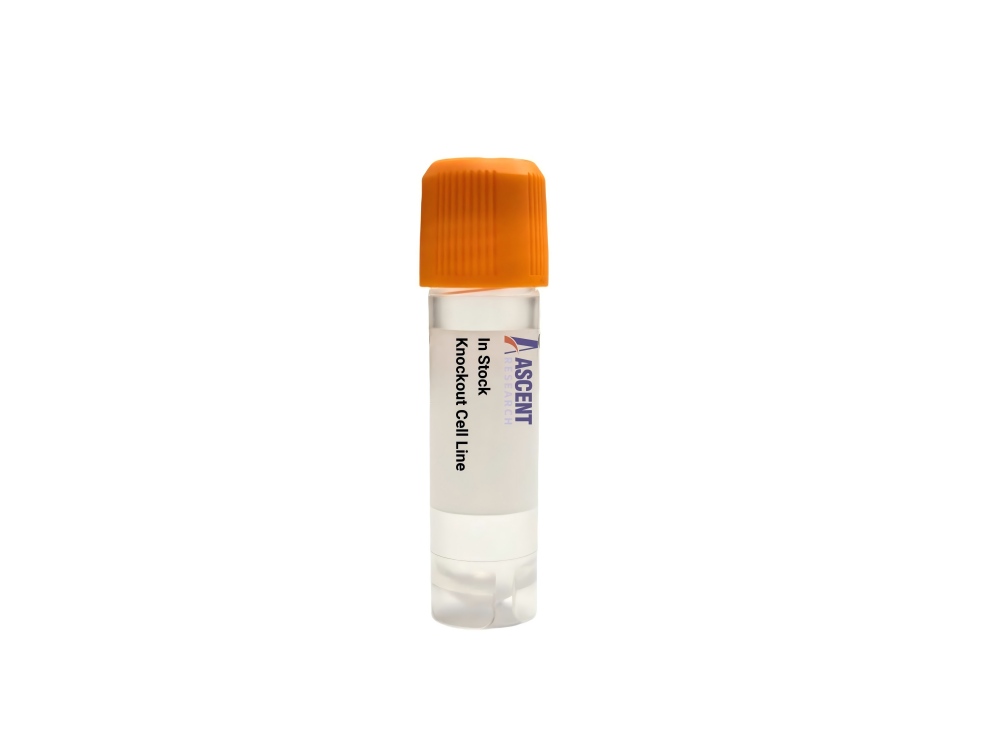
In Stock Cell Lines
Homo sapiens (Human)
Lung
Adherent
The KIF2C Knockout NCI-H1975 Cell Line offers a CRISPR/Cas9-edited loss-of-function model of the MCAK-encoding KIF2C gene in EGFR-mutant (L858R/T790M) lung adenocarcinoma cells. This model enables studies of mitotic spindle regulation and chromosome segregation in non-small cell lung cancer. Regulated by kinases such as AURKA and PLK1, MCAK??s microtubule depolymerization function is essential for spindle checkpoint fidelity. Applications include mitosis research, drug sensitivity assays, and functional genomics, providing a valuable tool for cancer biology and therapy studies.
 ALDH1A2 Knockout Hela Polyclonal Cells
Cat. No. ARG20750
GUSB Knockout HAP1 Polyclonal Cells
Cat. No. ARG22436
BCORL1 Knockout HEK293T Polyclonal Cells
Cat. No. ARG25832
HACL1 Knockout HAP1 Polyclonal Cells
Cat. No. ARG36994
DYNC2H1 Knockout AGS Polyclonal Cells
Cat. No. ARG40147
ALDH1A2 Knockout Hela Polyclonal Cells
Cat. No. ARG20750
GUSB Knockout HAP1 Polyclonal Cells
Cat. No. ARG22436
BCORL1 Knockout HEK293T Polyclonal Cells
Cat. No. ARG25832
HACL1 Knockout HAP1 Polyclonal Cells
Cat. No. ARG36994
DYNC2H1 Knockout AGS Polyclonal Cells
Cat. No. ARG40147
 Hs 865.Sk Luciferase Stable Cell Line
Cat. No. ARG0428
Hs 865.Sk Luciferase Stable Cell Line
Cat. No. ARG0428
The KIF2C Knockout NCI-H1975 Cell Line is a CRISPR/Cas9-edited knockout cell line derived from the NCI-H1975 human lung adenocarcinoma cell line. This product provides a targeted loss-of-function model of the KIF2C gene, which encodes the mitotic centromere-associated kinesin (MCAK). CRISPR/Cas9-mediated gene disruption allows researchers to investigate the roles of KIF2C in mitotic spindle regulation and chromosome segregation within a well-characterized non-small cell lung cancer (NSCLC) background.
The parental NCI-H1975 cell line is a widely utilized model of lung adenocarcinoma, harboring activating EGFR mutations (L858R and T790M) that drive oncogenic signaling and confer resistance to first-generation EGFR tyrosine kinase inhibitors. Originating from a female patient, these epithelial cells maintain features of NSCLC and are extensively employed in preclinical studies of targeted therapy resistance and tumor progression.
KIF2C encodes MCAK, a kinesin-13 family microtubule depolymerase that catalyzes microtubule disassembly during mitosis. MCAK localizes to centromeres, kinetochores, and spindle poles, where it is regulated by upstream kinases including AURKA, AURKB, and PLK1, as well as the transcription factor FOXM1. Phosphorylation by AURKA and PLK1 modulates its catalytic activity, while FOXM1 transcriptionally upregulates KIF2C expression. At kinetochores, MCAK interacts with CENPE, EB1 (encoded by MAPRE1), and TIP150 to correct erroneous kinetochore-microtubule attachments and ensure spindle assembly checkpoint fidelity. Its depolymerase function directly governs microtubule dynamics, chromosome congression, and mitotic progression.
In the NCI-H1975 lung adenocarcinoma background, disruption of KIF2C is particularly relevant given the high mitotic index and chromosomal instability characteristic of NSCLC. The EGFR T790M mutation confers a dependency on spindle checkpoint integrity, and loss of MCAK function is expected to induce severe mitotic errors, including lagging chromosomes and aneuploidy. This knockout cell line thus provides a platform to dissect the interplay between oncogenic EGFR signaling and mitotic regulation, and to evaluate the susceptibility of mutant EGFR-driven tumors to spindle poisons or mitotic kinase inhibitors.
This knockout cell line is ideally suited for investigating the mechanistic roles of MCAK in mitotic spindle assembly, chromosome segregation, and the cellular response to microtubule-targeting chemotherapies. It can be employed in immunoblotting and immunofluorescence assays to validate KIF2C depletion and assess spindle morphology, as well as in flow cytometry to examine cell cycle perturbations and aneuploidy induction. Functional studies including proliferation, drug sensitivity, and colony formation assays enable the exploration of KIF2C as a potential target in overcoming T790M-mediated resistance. For additional information or to discuss custom applications, please contact Ascent Research.