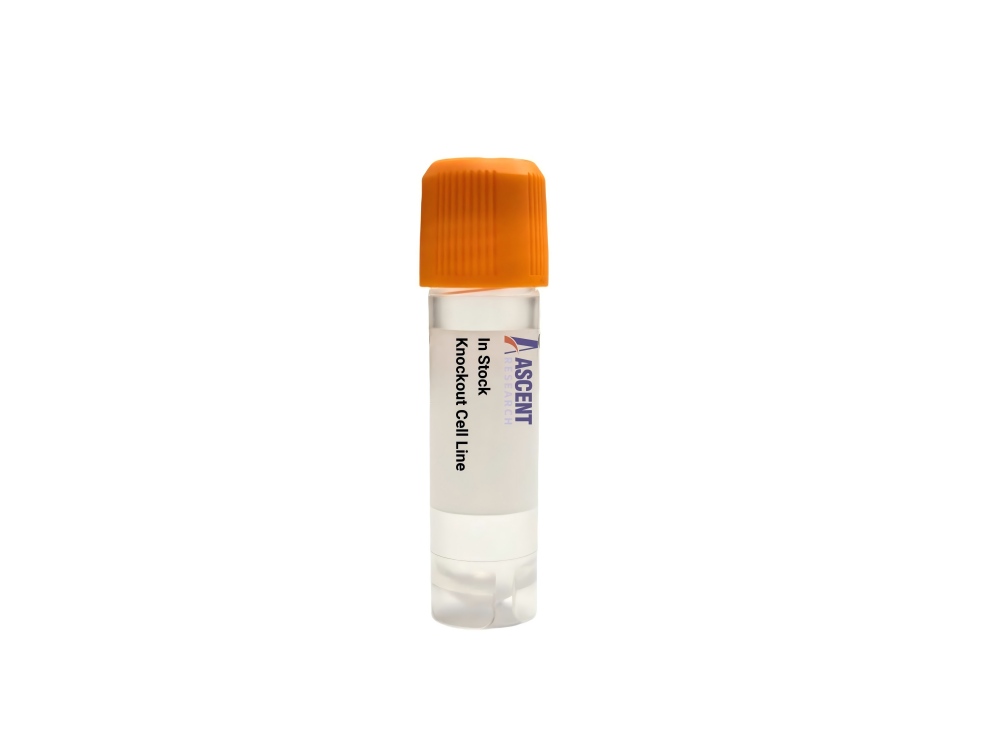
In Stock Cell Lines
Homo sapiens (Human)
Kidney
Adherent
The PBDC1 Knockout HEK293T Cell Line is a CRISPR/Cas9-edited knockout model that disrupts PBDC1 gene function in immortalized human embryonic kidney epithelial cells. PBDC1 encodes a pleckstrin homology domain-containing protein thought to act as a membrane-associated adaptor in phosphoinositide signaling. By disrupting PBDC1 expression, this cell line enables investigation of PI3K/PIP3-dependent AKT activation and membrane trafficking. It is designed for functional signaling studies, interaction proteomics, and cancer research applications, with assays such as phospho-AKT ELISA and co-immunoprecipitation.
 NOL3 Knockout Hela Polyclonal Cells
Cat. No. ARG8449
IRAK4 Knockout HT29 Polyclonal Cells
Cat. No. ARG33469
CBLL1 Knockout NCI-H1299 Polyclonal Cells
Cat. No. ARG42679
C8orf82 Knockout MES-OV Polyclonal Cells
Cat. No. ARG41580
LGALS3BP Knockout AGS Polyclonal Cells
Cat. No. ARG2945
NOL3 Knockout Hela Polyclonal Cells
Cat. No. ARG8449
IRAK4 Knockout HT29 Polyclonal Cells
Cat. No. ARG33469
CBLL1 Knockout NCI-H1299 Polyclonal Cells
Cat. No. ARG42679
C8orf82 Knockout MES-OV Polyclonal Cells
Cat. No. ARG41580
LGALS3BP Knockout AGS Polyclonal Cells
Cat. No. ARG2945
 Immortalized Human Pancreatic Stellate Cell
Cat. No. ARI0153
Immortalized Human Pancreatic Stellate Cell
Cat. No. ARI0153
The PBDC1 Knockout HEK293T Cell Line is a CRISPR/Cas9-edited knockout cell line providing a loss-of-function model for the PBDC1 gene in human cells. This ready-to-use cell line enables targeted disruption of PBDC1, a gene that encodes a pleckstrin homology (PH) domain-containing protein, to facilitate detailed functional studies without the need for transient silencing approaches. The absence of PBDC1 protein expression allows researchers to examine its role in phosphoinositide signaling and membrane-associated processes within a physiologically relevant cellular context.
HEK293T cells serve as an optimal host background for this knockout model. Derived from human embryonic kidney epithelium, HEK293T is an immortalized cell line that stably expresses the SV40 large T antigen, which promotes episomal replication of transfected plasmids and yields high-level protein expression. These cells are highly transfectable and widely employed in signal transduction research, protein interaction studies, and functional genomics. Their robust growth, ease of genetic manipulation, and well-characterized signaling networks make them particularly suited for generating knockout models to dissect membrane-dependent signaling pathways.
PBDC1 is predicted to function as a membrane-targeted adaptor protein through its PH domain, which binds phosphoinositides such as phosphatidylinositol (3,4,5)-trisphosphate (PIP3). This interaction likely localizes PBDC1 to the plasma membrane upon activation of receptor tyrosine kinases and PI3K. In the canonical PI3K/AKT pathway, the phosphatase PTEN antagonizes PIP3 generation, and AKT is a central effector controlling cell proliferation and survival. PBDC1 is hypothesized to influence AKT phosphorylation or cytoskeletal regulation downstream of PIP3, and its disruption may therefore impair signal transmission or alter the composition of signaling complexes at the membrane.
The HEK293T context is ideal for probing PBDC1 function because these cells retain functional RTK/PI3K/AKT signaling cascades and are amenable to high-resolution imaging and biochemical fractionation. Knockout of PBDC1 in this background allows unambiguous assessment of its contribution to phosphoinositide-dependent signaling events, uncontaminated by endogenous wild-type protein. Expression of exogenous PBDC1 variants in this knockout line permits structure?Cfunction analyses of the PH domain and investigation of membrane recruitment dynamics, while the efficient transfection capability supports rescue experiments to validate observed phenotypes.
This knockout cell line is suitable for a wide range of applications, including functional signaling studies via phospho-AKT ELISA and Western blotting, subcellular localization analysis by immunofluorescence, and interaction proteomics through co-immunoprecipitation. Researchers can also perform cell proliferation and apoptosis assays to explore potential roles of PBDC1 in cancer cell signaling dysregulation. The model is compatible with transient and stable transfection strategies, enabling both overexpression and rescue experiments. For additional details or technical inquiries, please contact Ascent Research.