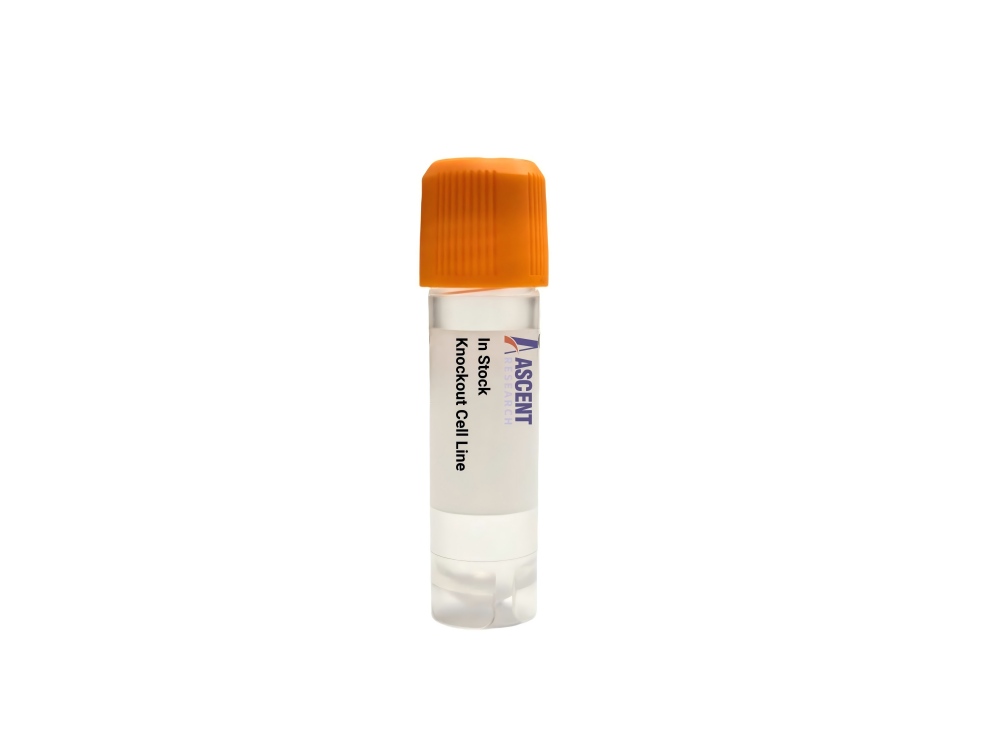
In Stock Cell Lines
Homo sapiens (Human)
Blood (peripheral blood)
Suspension
CRISPR/Cas9-edited knockout cell line targeting the VSIR gene (VISTA) in the Jurkat E6.1 human T lymphoblast background. This loss-of-function model abrogates expression of the V-domain Ig suppressor of T cell activation, a negative immune checkpoint receptor that inhibits T cell proliferation and cytokine production by recruiting SHP-1/SHP-2 phosphatases to dephosphorylate ZAP70 and LAT downstream of TCR engagement. Ideal for dissecting VISTA-dependent signaling networks, screening checkpoint-blocking antibodies, and validating targets in cancer immunotherapy and autoimmune disease research. Facilitates flow cytometric analysis of T cell activation markers, IL-2 and IFN-?? secretion assays, and phospho-signaling studies under controlled anti-CD3/CD28 stimulation.
 AMFR Knockout jurkat Polyclonal Cells
Cat. No. ARG33813
CAMK1 Knockout NCI-H1299 Polyclonal Cells
Cat. No. ARG41926
CCAR2 Knockout NCI-H1975 Polyclonal Cells
Cat. No. ARG42865
NUAK1 Knockout KYSE30 Polyclonal Cells
Cat. No. ARG9735
MBD1 Knockout 786-O Polyclonal Cells
Cat. No. ARG5155
GMPR2 Knockout AGS Polyclonal Cells
Cat. No. ARG3032
AMFR Knockout jurkat Polyclonal Cells
Cat. No. ARG33813
CAMK1 Knockout NCI-H1299 Polyclonal Cells
Cat. No. ARG41926
CCAR2 Knockout NCI-H1975 Polyclonal Cells
Cat. No. ARG42865
NUAK1 Knockout KYSE30 Polyclonal Cells
Cat. No. ARG9735
MBD1 Knockout 786-O Polyclonal Cells
Cat. No. ARG5155
GMPR2 Knockout AGS Polyclonal Cells
Cat. No. ARG3032
The VSIR Knockout Jurkat E6.1 Cell Line is a CRISPR/Cas9-edited knockout cell line engineered to disrupt the VSIR gene (V-domain Ig suppressor of T cell activation) via targeted gene disruption in the Jurkat E6.1 human T lymphoblast host. This loss-of-function model enables precise dissection of VISTA-mediated immune checkpoint regulation without background expression. The knockout cell line is provided as a living, proliferative culture and serves as a defined experimental tool for examining the molecular and cellular consequences of VSIR ablation in a T cell context.
The host Jurkat E6.1 cell line, derived from an acute T cell leukemia patient, is an immortalized CD4+ T lymphoblast cell line widely used to model T cell receptor (TCR) signaling, cytokine production, and activation dynamics. These cells recapitulate key aspects of T cell biology including CD3/CD28-dependent signal transduction, NFAT and NF-??B activation, and IL-2 secretion, making them an ideal platform for immune checkpoint studies. The Jurkat E6.1 background has been extensively characterized in the literature for its responsiveness to pharmacological inhibitors and monoclonal antibodies targeting co-inhibitory receptors.
VSIR encodes VISTA, a type I transmembrane protein of the B7 family that acts as a negative regulator of T cell function. Mechanistically, VISTA engagement by its ligand VSIG-3 or homophilic interactions recruits the tyrosine phosphatases SHP-1 and SHP-2, which dephosphorylate proximal TCR signaling components including ZAP70 and LAT. This phosphatase activity attenuates downstream cascades involving ERK1/2, NF-??B, and NFAT, ultimately suppressing IL-2 and IFN-?? production and limiting T cell proliferation. Upstream regulators of VSIR expression include TCR stimulation, cytokine signals such as IL-2 and IFN-??, hypoxia via HIF-1??, and the p53 tumor suppressor, embedding VISTA within a network connecting immune activation, metabolic stress, and apoptotic pathways.
In the Jurkat E6.1 model, elimination of VSIR relieves this inhibitory constraint, permitting enhanced TCR-proximal phosphorylation events and amplified downstream transcriptional responses. This knockout cell line is thus particularly valuable for dissecting VISTA-dependent control of T cell activation thresholds and for identifying signaling nodes modulated by SHP-1/2 recruitment. Researchers can compare anti-CD3/CD28-stimulated knockout and wild-type cells to quantify changes in ZAP70 and LAT phosphorylation status, ERK activation kinetics, and NFAT-driven reporter expression. The model also facilitates co-immunoprecipitation studies to examine altered SHP-1/2 association with the TCR signalosome in the absence of VISTA.
Typical applications include mechanistic investigations of VISTA-mediated immune checkpoint signaling in T cells, screening and functional evaluation of VISTA-blocking antibodies or small-molecule inhibitors, target validation in cancer immunotherapy programs, and studies of autoimmune disease pathology where VISTA dysregulation is implicated. Key experimental readouts encompass flow cytometric profiling of T cell activation markers (CD69, CD25), ELISA-based quantification of IL-2 and IFN-?? secretion, CFSE proliferation assays, and Western blot analysis of phospho-ZAP70 and phospho-ERK levels. For further details or customized experimental support, please contact Ascent Research.