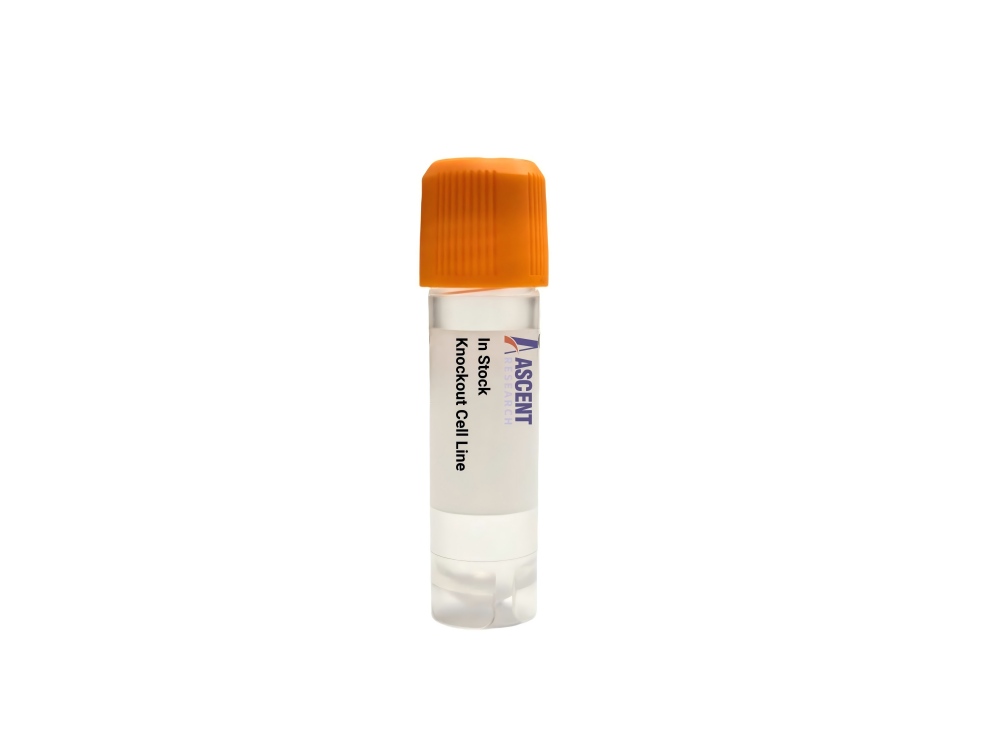
In Stock Cell Lines
Homo sapiens (Human)
Stomach
Adherent
The DOP1A Knockout AGS Cell Line is a CRISPR/Cas9-edited human knockout cell line that abolishes DOP1A expression in AGS gastric adenocarcinoma cells. DOP1A is a scaffold subunit of the Mon1-Ccz1 guanine nucleotide exchange factor complex that activates RAB7A, a master regulator of late endosome maturation and autophagy. Disruption of DOP1A prevents RAB7A activation, impairing autophagosome-lysosome fusion and lysosomal function. This model enables the study of autophagy-dependent drug resistance, mTORC1 signaling, and metabolic adaptations in a KRAS G12D-mutant background, using assays such as LC3B/p62 immunoblotting, autophagy flux analysis, and drug sensitivity profiling.
 ENTPD5 Knockout K562 Polyclonal Cells
Cat. No. ARG19248
ANAPC7 Knockout A549 Polyclonal Cells
Cat. No. ARG31480
ITPR1 Knockout HAP1 Polyclonal Cells
Cat. No. ARG27641
DNAL1 Knockout A549 Polyclonal Cells
Cat. No. ARG39351
ENTPD5 Knockout K562 Polyclonal Cells
Cat. No. ARG19248
ANAPC7 Knockout A549 Polyclonal Cells
Cat. No. ARG31480
ITPR1 Knockout HAP1 Polyclonal Cells
Cat. No. ARG27641
DNAL1 Knockout A549 Polyclonal Cells
Cat. No. ARG39351
 Rabbit Ependymal Cell Medium
Cat. No. ARM0868
Rabbit Ependymal Cell Medium
Cat. No. ARM0868
 Human Splenic Endothelial Cells
Cat. No. ARP0163
Human Splenic Endothelial Cells
Cat. No. ARP0163
The DOP1A Knockout AGS Cell Line is a CRISPR/Cas9-edited human knockout cell line targeting the DOP1A gene within the AGS gastric adenocarcinoma cellular background. This loss-of-function model is designed to investigate DOP1A-dependent regulation of late endosome maturation and autophagy in a disease-relevant context. The cell line is supplied as an adherent culture, ready for integration into standard cell-based functional assays.
The AGS cell line originates from a human gastric adenocarcinoma and harbors an oncogenic KRAS G12D mutation, exhibiting adherent epithelial morphology. This mutation constitutively activates proliferation and survival signaling, making AGS a widely accepted model for studying tumor cell biology, including the roles of endosomal trafficking and autophagy in cancer cell stress adaptation.
DOP1A functions as a scaffold subunit of the Mon1-Ccz1 guanine nucleotide exchange factor complex, which serves as the primary activator of the small GTPase RAB7A. RAB7A-GTP governs late endosome maturation, autophagosome-lysosome fusion, and recruitment of downstream effectors such as RILP and FYCO1 to coordinate lysosomal positioning. The activity of this complex is regulated by upstream nutrient-sensing cues including mTORC1 and amino acid availability. Disruption of DOP1A in AGS cells abolishes Mon1-Ccz1-dependent RAB7A activation, leading to accumulation of the autophagy substrate p62/SQSTM1 and impaired LC3B turnover, indicative of blocked autophagic flux, along with deficient lysosomal enzyme delivery.
Gastric adenocarcinoma cells, especially those driven by oncogenic KRAS, frequently rely on heightened autophagy and endosomal recycling to support proliferation under metabolic stress. By preventing DOP1A-mediated RAB7A activation, this knockout line uncouples these pro-survival pathways, offering a defined system to examine autophagy-dependent drug resistance mechanisms and metabolic reprogramming. It further enables investigation of synthetic lethal relationships between DOP1A loss and existing chemotherapeutic agents or targeted therapies.
Typical experimental applications include monitoring autophagy via western blotting for LC3B-II and p62, immunofluorescence detection of LC3 puncta, and autophagy flux assays using chloroquine treatment. Endosomal trafficking can be evaluated by RAB7A and LAMP1 colocalization, and mTORC1 pathway activity via phospho-S6K immunoblotting. The cell line is also suitable for drug sensitivity screening against gastric cancer standard-of-care agents (cisplatin, 5-fluorouracil) and RAS-pathway inhibitors, as well as RT-qPCR profiling of autophagy and lysosomal gene expression. For further assistance, contact Ascent Research.