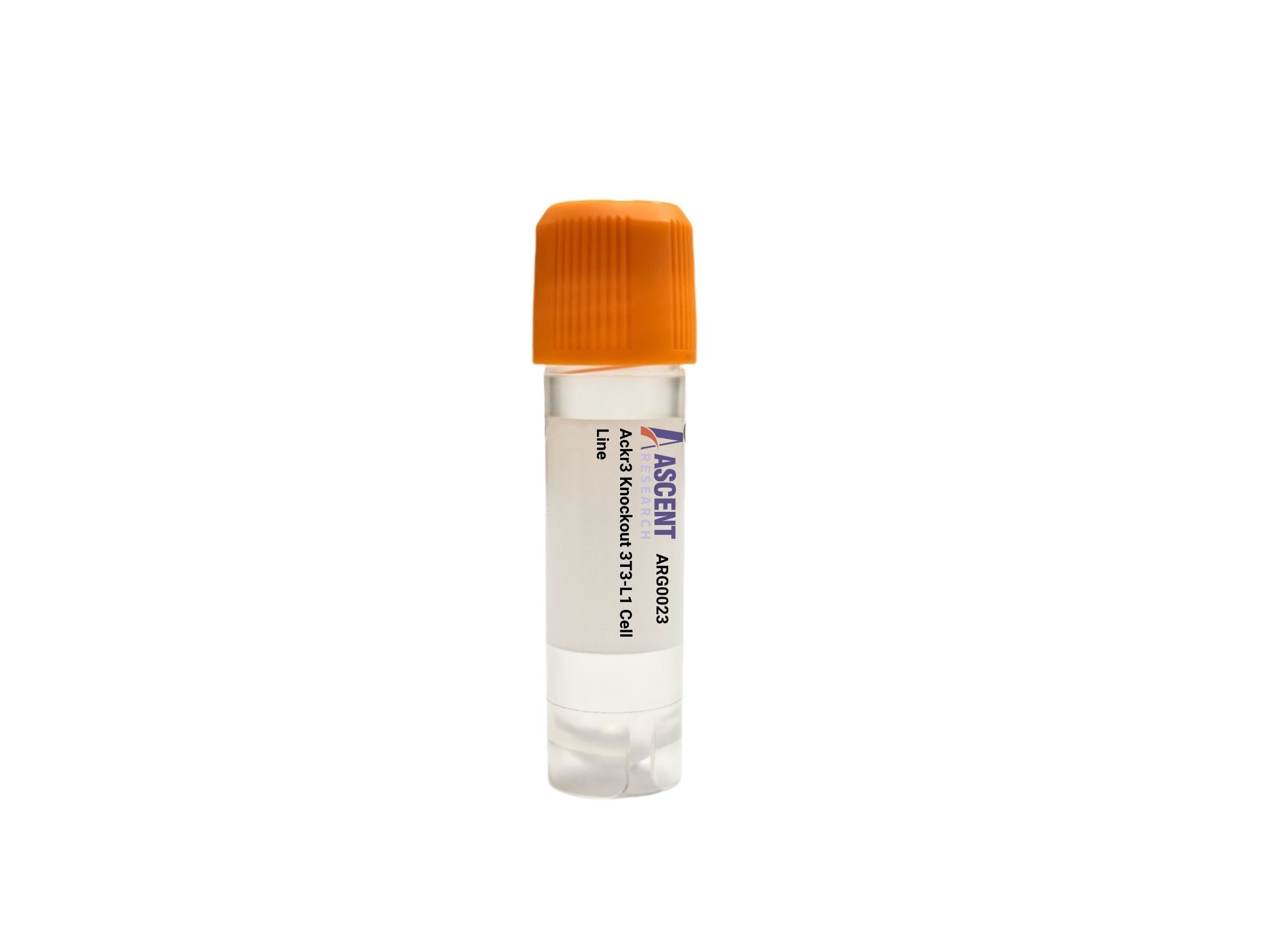
Genome-edited Cells
Embryo
Ackr3 Knockout 3T3-L1 is a CRISPR/Cas9-edited mouse preadipocyte cell line with disruption of Ackr3, encoding the atypical chemokine receptor ACKR3/CXCR7. In 3T3-L1 cells, this model supports analysis of adipocyte-lineage biology together with chemokine scavenging and beta-arrestin-biased signaling. ACKR3 interacts with CXCL12, CXCL11, CXCR4, and beta-arrestin 2 to regulate receptor internalization, chemokine uptake, and ERK1/2- or AKT-associated responses. The cell line is useful for studies of adipogenesis, migration, GPCR trafficking, CXCL12-CXCR4-ACKR3 pathway modulation, metabolic inflammation, and related assays including phospho-signaling, uptake, differentiation, and transcriptomic profiling.
 FGGY Knockout NCI-H1975 Polyclonal Cells
Cat. No. ARG16514
FBXL20 Knockout SK-HEP-1 Polyclonal Cells
Cat. No. ARG16003
FGGY Knockout NCI-H1975 Polyclonal Cells
Cat. No. ARG16514
FBXL20 Knockout SK-HEP-1 Polyclonal Cells
Cat. No. ARG16003
 HTR2B Knockout HL-60 Cell Line
Cat. No. ARG43914
CD300ld Knockout KYSE30 Polyclonal Cells
Cat. No. ARG43492
NHS Knockout MES-OV Polyclonal Cells
Cat. No. ARG5867
HTR2B Knockout HL-60 Cell Line
Cat. No. ARG43914
CD300ld Knockout KYSE30 Polyclonal Cells
Cat. No. ARG43492
NHS Knockout MES-OV Polyclonal Cells
Cat. No. ARG5867
 MDA-MB-435
Cat. No. ARC0500
MDA-MB-435
Cat. No. ARC0500
The Ackr3 Knockout 3T3-L1 Cell Line is a CRISPR/Cas9-engineered mouse cell model in which the Ackr3 gene has been disrupted to eliminate functional ACKR3 expression. This stable knockout line is generated in 3T3-L1 cells, a fibroblast-like murine preadipocyte line commonly used for mechanistic studies of adipocyte lineage biology. The model provides a defined in vitro system for examining the consequences of ACKR3 loss in a cellular background relevant to adipogenesis, lipid handling, adipokine-associated signaling, and inflammatory responses linked to metabolic regulation.
3T3-L1 cells are derived from mouse embryonic fibroblast-like precursors and are widely used because they undergo robust hormone-induced differentiation into adipocyte-like cells. This transition supports experimental analysis of adipocyte differentiation programs, insulin responsiveness, lipid accumulation, and transcriptional remodeling associated with metabolic homeostasis. As a result, 3T3-L1 has become a standard platform for investigating how signaling pathways influence preadipocyte commitment, mature adipocyte phenotypes, and inflammatory crosstalk in metabolically active cell states.
ACKR3, also known as CXCR7, is an atypical chemokine receptor for CXCL12 and CXCL11 that primarily functions through ligand scavenging and beta-arrestin-biased signaling rather than canonical heterotrimeric G protein activation. ACKR3 is regulated by chemokine ligands, inflammatory cytokines, hypoxia-related stimuli, and GPCR regulatory kinases, including GRK2 and GRK5. At the molecular level, it interacts with beta-arrestin 1, beta-arrestin 2, CXCR4, and clathrin-dependent endocytic machinery to mediate constitutive internalization, chemokine uptake, and receptor trafficking. Through these processes, ACKR3 acts upstream of altered CXCL12-CXCR4 signaling output and can promote ERK1/2 and AKT phosphorylation in a beta-arrestin-associated manner. This signaling network is relevant to chemokine gradient formation, cell migration, survival-associated responses, tissue repair, vascular biology, inflammatory disorders, and metastatic behavior.
In the 3T3-L1 background, Ackr3 knockout enables direct investigation of how chemokine scavenging and receptor-trafficking mechanisms shape adipocyte-lineage signaling. Loss of ACKR3 may be used to dissect the contribution of the CXCL12-CXCR4-ACKR3 axis to preadipocyte behavior, differentiation-associated signaling rewiring, and metabolic inflammation. Because 3T3-L1 cells model adipose lineage responses, this system is particularly useful for examining how chemokine availability influences insulin-related phenotypes, survival pathways, migratory behavior, and inflammatory sensitivity in a metabolically relevant context.
This knockout model is suited for RT-qPCR and RNA-seq analysis of chemokine-responsive transcriptional changes, western blotting or phospho-specific assays for ERK1/2 and AKT pathway responses, and immunofluorescence or flow cytometry to evaluate ACKR3-associated receptor localization and surface phenotypes. It is also applicable to chemokine uptake assays, receptor internalization studies, co-immunoprecipitation of beta-arrestin-linked complexes, and migration assays designed to resolve altered CXCR4-dependent responses to CXCL12. In adipocyte-lineage studies, researchers can combine adipogenic differentiation protocols with lipid accumulation assays to determine how Ackr3 disruption modifies differentiation efficiency, signaling dynamics, or inflammatory pathway engagement during adipogenesis. Researchers may contact Ascent Research for additional technical information, product details, or related gene-edited cell models.