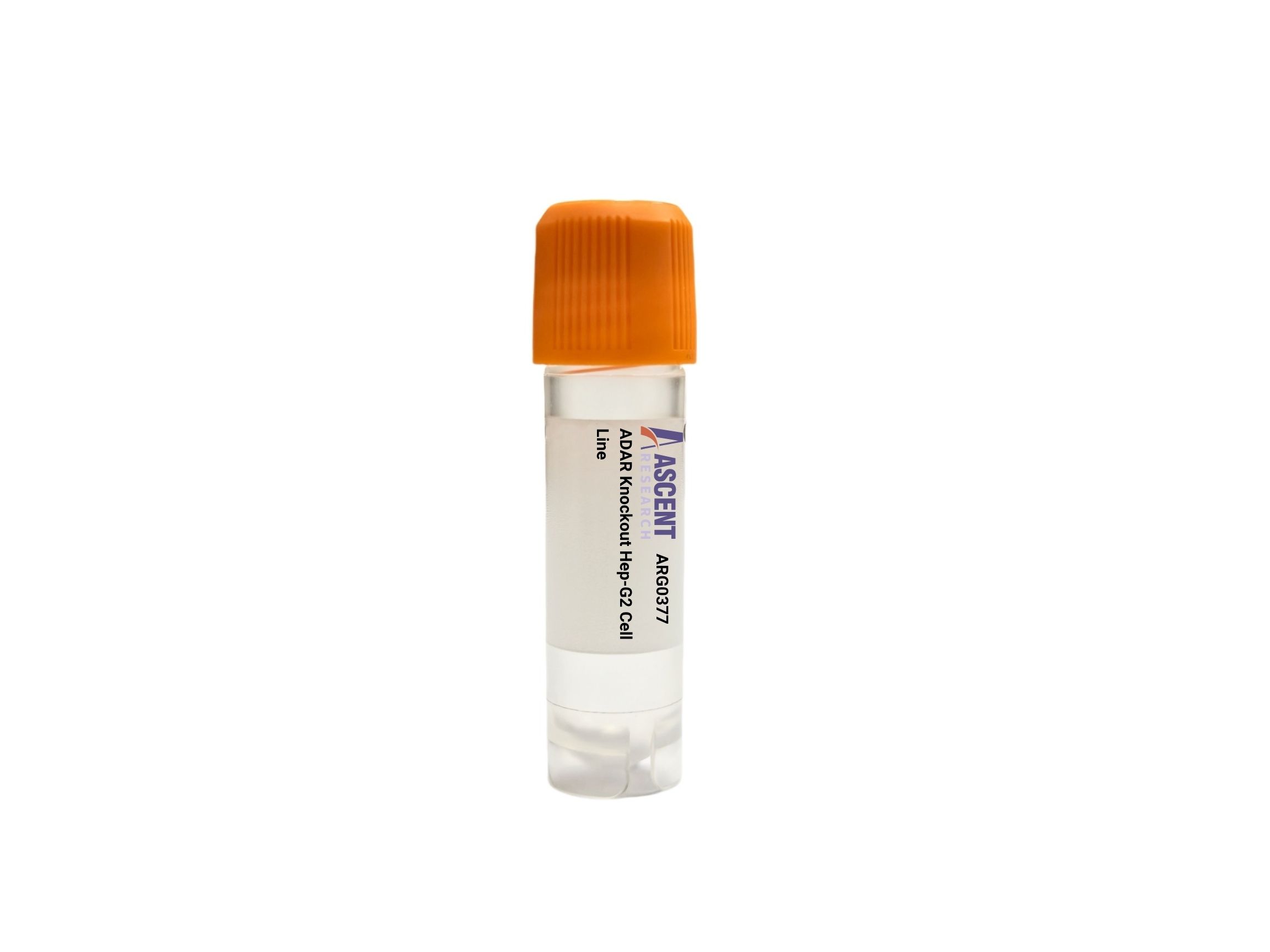
Genome-edited Cells
Liver
The ADAR Knockout Hep-G2 Cell Line provides a CRISPR/Cas9-edited loss-of-function model in human hepatocellular carcinoma cells for studying adenosine-to-inosine RNA editing. ADAR1 edits dsRNA to prevent aberrant innate immune activation by sensors such as MDA5 and PKR. Loss of ADAR1 unmasks immunostimulatory dsRNA, leading to JAK-STAT and NF-??B signaling. Applications include investigation of RNA editing in liver cancer, innate immune activation by endogenous dsRNA, and evaluation of ADAR1 as a therapeutic target. Key assays include RNA editing analysis, western blotting for ISGs, and STAT1 phosphorylation detection.
 LONP2 Knockout A2780 Polyclonal Cells
Cat. No. ARG19119
LONP2 Knockout A2780 Polyclonal Cells
Cat. No. ARG19119
 Cynomolgus Monkey Splenocytes
Cat. No. ARP1049
AKT2 Knockout A549 Polyclonal Cells
Cat. No. ARG23108
GOLGA3 Knockout NCI-H1299 Polyclonal Cells
Cat. No. ARG30635
GSKIP Knockout AGS Polyclonal Cells
Cat. No. ARG26892
C5orf22 Knockout AGS Polyclonal Cells
Cat. No. ARG26811
Cynomolgus Monkey Splenocytes
Cat. No. ARP1049
AKT2 Knockout A549 Polyclonal Cells
Cat. No. ARG23108
GOLGA3 Knockout NCI-H1299 Polyclonal Cells
Cat. No. ARG30635
GSKIP Knockout AGS Polyclonal Cells
Cat. No. ARG26892
C5orf22 Knockout AGS Polyclonal Cells
Cat. No. ARG26811
The ADAR Knockout Hep-G2 Cell Line is a CRISPR/Cas9-edited knockout cell line derived from the human hepatocellular carcinoma cell line Hep-G2. This product provides a loss-of-function model through targeted disruption of the ADAR gene, enabling investigation of adenosine-to-inosine RNA editing in a hepatic cellular context. The knockout cell line is suitable for functional assays and comparative studies with parental Hep-G2 cells.
Hep-G2 cells are an adherent epithelial cell line established from a human hepatocellular carcinoma, widely used for studies of liver function, drug metabolism, and hepatotoxicity. Their well-characterized hepatic properties, including expression of drug-metabolizing enzymes and relevant signaling pathways, provide a physiologically appropriate host for examining ADAR1??s role in liver cancer biology.
ADAR1 edits adenosines to inosines in double-stranded RNA (dsRNA), preventing endogenous dsRNA from triggering innate immune sensors. Loss of ADAR1 leads to accumulation of unedited dsRNA, which engages MDA5 and RIG-I, triggering MAVS-dependent activation of TBK1 and IKK?? kinases. These kinases phosphorylate IRF3 and IRF7, driving interferon-stimulated gene (ISG) expression via the JAK-STAT pathway. Simultaneously, PKR is activated, phosphorylating eIF2?? and suppressing translation, while NF-??B p65 is also recruited to promote inflammatory signaling. ADAR1 expression is itself induced by type I interferons through STAT1 and STAT2, forming a feedback loop that limits innate immune activation. Known editing targets include GRIA2 and HTR2C, and editing influences MDA5 and PKR signaling thresholds.
In Hep-G2 cells, ADAR knockout causes unedited dsRNA accumulation that constitutively activates interferon and inflammatory pathways, modeling sterile inflammation relevant to liver cancer. ADAR1 dysregulation is linked to hepatocellular carcinoma progression, immune evasion, and viral infection responses. This cell line allows dissection of RNA editing??s impact on hepatic JAK-STAT and NF-??B signaling, and provides a platform for studying interferonopathies like Aicardi-Gouti??res syndrome in a liver cell background.
Applications include RNA editing analysis by Sanger sequencing, western blotting for ADAR1 and ISG proteins, RT-qPCR for ISG expression, and immunofluorescence for dsRNA accumulation. STAT1 phosphorylation assays and viability or interferon-reporter assays facilitate functional studies. This model supports research on ADAR1 as a therapeutic target, innate immune activation by endogenous dsRNA, viral replication, and RNA modification in liver cancer. For further information, contact Ascent Research.