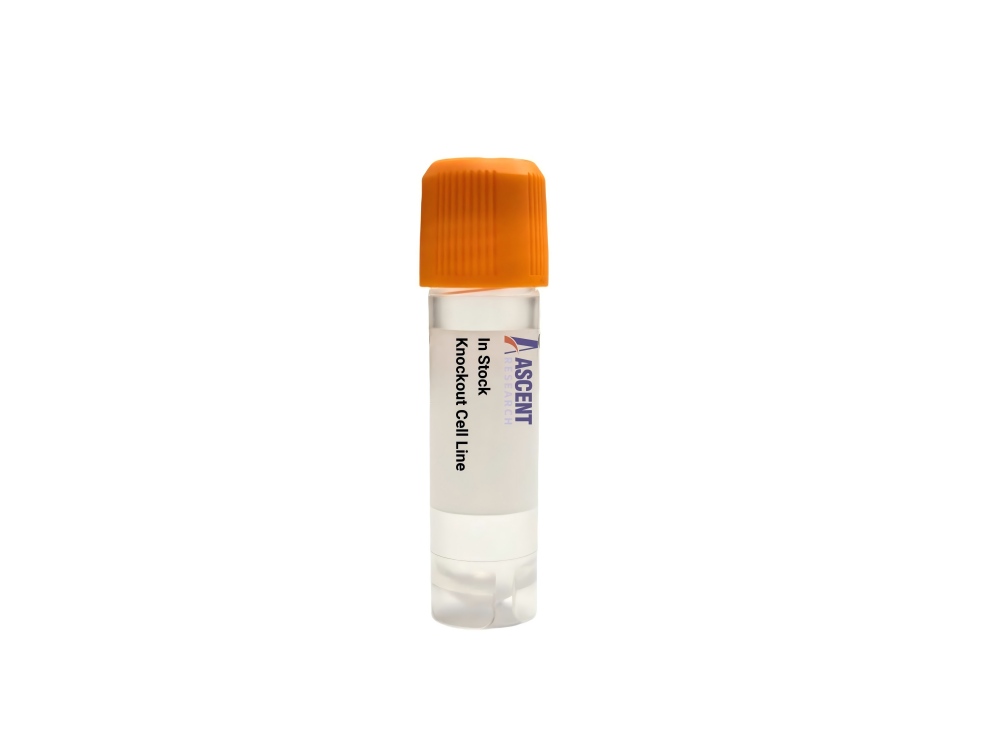
In Stock Cell Lines
Homo sapiens (Human)
Kidney
Adherent
The AICDA Knockout HEK293T Cell Line is a CRISPR/Cas9-edited model in which the AICDA gene has been disrupted in HEK293T human embryonic kidney cells. AICDA encodes activation-induced cytidine deaminase (AID), which deaminates cytidine at immunoglobulin loci, a process regulated by CD40L, IL-4, TGF-??, and NF-??B, and executed with DNA repair partners UNG, APE1, and MMR proteins. This knockout line is suited for AID enzymatic and mutagenesis studies in a non-lymphoid context. Key research areas include off-target mutagenesis screening, DNA damage and repair analysis, and investigation of B cell pathology such as Hyper-IgM syndrome type 2 and lymphomagenesis. Assays like western blotting, RT-qPCR, immunofluorescence, comet assay, and mutation reporter systems are readily applied.
 MAP3K21 Knockout HEK293 Polyclonal Cells
Cat. No. ARG12695
CALM3 Knockout Hela Polyclonal Cells
Cat. No. ARG41875
MIF Knockout CaSki Polyclonal Cells
Cat. No. ARG9747
CHMP4C Knockout 786-O Polyclonal Cells
Cat. No. ARG4943
MAP3K21 Knockout HEK293 Polyclonal Cells
Cat. No. ARG12695
CALM3 Knockout Hela Polyclonal Cells
Cat. No. ARG41875
MIF Knockout CaSki Polyclonal Cells
Cat. No. ARG9747
CHMP4C Knockout 786-O Polyclonal Cells
Cat. No. ARG4943
 Panc 02.03
Cat. No. ARC0711
Panc 02.03
Cat. No. ARC0711
 Human Bladder Microvascular Endothelial Cells
Cat. No. ARP0168
Human Bladder Microvascular Endothelial Cells
Cat. No. ARP0168
The AICDA Knockout HEK293T Cell Line is a CRISPR/Cas9-edited human knockout cell line designed for loss-of-function studies of the AICDA gene. This gene-edited line provides a genetically defined model to investigate AICDA-mediated molecular processes in a tractable epithelial cell background. The stable disruption of AICDA enables researchers to dissect its catalytic and non-catalytic functions without interference from endogenous wild-type protein.
Derived from the HEK293T line, these cells originate from human embryonic kidney epithelium transformed with sheared adenovirus type 5 DNA. They constitutively express the SV40 large T antigen, which supports episomal replication of plasmids carrying the SV40 origin, making them a workhorse for transient transfection, protein expression, and lentiviral packaging. The adherent growth and robust transfection efficiency of HEK293T cells provide an ideal platform for studying ectopically expressed or exogenous genes.
AICDA encodes activation-induced cytidine deaminase (AID), a catalytic deaminase that initiates somatic hypermutation and class switch recombination in germinal center B cells by deaminating deoxycytidine to deoxyuridine at immunoglobulin loci. The resulting U:G mismatches are processed by base excision repair (UNG, APE1) and mismatch repair (MSH2/MSH6) factors, generating DNA breaks or point mutations. AID activity is regulated by upstream signals such as CD40L?CCD40 ligation, IL-4, TGF-??, and NF-??B via transcription factors including STAT6 and SMADs. AID interacts with replication protein A (RPA), RNA polymerase II, Spt6, and CtBP, and its downstream targets include immunoglobulin switch and variable regions as well as DNA repair effectors like DNA polymerase ?? and topoisomerase 1.
In this HEK293T AICDA knockout cell line, the absence of endogenous AID provides a clean background for reconstitution experiments and off-target mutagenesis studies. HEK293T cells do not normally express AID, making this knockout model valuable for ectopic expression assays that recapitulate AID-induced DNA damage and repair in a non-lymphoid setting. Researchers can dissect the molecular requirements for AID-mediated deamination, examine the consequences of unprogrammed U:G lesions, and screen for factors that modulate AID activity and processivity.
This cell line is suited for a broad range of assays, including western blotting and RT-qPCR to confirm gene disruption and expression levels, immunofluorescence to study subcellular localization, and comet assays to assess global DNA damage. Mutation reporter assays enable quantitative analysis of AID-induced mutagenesis at specific loci. Applications extend to investigating AID??s role in B-cell lymphomagenesis and class-switch recombination defects such as Hyper-IgM syndrome type 2. For further details, contact Ascent Research.