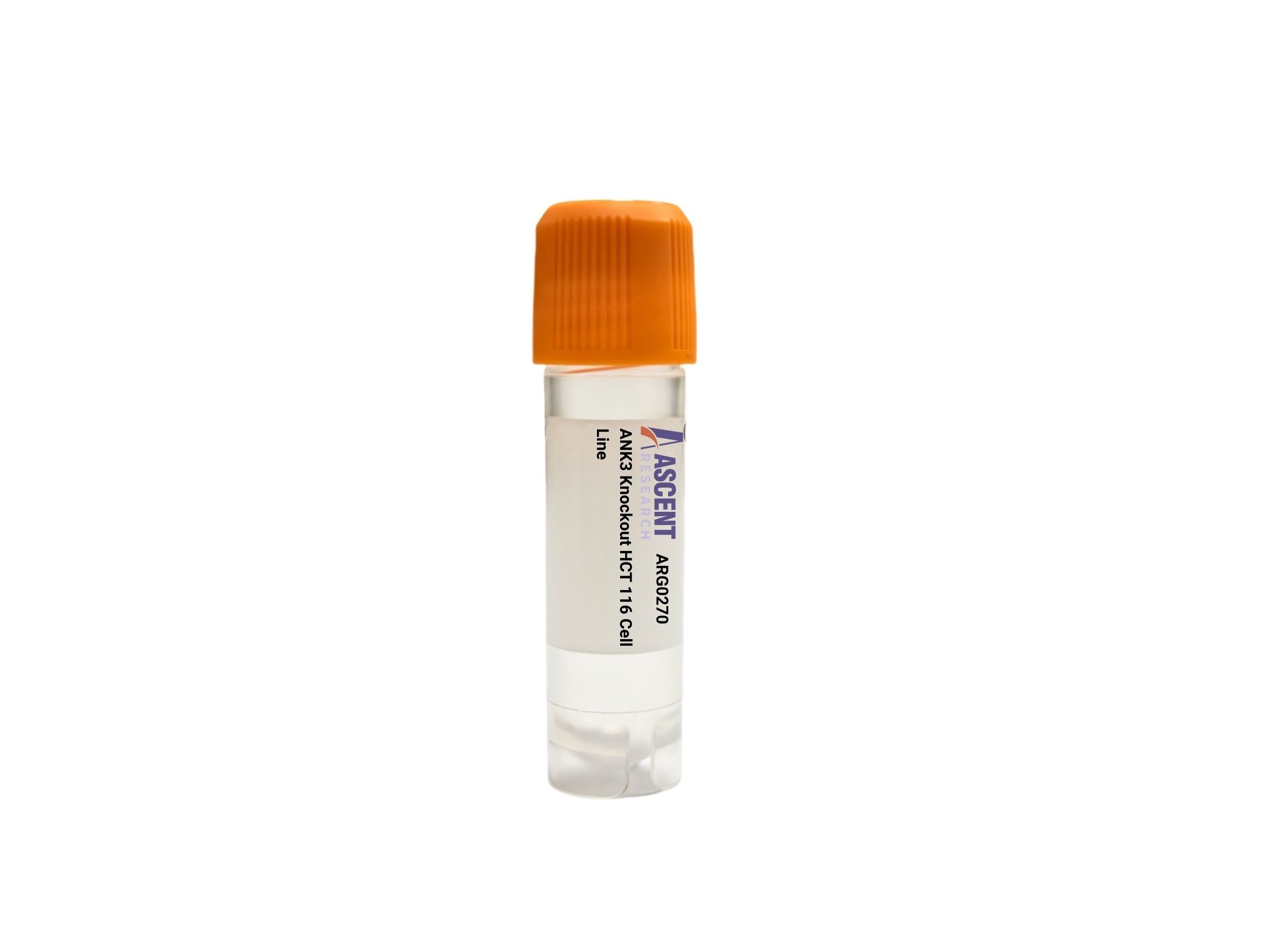
Genome-edited Cells
Large intestine (colon)
The ANK3 Knockout HCT 116 Cell Line is a CRISPR/Cas9-edited knockout cell line derived from the HCT 116 human colorectal carcinoma cell line. This model features disruption of the ANK3 gene, encoding ankyrin-G, a critical scaffolding protein that links membrane proteins to the spectrin-actin cytoskeleton. ANK3 interacts with beta-spectrin, actin, and E-cadherin, and is regulated by Wnt/beta-catenin signaling. Its loss disrupts cell adhesion, migration, and signaling pathways. This cell line is ideal for studying colorectal cancer metastasis, epithelial-mesenchymal transition, and ankyrin-related psychiatric disorders, as well as for drug screening targeting ankyrin interactions.
 FOXC1 Knockout A2780 Polyclonal Cells
Cat. No. ARG19192
FOXC1 Knockout A2780 Polyclonal Cells
Cat. No. ARG19192
 Human Mesothelial Cells
Cat. No. ARP1177
PCMT1 Knockout HT29 Polyclonal Cells
Cat. No. ARG14638
MAN2B2 Knockout 786-O Polyclonal Cells
Cat. No. ARG5746
MARK3 Knockout 786-O Polyclonal Cells
Cat. No. ARG5665
CHID1 Knockout 786-O Polyclonal Cells
Cat. No. ARG4793
Human Mesothelial Cells
Cat. No. ARP1177
PCMT1 Knockout HT29 Polyclonal Cells
Cat. No. ARG14638
MAN2B2 Knockout 786-O Polyclonal Cells
Cat. No. ARG5746
MARK3 Knockout 786-O Polyclonal Cells
Cat. No. ARG5665
CHID1 Knockout 786-O Polyclonal Cells
Cat. No. ARG4793
The ANK3 Knockout HCT 116 Cell Line is a CRISPR/Cas9-edited knockout cell line engineered from the HCT 116 human colorectal carcinoma cell line, designed for loss-of-function studies of the ANK3 gene. This model features targeted disruption of ANK3, which encodes ankyrin-G, a scaffolding protein that organizes the spectrin-actin cytoskeleton and anchors membrane proteins. The resulting cell line provides a robust in vitro system to dissect ANK3??s roles in cell adhesion, migration, and signaling without the confounding effects of pharmacological inhibition.
HCT 116 cells are a well-characterized epithelial cell line derived from a male colorectal carcinoma patient, exhibiting a near-diploid karyotype. Widely adopted in cancer research, these cells retain key features of colorectal tumor biology, including active Wnt signaling and intact adhesion machinery, making them an ideal parental line for gene-editing applications. The epithelial morphology and genetic stability of HCT 116 ensure reproducible results in downstream functional assays, and the ANK3 knockout derivative preserves these baseline characteristics while introducing a defined genetic alteration.
Ankyrin-G, the protein product of ANK3, functions as a scaffold that couples integral membrane proteins, such as E-cadherin and Na/K ATPase, to the spectrin-actin cytoskeleton via direct interactions with beta-spectrin and actin. In the context of Wnt signaling, beta-catenin/TCF complex transcriptionally regulates ANK3 expression, while TGF-beta also acts upstream to modulate ankyrin-G levels. Downstream, ANK3 is critical for E-cadherin localization at adherens junctions and for maintaining organized actin networks, thereby reinforcing cell adhesion and polarity. Its disruption impairs spectrin?Cactin complexes, likely affecting downstream effectors such as the actin cytoskeleton and cell adhesion molecules, with consequences for both structural integrity and signal transduction.
In HCT 116 colorectal cancer cells, ANK3 knockout models the consequences of ankyrin-G loss in a transformed epithelial context. Given that colorectal carcinoma progression involves dysregulated adhesion and migration, this model is particularly valuable for investigating epithelial-mesenchymal transition (EMT) and metastatic potential. Loss of ankyrin-G may compromise E-cadherin stability and actin organization, recapitulating features observed in invasive cancers. Moreover, because ANK3 is implicated in psychiatric disorders such as bipolar disorder and autism spectrum disorder, this cell line offers a platform to study neuron?Cglia adhesion mechanisms in a reductionist system, bridging cancer biology and neurobiology.
Researchers can employ this ANK3 knockout cell line in a range of assays to probe ankyrin-G function. Western blotting and immunofluorescence enable confirmation of ANK3 ablation and assessment of E-cadherin and actin organization. Cell migration and invasion assays quantify metastatic behavior, while co-immunoprecipitation elucidates spectrin-ankyrin complexes. RNA-seq can reveal transcriptomic changes resulting from ANK3 loss, and drug sensitivity studies facilitate screening for compounds targeting ankyrin interactions. This versatile tool supports diverse investigations in cell adhesion, cancer progression, and neurobiology. For further information, please contact Ascent Research.