Genome-edited Cells
Kidney
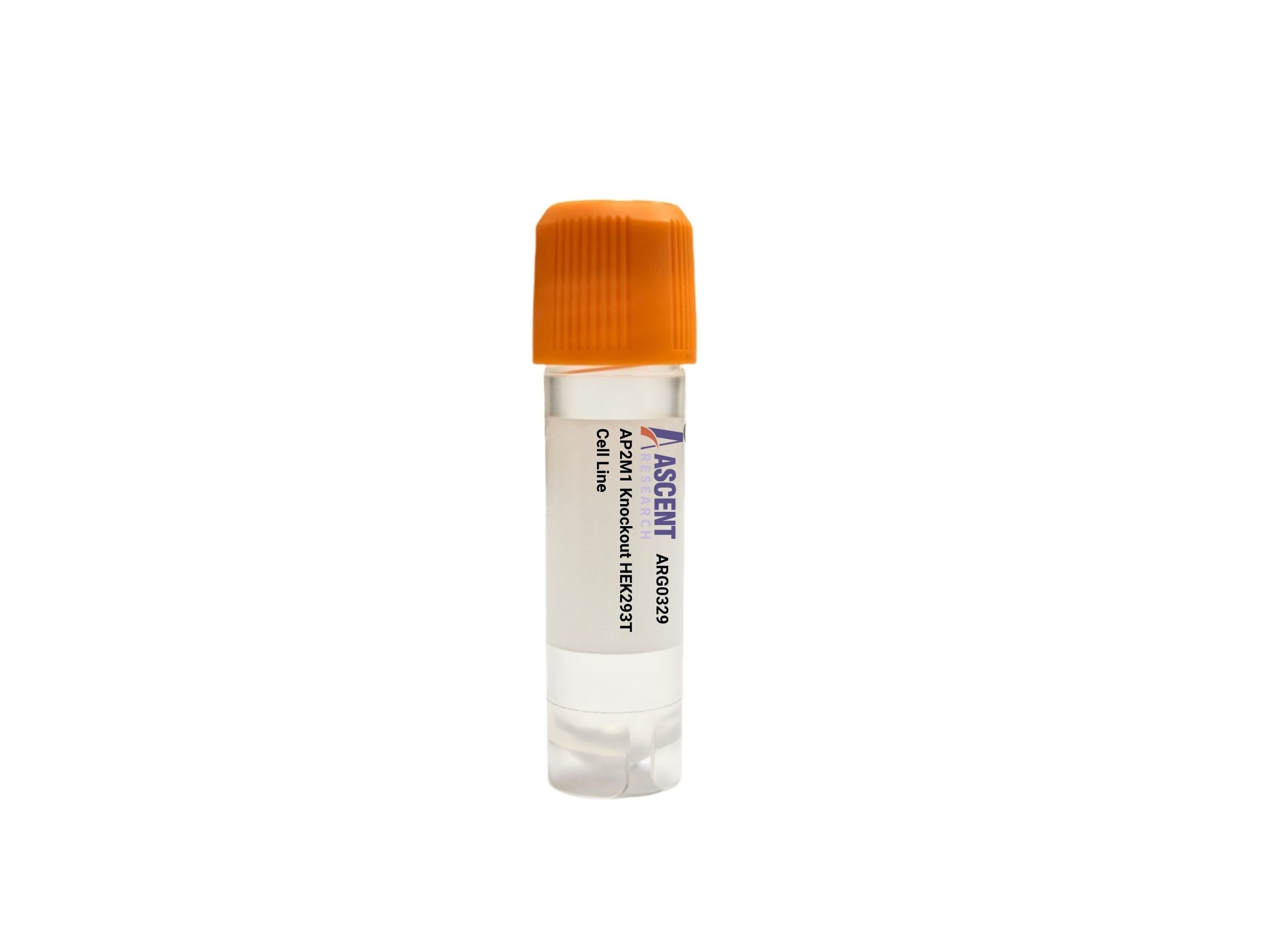
The AP2M1 Knockout HEK293T Cell Line is a CRISPR/Cas9-edited knockout derived from HEK293T epithelial cells, targeting the mu2 subunit of the AP-2 adaptor complex. This loss-of-function model impairs clathrin-mediated endocytosis of cargo such as transferrin and LDL receptors, perturbing signaling downstream of AAK1 kinase and PI(4,5)P2. It is suitable for receptor trafficking studies, endocytosis research, and modeling of intellectual disability and cancer. Key assays include transferrin uptake, immunofluorescence, and flow cytometry. For technical support, contact Ascent Research.
 G6PC3 Knockout K562 Polyclonal Cells
Cat. No. ARG19374
CPPED1 Knockout NCI-H1975 Polyclonal Cells
Cat. No. ARG17156
AGPAT5 Knockout MES-OV Polyclonal Cells
Cat. No. ARG24077
AGR2 Knockout 786-O Polyclonal Cells
Cat. No. ARG24852
IKZF5 Knockout HGC-27 Polyclonal Cells
Cat. No. ARG30021
APOL2 Knockout Hela Polyclonal Cells
Cat. No. ARG37235
G6PC3 Knockout K562 Polyclonal Cells
Cat. No. ARG19374
CPPED1 Knockout NCI-H1975 Polyclonal Cells
Cat. No. ARG17156
AGPAT5 Knockout MES-OV Polyclonal Cells
Cat. No. ARG24077
AGR2 Knockout 786-O Polyclonal Cells
Cat. No. ARG24852
IKZF5 Knockout HGC-27 Polyclonal Cells
Cat. No. ARG30021
APOL2 Knockout Hela Polyclonal Cells
Cat. No. ARG37235
The AP2M1 Knockout HEK293T Cell Line is a CRISPR/Cas9-edited knockout cell line designed to disrupt the AP2M1 gene, which encodes the mu2 subunit of the adaptor protein complex 2 (AP-2). This loss-of-function model enables systematic investigation of clathrin-mediated endocytosis and associated trafficking pathways in a human cellular context.
The host cell line, HEK293T, is an adherent human embryonic kidney epithelial cell line that constitutively expresses the SV40 large T antigen, facilitating high-level transient protein expression and efficient viral production. Its robust growth, ease of transfection, and well-characterized signaling networks make it an ideal platform for generating gene knockouts to dissect molecular mechanisms in an epithelial background.
AP2M1 encodes the mu2 subunit, which recognizes tyrosine-based (YXX??) and dileucine sorting motifs on the cytoplasmic tails of cargo receptors, such as transferrin receptor and LDL receptor, recruiting them into clathrin-coated pits. This process is regulated by upstream factors including AAK1 kinase, which phosphorylates mu2 to enhance cargo binding, and the phosphoinositide PI(4,5)P2, which recruits AP-2 to the plasma membrane. The AP-2 complex interacts with clathrin, AP2 alpha and beta2 adaptins, Eps15, and amphiphysin to drive clathrin lattice assembly and dynamin-mediated vesicle scission. Thus, AP2M1 functions downstream of receptor activation and upstream of cargo internalization and receptor recycling.
In HEK293T cells, AP2M1 knockout disrupts selective internalization of a broad range of surface receptors, leading to altered receptor composition and attenuated downstream signaling. Impaired clathrin-dependent uptake of transferrin and LDL provides a direct functional readout. This model enables dissection of endocytic sorting and crosstalk with signaling pathways controlling proliferation, differentiation, and survival. Given the epithelial origin, it is particularly relevant for investigating how AP2M1 dysfunction contributes to neurodevelopmental disorders and cancer progression.
Researchers can employ this cell line for clathrin-mediated endocytosis studies, drug delivery research, receptor trafficking analysis, and disease modeling. Representative assays include transferrin and LDL uptake measurements, immunofluorescence staining for clathrin-coated pits, western blotting and RT-qPCR to confirm AP2M1 disruption, flow cytometry to quantify surface receptor levels, co-immunoprecipitation to assess AP-2 complex interactions, and receptor recycling kinetic assays. For further details, contact Ascent Research.