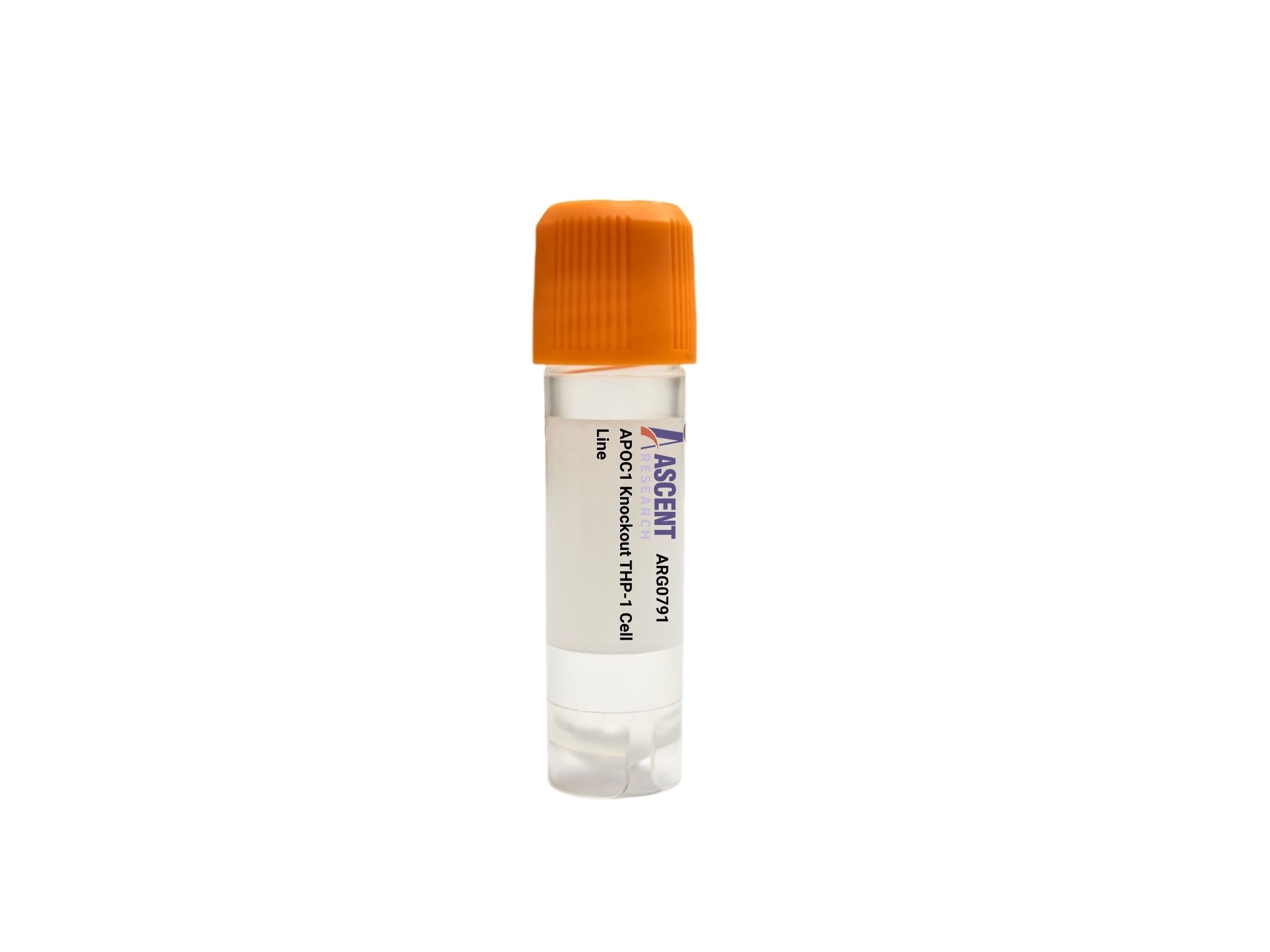
Genome-edited Cells
Blood (peripheral blood)
The APOC1 Knockout THP-1 Cell Line is a CRISPR/Cas9-edited human cell line designed to abolish expression of apolipoprotein C-I, a critical regulator of lipid metabolism and atherosclerosis. Derived from the THP-1 monocytic leukemia line, these cells can be differentiated into macrophages and are ideal for studying foam cell formation and reverse cholesterol transport. APOC1 interacts with APOE and LPL to control VLDL and HDL metabolism; its knockout disrupts these pathways, enabling investigation of lipid uptake, efflux, and signaling through PPAR??/LXR?? networks. Applications range from drug screening for hyperlipidemia to dissecting molecular mechanisms of metabolic syndrome and Alzheimer disease.
 ADCY9 Knockout Hela Polyclonal Cells
Cat. No. ARG20438
NAIF1 Knockout A2780 Polyclonal Cells
Cat. No. ARG18296
GFAP Knockout DLD-1 Polyclonal Cells
Cat. No. ARG12085
DIXDC1 Knockout NCI-H1299 Polyclonal Cells
Cat. No. ARG38820
ANXA11 Knockout A549 Polyclonal Cells
Cat. No. ARG38713
OSBPL10 Knockout HEK293T Polyclonal Cells
Cat. No. ARG3997
ADCY9 Knockout Hela Polyclonal Cells
Cat. No. ARG20438
NAIF1 Knockout A2780 Polyclonal Cells
Cat. No. ARG18296
GFAP Knockout DLD-1 Polyclonal Cells
Cat. No. ARG12085
DIXDC1 Knockout NCI-H1299 Polyclonal Cells
Cat. No. ARG38820
ANXA11 Knockout A549 Polyclonal Cells
Cat. No. ARG38713
OSBPL10 Knockout HEK293T Polyclonal Cells
Cat. No. ARG3997
The APOC1 Knockout THP-1 Cell Line is a CRISPR/Cas9-edited knockout cell line generated from the THP-1 human monocytic leukemia background. It features targeted disruption of the APOC1 gene, eliminating apolipoprotein C-I expression. The cells are supplied as a suspension culture suitable for differentiation studies and provide a genetically defined model for investigating lipid metabolism and macrophage function.
THP-1 cells, derived from an acute monocytic leukemia patient, are a standard model for monocyte/macrophage biology. Upon PMA induction, they differentiate into macrophage-like cells, upregulating scavenger receptors such as CD36 and SR-A and gaining the ability to take up modified lipoproteins. This system is widely used to study innate immunity, inflammation, and particularly foam cell formation in the context of atherosclerosis.
APOC1 is a lipoprotein lipase (LPL) inhibitor that associates with VLDL and HDL. Its expression is regulated by PPAR??, LXR??, SREBP-1c, and insulin. By interacting with APOE, VLDLR, and LRP1, APOC1 modulates triglyceride hydrolysis, remnant clearance, and cholesterol esterification via LCAT. Knockout of APOC1 disrupts these interactions, leading to altered VLDL and HDL metabolism and impacting cholesterol efflux and atherogenic particle balance within the LXR/RXR and atherosclerosis signaling pathways.
In THP-1 macrophages, APOC1 deficiency is predicted to reduce LPL inhibition, potentially accelerating triglyceride-rich lipoprotein clearance. However, APOC1 also participates in HDL-mediated reverse cholesterol transport; its loss may impair cholesterol efflux and promote lipid droplet accumulation. This dual role makes the knockout cell line a valuable tool for dissecting the molecular events governing foam cell formation, including the regulation of ABCA1 and SR-BI expression and the interplay between APOC1, APOE, and LPL in atherogenesis.
Key applications include DiI-oxLDL uptake assays and Oil Red O staining for lipid accumulation, cholesterol efflux measurements, and RT-qPCR profiling of genes such as ABCA1, LPL, and CETP. Western blotting for APOC1 and APOE, flow cytometric analysis of CD36 and VLDLR surface expression, and foam cell formation assays coupled with LPL activity assessments are also enabled. These approaches support drug screening for dyslipidemia and mechanistic studies of metabolic syndrome, atherosclerosis, and Alzheimer disease. For additional technical information, please contact Ascent Research.