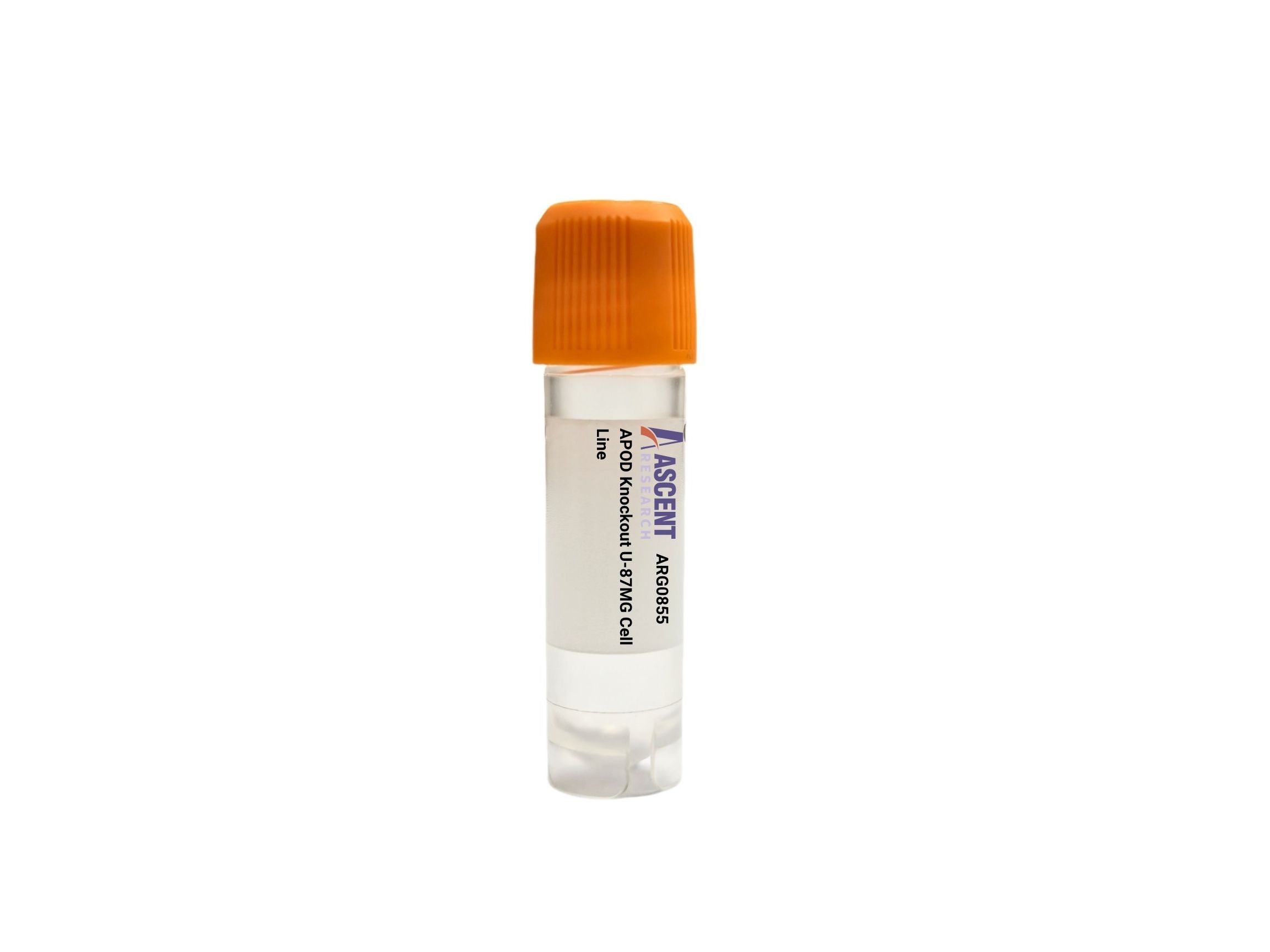
Genome-edited Cells
The APOD Knockout U-87MG Cell Line offers a precise CRISPR/Cas9-edited knockout of apolipoprotein D in the human glioblastoma cell line U-87MG, which carries EGFR amplification and a PTEN mutation. This model is suited for dissecting APOD's contributions to lipid transport, retinoid metabolism, and antioxidant responses in an aggressive brain tumor context. APOD associates with HDL particles to shuttle cholesterol and retinoic acid, engaging receptors LRP1 and SR-B1 to regulate AKT and MAPK signaling and BCL2-mediated survival. Applications include lipid uptake assays, viability and apoptosis analyses, and oxidative stress measurements, supporting research in glioblastoma biology, neuroprotection, and cancer therapeutic development.
 LCOR Knockout NCI-H1703 Polyclonal Cells
Cat. No. ARG12557
NTPCR Knockout A549 Polyclonal Cells
Cat. No. ARG10581
EED Knockout 786-O Polyclonal Cells
Cat. No. ARG40518
NOL3 Knockout MES-OV Polyclonal Cells
Cat. No. ARG6290
MAD1L1 Knockout AGS Polyclonal Cells
Cat. No. ARG3240
LCOR Knockout NCI-H1703 Polyclonal Cells
Cat. No. ARG12557
NTPCR Knockout A549 Polyclonal Cells
Cat. No. ARG10581
EED Knockout 786-O Polyclonal Cells
Cat. No. ARG40518
NOL3 Knockout MES-OV Polyclonal Cells
Cat. No. ARG6290
MAD1L1 Knockout AGS Polyclonal Cells
Cat. No. ARG3240
 BW5147
Cat. No. ARC0082
BW5147
Cat. No. ARC0082
The APOD Knockout U-87MG Cell Line is a CRISPR/Cas9-edited knockout cell line with targeted disruption of the apolipoprotein D (APOD) gene in the human glioblastoma U-87MG background. This loss-of-function model enables investigation of APOD-dependent lipid transport, neuroprotection, and antioxidant regulation. By eliminating APOD expression, the cell line serves as a vital tool for dissecting molecular mechanisms in glioblastoma and related cancers.
U-87MG cells, derived from malignant glioma, harbor EGFR amplification and PTEN mutation, characteristics that drive aberrant proliferation and survival signaling. As a widely employed in vitro model for glioblastoma multiforme, U-87MG provides a physiologically relevant context for studying tumor biology, metabolic reprogramming, and therapeutic resistance under well-defined experimental conditions.
APOD is a lipid-binding glycoprotein that associates with HDL particles to mediate transport of cholesterol, retinoic acid, and arachidonic acid. Its expression is governed by upstream regulators such as glucocorticoid receptor, estrogen receptor, NF-??B, and HIF1A, and it interacts with receptors LRP1 and SR-B1. Downstream, APOD modulates AKT and MAPK pathways, influences BCL2 family members, and supports antioxidant enzymes like SOD1, thereby controlling cell survival and oxidative stress responses.
Disrupting APOD in U-87MG cells perturbs HDL-mediated lipid homeostasis, diminishes antioxidant defenses, and alters signaling through AKT and MAPK cascades. Given the cell line??s intrinsic EGFR and PTEN alterations, this model is particularly suited for examining how APOD loss impacts glioblastoma cell proliferation, apoptosis, and stress adaptation, with potential translational relevance to breast and prostate cancers where APOD is also implicated.
The cell line supports applications including western blotting, RT-qPCR, lipid uptake assays, MTT viability tests, annexin V apoptosis assays, migration/invasion studies, and ROS measurements. Researchers can thus explore APOD??s role in glioma lipid metabolism, neuroprotection, oxidative stress, and target validation. For additional technical details, researchers are encouraged to contact Ascent Research.