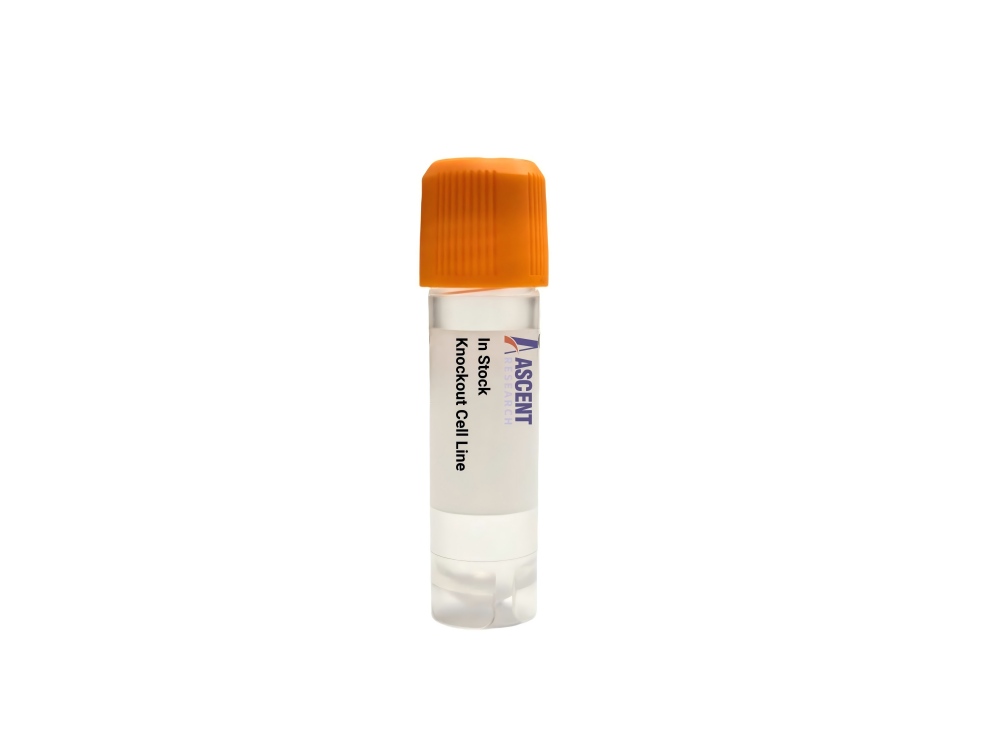
In Stock Cell Lines
Rattus norvegicus (Rat)
Heart
Adherent
The Atf4 Knockout H9c2(2-1) Cell Line is a CRISPR/Cas9-edited knockout cell line derived from rat cardiac myoblasts, providing a targeted loss-of-function model for the Atf4 gene. Atf4 encodes a master transcription factor of the integrated stress response, activated by eIF2?? phosphorylation downstream of PERK, GCN2, and other kinases. This product enables dissection of ATF4-mediated transcriptional programs, including regulation of downstream targets such as DDIT3 (CHOP) and ASNS. The knockout line is ideal for investigating ER stress, the unfolded protein response, and stress-induced apoptosis in a cardiomyocyte context. Applications include mechanistic studies of cardiac hypertrophy, ischemia/reperfusion injury, and metabolic stress, as well as screening modulators of the integrated stress response.
 HMBOX1 Knockout K562 Polyclonal Cells
Cat. No. ARG20568
ABCG5 Knockout HAP1 Polyclonal Cells
Cat. No. ARG21561
CAMSAP3 Knockout A2780 Polyclonal Cells
Cat. No. ARG42094
ENDOD1 Knockout KYSE30 Polyclonal Cells
Cat. No. ARG9692
GALNT1 Knockout Raji Polyclonal Cells
Cat. No. ARG1417
HMBOX1 Knockout K562 Polyclonal Cells
Cat. No. ARG20568
ABCG5 Knockout HAP1 Polyclonal Cells
Cat. No. ARG21561
CAMSAP3 Knockout A2780 Polyclonal Cells
Cat. No. ARG42094
ENDOD1 Knockout KYSE30 Polyclonal Cells
Cat. No. ARG9692
GALNT1 Knockout Raji Polyclonal Cells
Cat. No. ARG1417
 RKO-E6
Cat. No. ARC0774
RKO-E6
Cat. No. ARC0774
The Atf4 Knockout H9c2(2-1) Cell Line is a CRISPR/Cas9-edited knockout cell line derived from the H9c2(2-1) subclone of rat embryonic cardiac myoblasts. This validated loss-of-function model targets the Atf4 gene, encoding a transcription factor central to the integrated stress response. CRISPR-mediated disruption abolishes functional ATF4 protein, enabling precise interrogation of ATF4-dependent signaling in a cardiac-relevant context.
H9c2(2-1) cells originate from embryonic rat ventricle and are widely used as a cardiomyocyte model. This subclone retains myogenic properties and exhibits hallmark cardiac features, including responsiveness to hypertrophic and stress stimuli. The line is a standard tool for studying cardiac hypertrophy, ischemia/reperfusion injury, oxidative stress, and metabolic dysfunction, offering a reproducible in vitro system that mirrors cardiomyocyte stress responses.
Atf4 is a master transcription factor of the integrated stress response, translationally induced upon eIF2?? phosphorylation by kinases PERK, GCN2, PKR, or HRI. Under ER stress, amino acid deprivation, hypoxia, or reactive oxygen species, ATF4 drives adaptive gene programs, transactivating targets like ASNS, ATF3, VEGFA, and the pro-apoptotic factors DDIT3 (CHOP) and BCL2L11 (BIM). It also induces PPP1R15A (GADD34) to feedback-regulate eIF2?? phosphorylation. ATF4 interacts with C/EBP??, ATF3, DDIT3, and NRF2 to modulate transcriptional responses. While acute activation promotes survival, sustained ATF4 signaling shifts the balance toward CHOP-mediated apoptosis.
In cardiac myoblasts, ATF4 governs cell fate under pathological conditions. The PERK-ATF4 pathway is activated during ischemia/reperfusion and pressure overload, contributing to hypertrophy and apoptosis. This knockout cell line allows dissection of ATF4-specific roles in cardiac stress responses, separating its effects from parallel signaling cascades. By eliminating ATF4 function, researchers can define how the integrated stress response modulates viability, metabolism, and hypertrophic growth in a myocardial model.
Applications include ER stress induction with tunicamycin or thapsigargin, followed by western blotting for ATF4, CHOP, and phospho-eIF2??, RT-qPCR for target genes, or ASNS luciferase reporter assays. Apoptosis can be measured via Annexin V flow cytometry, and immunofluorescence can monitor ATF4 localization in controls. Seahorse metabolic flux analysis assesses bioenergetic adaptations, while cell viability assays under stress evaluate therapeutic interventions. The line is suited for screening integrated stress response modulators in cardiac contexts. For inquiries, contact Ascent Research.