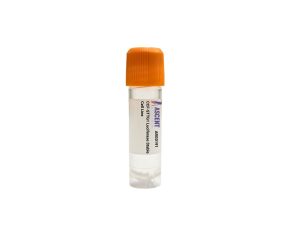
In Stock Cell Lines
Homo sapiens (Human)
Blood (peripheral blood)
Suspension
The ATG5 Knockout THP-1 Cell Line is a CRISPR/Cas9-edited knockout cell line disrupting ATG5 expression in the human monocytic THP-1 cell line. ATG5 is essential for ATG12-ATG5 conjugate formation and LC3 lipidation, blocking canonical autophagy. This model enables studies on autophagy's role in innate immunity, inflammasome regulation, and cell survival. Derived from acute monocytic leukemia, THP-1 cells offer a myeloid background for autophagy research. Applications include drug screening, inflammasome studies, and host-pathogen interactions, with typical assays like autophagic flux and LC3/p62 detection.
 UBE2S Knockout Huh-7 Cell Line
Cat. No. ARG44205
UBE2S Knockout Huh-7 Cell Line
Cat. No. ARG44205
 Human Bronchial Epithelial Cells (∆F508/∆1152H Cystic Fibrosis)
Cat. No. ARP1158
Human Bronchial Epithelial Cells (∆F508/∆1152H Cystic Fibrosis)
Cat. No. ARP1158
 NFIC Knockout HT29 Polyclonal Cells
Cat. No. ARG14393
CDKN1B Knockout 143B Polyclonal Cells
Cat. No. ARG11892
HMGN5 Knockout AGS Polyclonal Cells
Cat. No. ARG26958
KIF1C Knockout HT29 Polyclonal Cells
Cat. No. ARG33534
NFIC Knockout HT29 Polyclonal Cells
Cat. No. ARG14393
CDKN1B Knockout 143B Polyclonal Cells
Cat. No. ARG11892
HMGN5 Knockout AGS Polyclonal Cells
Cat. No. ARG26958
KIF1C Knockout HT29 Polyclonal Cells
Cat. No. ARG33534
The ATG5 Knockout THP-1 Cell Line is a CRISPR/Cas9-edited knockout cell line disrupting the ATG5 gene in the human monocytic THP-1 background. This loss-of-function model enables detailed study of autophagy, specifically the ATG12-ATG5 conjugation and LC3 lipidation. By stably ablating ATG5 expression, it provides a defined genetic tool for dissecting autophagic pathways without chemical inhibition, facilitating research into innate immune signaling and cell survival.
THP-1, derived from peripheral blood of an acute monocytic leukemia patient, is a widely used model for monocyte/macrophage differentiation and function. These cells can be differentiated into macrophage-like cells with phorbol esters, recapitulating key innate immune processes such as phagocytosis, cytokine release, and inflammasome activation. The line retains NF-??B and interferon signaling pathways, making it ideal for examining how autophagy integrates with inflammatory responses. ATG5 disruption in this background facilitates mechanistic studies linking autophagy to myeloid cell biology.
ATG5 is a core autophagy protein that conjugates with ATG12 via ATG7 and ATG10, forming a complex with ATG16L1 that acts as an E3-like enzyme for LC3 lipidation by ATG3. This step is essential for phagophore elongation. Knockout of ATG5 abolishes ATG12-ATG5 conjugate formation, blocking LC3 lipidation and halting canonical autophagy, which leads to accumulation of p62/SQSTM1 and defective mitochondrial clearance. ATG5 also intersects with apoptosis, NLRP3 inflammasome regulation, and interferon signaling. Upstream regulators include mTORC1, AMPK, and transcription factors like TFEB and FOXO3, which tune autophagy in response to nutrient and stress signals.
In THP-1 cells, ATG5 knockout impairs autophagic degradation of p62 and mitophagy, leading to altered NLRP3 inflammasome activity and dysregulated cytokine production. This model reveals how autophagy shapes macrophage polarization, antigen presentation, and antimicrobial responses. It is particularly useful for studying host-pathogen interactions with intracellular bacteria like M. tuberculosis and L. monocytogenes, where canonical autophagy contributes to pathogen containment. Additionally, it allows investigation of autophagy-dependent cell death and survival under chemotherapeutic stress in a monocytic context.
Research applications include autophagy mechanism studies, drug screening for autophagy modulators, inflammasome research, cancer cell survival assays, neurodegenerative disease models, and host-pathogen interaction analysis. Representative assays are LC3 immunofluorescence, p62 Western blotting, autophagic flux with bafilomycin A1, flow cytometry for apoptosis, RT-qPCR for cytokines, and co-immunoprecipitation for the ATG12-ATG5 complex. For further information, please contact Ascent Research.