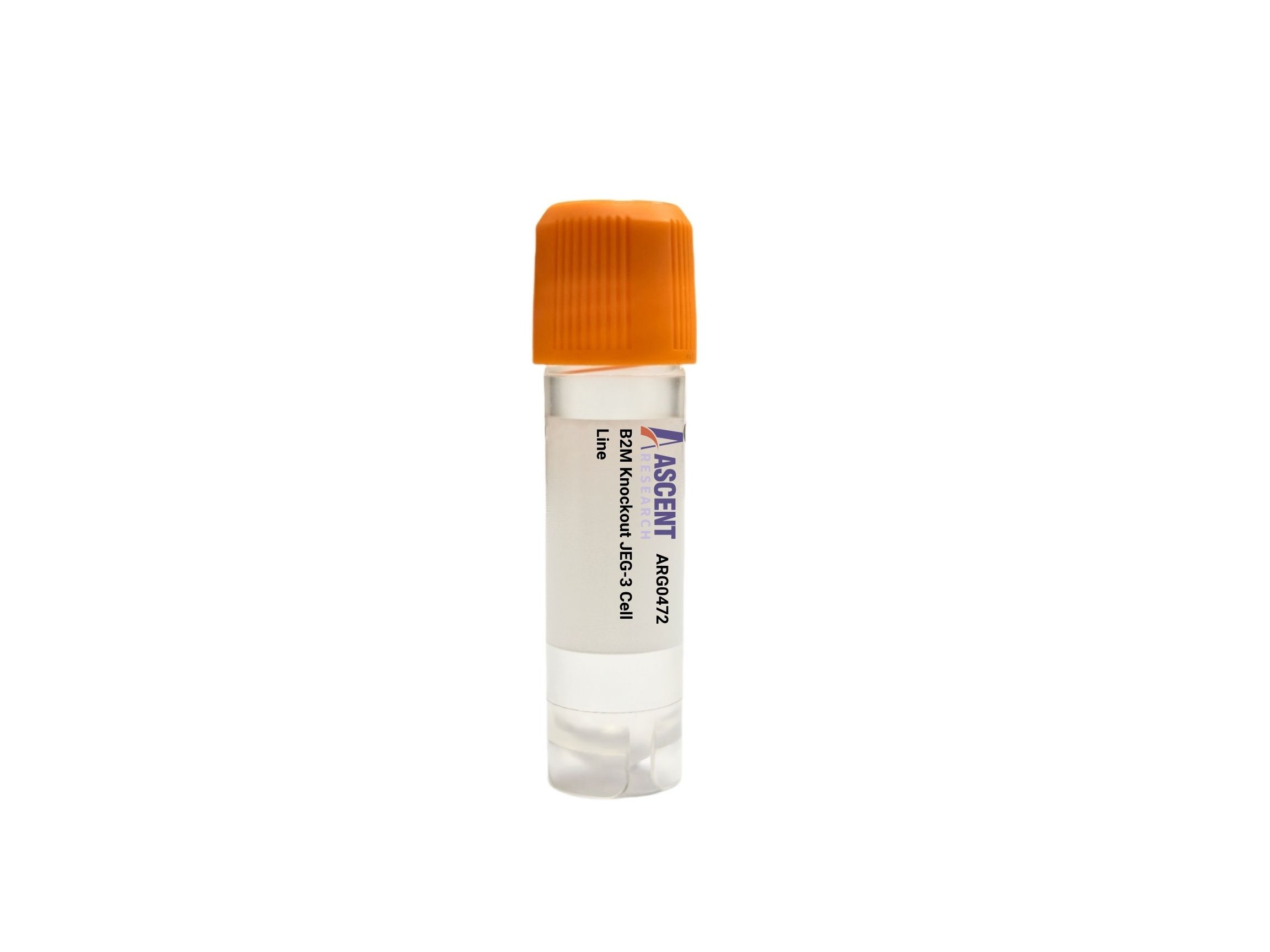
Genome-edited Cells
Placenta
The B2M Knockout JEG-3 Cell Line is a CRISPR/Cas9-edited choriocarcinoma line with targeted disruption of the B2M gene, eliminating beta-2-microglobulin and abrogating MHC class I surface expression. This impairs CD8+ T-cell activation and promotes NK cell missing-self recognition. JEG-3 cells, derived from a cerebral metastasis, serve as a trophoblast model for studying placental immune privilege and choriocarcinoma immune evasion. Downstream of IFN-??, B2M normally supports antigen presentation; its loss enables dissection of MHC-I deficiency using cytotoxicity assays, flow cytometry, and xenograft models.
 MLKL Knockout A549 Polyclonal Cells
Cat. No. ARG10209
ADRA2B Knockout HAP1 Polyclonal Cells
Cat. No. ARG21714
ITFG2 Knockout AGS Polyclonal Cells
Cat. No. ARG27062
ATXN2L Knockout HEK293T Polyclonal Cells
Cat. No. ARG38171
GYG1 Knockout AGS Polyclonal Cells
Cat. No. ARG26907
MORF4L2 Knockout MES-OV Polyclonal Cells
Cat. No. ARG6474
MLKL Knockout A549 Polyclonal Cells
Cat. No. ARG10209
ADRA2B Knockout HAP1 Polyclonal Cells
Cat. No. ARG21714
ITFG2 Knockout AGS Polyclonal Cells
Cat. No. ARG27062
ATXN2L Knockout HEK293T Polyclonal Cells
Cat. No. ARG38171
GYG1 Knockout AGS Polyclonal Cells
Cat. No. ARG26907
MORF4L2 Knockout MES-OV Polyclonal Cells
Cat. No. ARG6474
The B2M Knockout JEG-3 Cell Line is a CRISPR/Cas9-edited human choriocarcinoma line with targeted B2M gene disruption, eliminating beta-2-microglobulin (??2m) and preventing MHC class I (MHC-I) assembly and surface expression. This CRISPR/Cas9-edited knockout resource provides a stable platform for immunological studies.
JEG-3 is a human choriocarcinoma cell line originally derived from a cerebral metastasis. It retains key trophoblast-like characteristics, including the expression of placental hormones such as human chorionic gonadotropin, and exhibits invasive behavior in vitro. Widely used as a model for placental trophoblast function and maternal-fetal interface biology, its metastatic derivation also renders it valuable for examining immune evasion mechanisms in trophoblastic malignancies.
??2m functions as the non-covalently associated light chain of MHC class I heterodimers, forming complexes with heavy chains (HLA-A, HLA-B, HLA-C) and interacting with the peptide-loading complex composed of calnexin, calreticulin, ERp57, TAP1, TAP2, and tapasin. B2M knockout prevents MHC-I surface expression, abolishing presentation of endogenous peptides to CD8+ T cells and thereby suppressing TCR-mediated cytotoxicity. IFN-?? transcriptionally upregulates B2M through IRF1 and NF-??B, while CIITA contributes to MHC-I gene induction. Loss of surface MHC-I also disrupts inhibitory signals to natural killer (NK) cells, triggering missing-self recognition, degranulation, and target cell lysis.
In the context of choriocarcinoma, B2M disruption mimics the immune evasion strategy used by invasive trophoblasts, which normally downregulate classical MHC-I molecules to avoid maternal CD8+ T-cell attack while retaining non-classical HLA-G. The JEG-3 knockout line thus models broad MHC-I deficiency, facilitating systematic investigation of immune privilege, tumor escape, and NK cell surveillance in gestational trophoblastic diseases. This model is particularly useful for evaluating therapeutic approaches aimed at restoring immune recognition or redirecting NK cell activity against MHC-I-null tumors.
Key research applications include flow cytometric analysis of MHC-I surface levels, CD8+ T-cell killing assays, and NK cell degranulation and cytotoxicity assays. Western blotting, RT-qPCR, and immunofluorescence confirm ??2m ablation and MHC-I mislocalization. Tumor xenograft models enable in vivo assessment of immune interactions, complemented by cytokine profiling. The cell line supports studies in placental immune privilege, choriocarcinoma immunotherapy, allogeneic cell therapy optimization, and fundamental MHC-I biology. For technical data or batch-specific information, please contact Ascent Research.