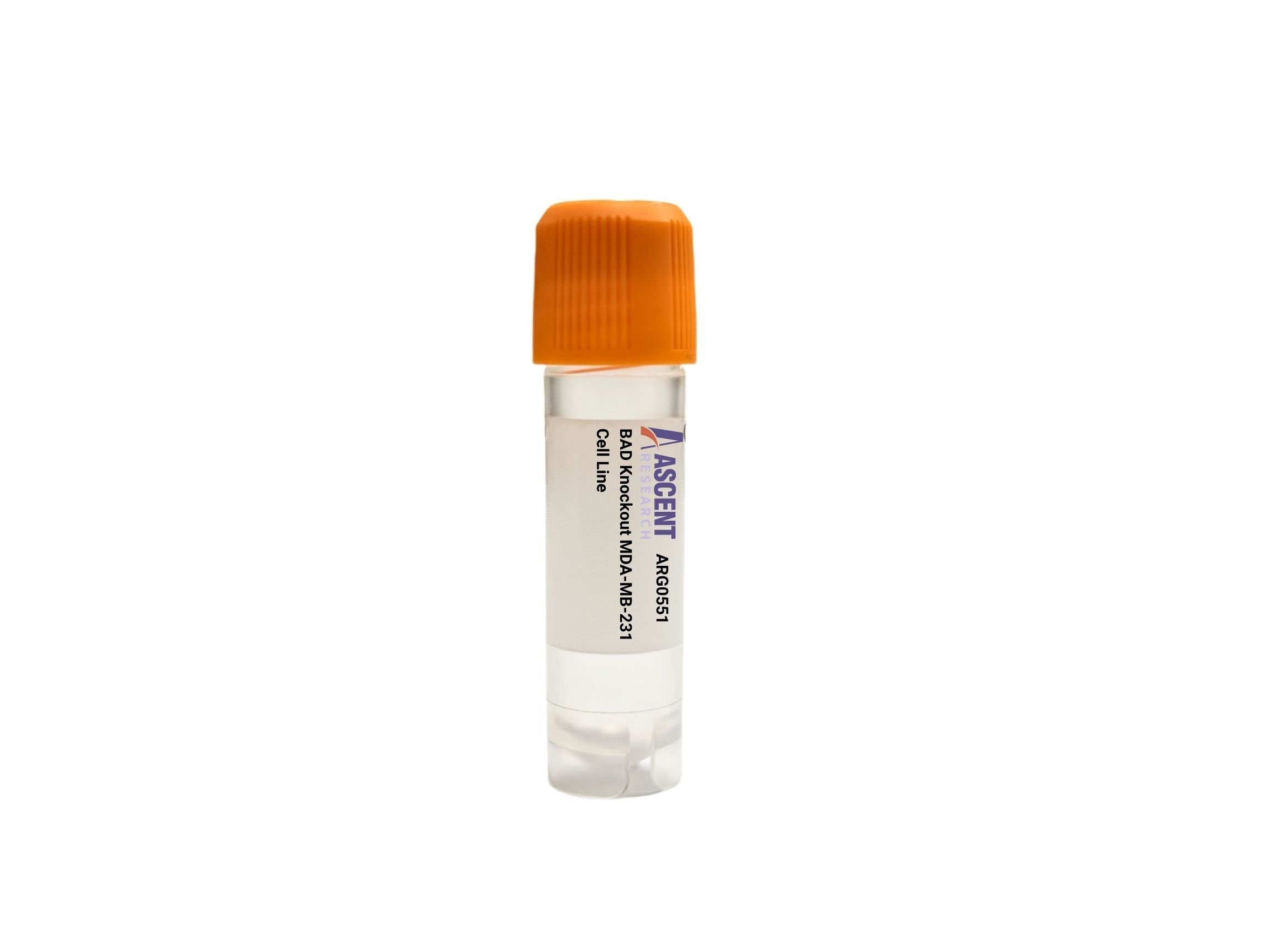
Genome-edited Cells
Breast (mammary gland)
The BAD Knockout MDA-MB-231 Cell Line is a CRISPR/Cas9-edited loss-of-function model in the triple-negative breast cancer cell line MDA-MB-231. It disrupts the pro-apoptotic BH3-only protein BAD, a key regulator of the intrinsic apoptosis pathway that is inactivated by survival kinases including AKT via phosphorylation and 14-3-3 binding. This knockout cell line enables dissection of apoptosis signaling and chemoresistance mechanisms in an aggressive TNBC background. Designed for biomedical research, it supports mechanistic studies of BCL2 family interactions, BH3 mimetic drug screening, and analysis of PI3K/AKT, MAPK/ERK, and JAK/STAT survival pathways. Representative assays include Western blotting, Annexin V apoptosis assays, cytochrome c release, caspase activity measurements, and cell viability assays.
 BLOC1S4 Knockout Hela Polyclonal Cells
Cat. No. ARG21505
CHCHD6 Knockout NCI-H1975 Polyclonal Cells
Cat. No. ARG16655
CPNE1 Knockout NCI-H1975 Polyclonal Cells
Cat. No. ARG16338
CBX6 Knockout NCI-H1975 Polyclonal Cells
Cat. No. ARG42795
ELAVL2 Knockout K562 Polyclonal Cells
Cat. No. ARG41132
FNDC3A Knockout HEK293T Polyclonal Cells
Cat. No. ARG4318
BLOC1S4 Knockout Hela Polyclonal Cells
Cat. No. ARG21505
CHCHD6 Knockout NCI-H1975 Polyclonal Cells
Cat. No. ARG16655
CPNE1 Knockout NCI-H1975 Polyclonal Cells
Cat. No. ARG16338
CBX6 Knockout NCI-H1975 Polyclonal Cells
Cat. No. ARG42795
ELAVL2 Knockout K562 Polyclonal Cells
Cat. No. ARG41132
FNDC3A Knockout HEK293T Polyclonal Cells
Cat. No. ARG4318
The BAD Knockout MDA-MB-231 Cell Line is a CRISPR/Cas9-edited knockout cell line originating from the widely used MDA-MB-231 human breast adenocarcinoma cell line. This product enables targeted disruption of the BAD gene, encoding a pro-apoptotic BH3-only member of the BCL2 family. The knockout model provides a valuable resource for dissecting apoptosis signaling and therapeutic resistance mechanisms in triple-negative breast cancer (TNBC).
MDA-MB-231 is a highly aggressive, triple-negative, mesenchymal-like breast cancer cell line derived from a pleural effusion. It serves as a widely used model for studying the biology and therapy of triple-negative breast cancer (TNBC). The cell line exhibits robust proliferative and survival signaling, partly through activation of the PI3K/AKT pathway, making it an apt host for dissecting apoptosis regulation.
BAD (BCL2-associated agonist of cell death) is a pro-apoptotic BH3-only protein that binds and neutralizes anti-apoptotic BCL2 family members such as Bcl-2 and Bcl-XL. By sequestering these survival proteins, BAD permits Bax and Bak oligomerization, leading to mitochondrial outer membrane permeabilization (MOMP), cytochrome c release, and subsequent activation of caspase-9 and caspase-3. Pro-survival kinases including AKT (PKB), PKA, RSK, and PKC phosphorylate BAD at specific residues, notably Ser136, promoting its interaction with 14-3-3 scaffold proteins and cytosolic retention, thereby inhibiting apoptosis. BAD thus functions at a key regulatory node connecting growth factor receptor signaling to the intrinsic apoptosis pathway. Additional interacting factors include PP2A and PKA anchoring proteins, which modulate BAD phosphorylation status and localization.
In the MDA-MB-231 triple-negative breast cancer context, disruption of BAD removes a critical pro-apoptotic barrier, potentially enhancing survival signaling and chemoresistance. This cell line enables investigation of how upstream survival kinases, particularly AKT, phosphorylate and inactivate BAD to promote cell survival. The BAD knockout MDA-MB-231 model is thus especially useful for studying the interplay between PI3K/AKT survival signaling and apoptosis evasion in TNBC. It also facilitates evaluation of BH3 mimetics, which target anti-apoptotic BCL2 members, and may reveal alternative apoptotic vulnerabilities in BAD-deficient cells. Moreover, because BAD integrates signals from multiple kinases, this model can help dissect MAPK/ERK and JAK/STAT pathway contributions to apoptosis regulation.
The BAD Knockout MDA-MB-231 Cell Line is ideally suited for a range of experimental applications, including mechanistic studies of intrinsic apoptosis, functional analysis of BCL2 family interactions, and drug sensitivity profiling. Representative assays include Western blotting to assess expression or phosphorylation of BAD and other BCL2 members, Annexin V/PI flow cytometry for apoptosis quantification, cytochrome c release assays, and caspase-3/7 activity measurements. Co-immunoprecipitation can be used to examine BAD interaction with 14-3-3 or Bcl-2. Phospho-specific antibodies against BAD (e.g., Ser136) allow monitoring of kinase-mediated regulation. Additionally, cell viability assays such as MTT or WST-1 enable drug screening for BH3 mimetics or other therapeutics targeting apoptosis resistance. For further technical details or to discuss customized applications, please contact Ascent Research.