Genome-edited Cells
Ascites
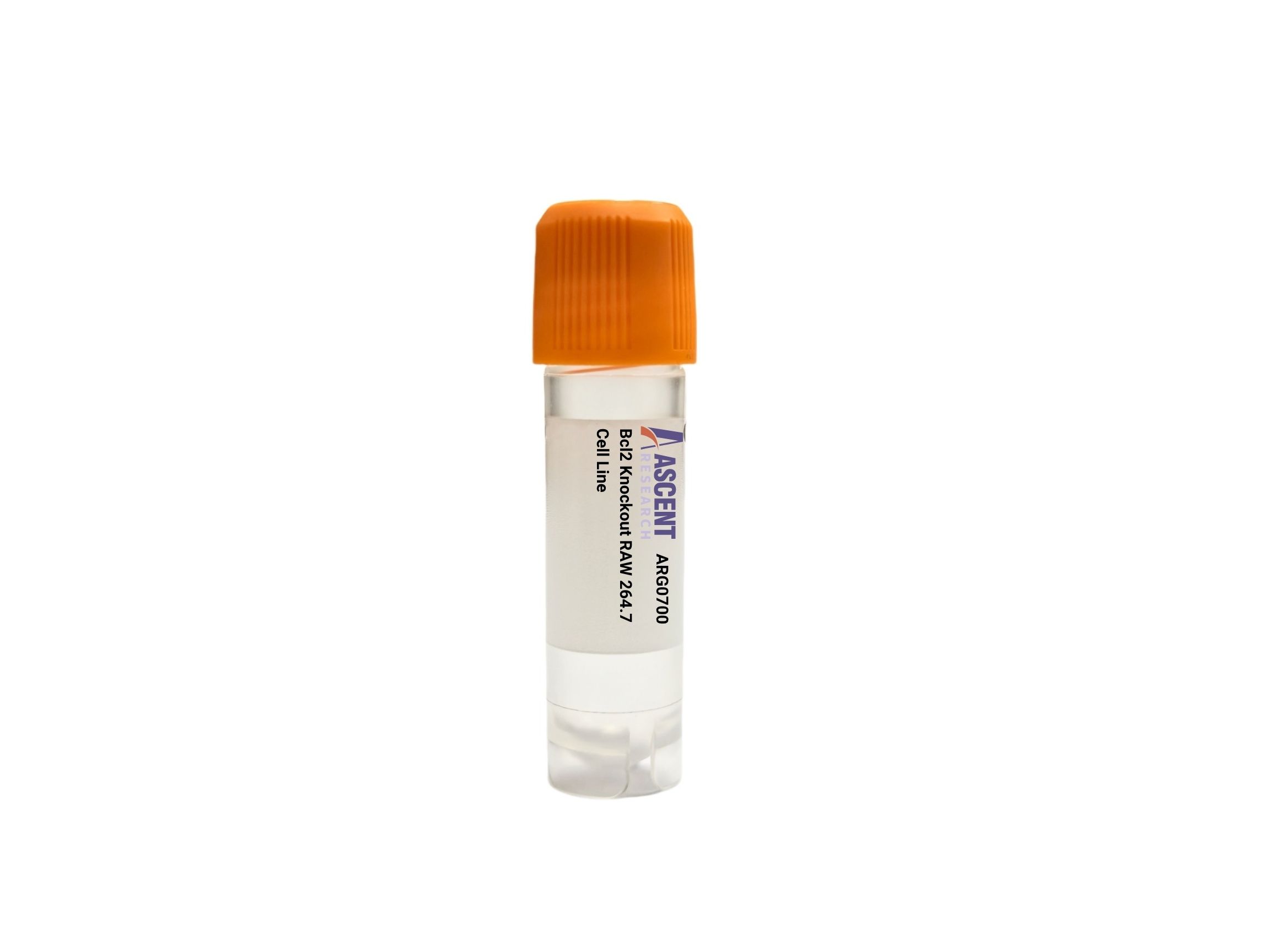
The Bcl2 Knockout RAW 264.7 Cell Line is a CRISPR/Cas9-edited mouse macrophage knockout model lacking the anti-apoptotic protein BCL2. Disruption of this gene sensitizes cells to intrinsic apoptosis by preventing inhibition of BAX and BAK, which normally preserve mitochondrial integrity. Applications include studying macrophage survival, apoptosis signaling, and BCL2-targeted drug resistance. Key assays involve annexin V flow cytometry, caspase-3/7 activity, and mitochondrial membrane potential measurement. This cell line is valuable for research on lymphoma, leukemia, and solid tumors where BCL2 overexpression is common.
 CDKN2AIP Knockout SK-HEP-1 Polyclonal Cells
Cat. No. ARG15358
MAP4K3 Knockout Jurkat Polyclonal Cells
Cat. No. ARG13804
Cdk2 Knockout RAW 264.7 Polyclonal Cells
Cat. No. ARG12491
CALCOCO2 Knockout Hela Polyclonal Cells
Cat. No. ARG41809
CACNG6 Knockout HEK293T Polyclonal Cells
Cat. No. ARG38128
DNPEP Knockout 786-O Polyclonal Cells
Cat. No. ARG39461
CDKN2AIP Knockout SK-HEP-1 Polyclonal Cells
Cat. No. ARG15358
MAP4K3 Knockout Jurkat Polyclonal Cells
Cat. No. ARG13804
Cdk2 Knockout RAW 264.7 Polyclonal Cells
Cat. No. ARG12491
CALCOCO2 Knockout Hela Polyclonal Cells
Cat. No. ARG41809
CACNG6 Knockout HEK293T Polyclonal Cells
Cat. No. ARG38128
DNPEP Knockout 786-O Polyclonal Cells
Cat. No. ARG39461
The Bcl2 Knockout RAW 264.7 Cell Line is a CRISPR/Cas9-edited knockout cell line in which the Bcl2 gene has been disrupted, eliminating functional BCL2 protein expression. This knockout model, generated using CRISPR/Cas9 technology, provides a critical tool for dissecting intrinsic apoptotic pathways and BCL2-mediated survival signaling in macrophages, enabling loss-of-function studies in a well-characterized innate immune cell context.
RAW 264.7 is a mouse macrophage cell line derived from BALB/c monocytes and transformed with Abelson murine leukemia virus, widely employed for innate immunity research. These adherent, phagocytic cells respond to toll-like receptor agonists and inflammatory stimuli, exhibit robust antigen presentation, and offer genetic stability favorable for generating targeted knockouts. Their capacity to model macrophage activation, microbial killing, and cytokine production underpins their use in studies connecting apoptosis to immune function.
BCL2 preserves mitochondrial outer membrane integrity by heterodimerizing with and inhibiting the pro-apoptotic effectors BAX and BAK, thereby blocking cytochrome c release and APAF1-mediated activation of caspase-9 and downstream caspase-3/7. Its activity is enhanced by survival signals including PI3K/AKT-mediated phosphorylation, NF-??B (RELA) transcriptional induction, and IL-6/STAT3 pathway activation, while being antagonized by BH3-only sensitizers such as BAD, BIM, and PUMA. BCL2 also engages in autophagy regulation through Beclin-1 binding and influences mitochondrial calcium flux via VDAC and IP3R modulation.
In macrophages, BCL2 knockout profoundly sensitizes cells to intrinsic apoptotic stimuli, disrupting survival signals critical for immune homeostasis. This vulnerability is relevant for studying apoptosis resistance in chronic inflammation, tumor microenvironments, and autoimmune conditions, where macrophage persistence often depends on anti-apoptotic machinery. By eliminating BCL2, the model reveals how BCL2-dependent survival intersects with NF-??B and MAPK/ERK pathways, which are frequently co-opted in stressed or transformed macrophages, and allows evaluation of mitochondrial regulation of polarization and cell fate decisions.
This cell line supports a range of apoptosis-focused applications, including annexin V/PI flow cytometry, caspase-3/7 luminescence assays, and cytochrome c release ELISA. Mitochondrial membrane potential can be assessed by JC-1 flow cytometry, and western blotting confirms BCL2 knockout alongside BAX, BAK, and cleaved caspase-3. It also enables phagocytosis assays, viability screens with staurosporine or etoposide, and BCL2 inhibitor testing relevant to lymphoma, leukemia, breast cancer, and other malignancies. Additionally, RT-qPCR analysis of Bcl2, Bax, and Bim transcripts is supported. For further information, please contact Ascent Research.