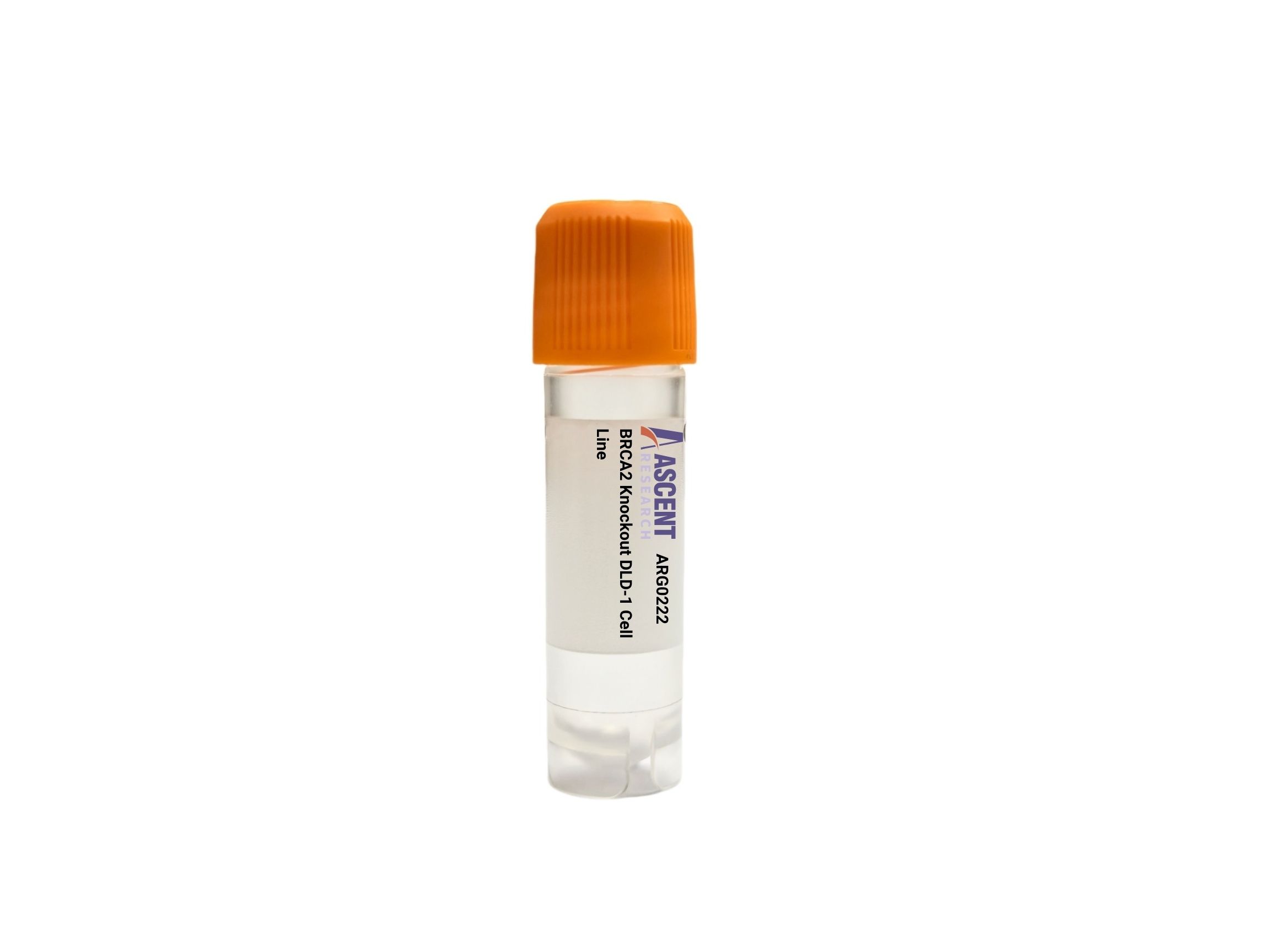
Genome-edited Cells
Large intestine (colon)
BRCA2 Knockout DLD-1 Cell Line is a CRISPR/Cas9-edited colorectal adenocarcinoma model with targeted disruption of the BRCA2 tumor suppressor gene. Loss of BRCA2 impairs RAD51-mediated homologous recombination repair, leading to genomic instability in the context of DLD-1??s endogenous APC, KRAS, and TP53 mutations. Ideal for DNA repair research and PARP inhibitor sensitivity screening, this cell line supports studies of the BRCA1-PALB2-BRCA2-RAD51 axis and Fanconi anemia pathway interactions. Key assays include RAD51 foci imaging, ??H2AX detection, and cell viability analyses under therapeutic stress.
 MTMR3 Knockout jurkat Polyclonal Cells
Cat. No. ARG13637
PDLIM1 Knockout jurkat Polyclonal Cells
Cat. No. ARG13555
ARHGEF10 Knockout NCI-H1299 Polyclonal Cells
Cat. No. ARG30408
ABHD14B Knockout jurkat Polyclonal Cells
Cat. No. ARG33695
CASP1 Knockout SK-HEP-1 Polyclonal Cells
Cat. No. ARG42406
MTMR3 Knockout jurkat Polyclonal Cells
Cat. No. ARG13637
PDLIM1 Knockout jurkat Polyclonal Cells
Cat. No. ARG13555
ARHGEF10 Knockout NCI-H1299 Polyclonal Cells
Cat. No. ARG30408
ABHD14B Knockout jurkat Polyclonal Cells
Cat. No. ARG33695
CASP1 Knockout SK-HEP-1 Polyclonal Cells
Cat. No. ARG42406
 U-937 Luciferase Stable Cell Line
Cat. No. ARG0867
U-937 Luciferase Stable Cell Line
Cat. No. ARG0867
The BRCA2 Knockout DLD-1 Cell Line is a CRISPR/Cas9-edited knockout cell line engineered from the DLD-1 human colorectal adenocarcinoma cell line. This product provides a stable loss-of-function model for BRCA2, a critical tumor suppressor and mediator of homologous recombination repair. Disruption of the BRCA2 gene enables precise investigation of its roles in DNA damage response and genomic stability, making it an essential tool for cancer research and drug development.
DLD-1 is an epithelial colorectal adenocarcinoma cell line harboring well-characterized oncogenic mutations in APC, KRAS, and TP53. These background alterations drive key hallmarks of colorectal cancer, including aberrant Wnt signaling, constitutive MAPK pathway activation, and loss of p53-mediated checkpoint control. The introduction of a BRCA2 knockout onto this genetic landscape creates a physiologically relevant model to study DNA repair defects within a colorectal tumor context.
BRCA2 functions as a central scaffold for loading RAD51 recombinase onto RPA-coated single-stranded DNA, a crucial step in homologous recombination repair and replication fork protection. Its activity is regulated by upstream kinases such as ATM and ATR, as well as cyclin-dependent kinases and E2F transcription factors. BRCA2 interacts with PALB2, BRCA1, BARD1, and DSS1, and its loss disrupts RAD51 filament formation, leading to unrepaired DNA breaks, CHK2 and p53 activation, and apoptosis. The BRCA2 pathway is interconnected with the Fanconi anemia network via FANCD2 and FANCN.
In the DLD-1 background, BRCA2 knockout synergizes with existing APC, KRAS, and TP53 mutations to drive synthetic lethality paradigms, particularly with PARP inhibitors. This model recapitulates the genomic instability observed in BRCA2-deficient tumors, allowing researchers to study the impact of homologous recombination deficiency on tumor progression and therapeutic response in a colorectal adenocarcinoma setting. It also serves as a platform to investigate the role of BRCA2 in centrosome duplication and cell cycle checkpoints.
Typical applications include functional genomics, DNA repair pathway analysis, and screening for PARP inhibitor sensitivity. Researchers can validate BRCA2 knockout status via Western blotting and examine downstream markers such as ??H2AX and RAD51 foci formation. Complementary assays include homologous recombination reporter assays, cell viability assays under PARP inhibitor treatment, comet assays for DNA damage quantification, cell cycle analysis by flow cytometry, and Annexin V apoptosis assays. This cell line is also suitable for biomarker discovery and mechanism-of-action studies for emerging therapeutics. For further details, please contact Ascent Research.