Genome-edited Cells
Large intestine (colon)
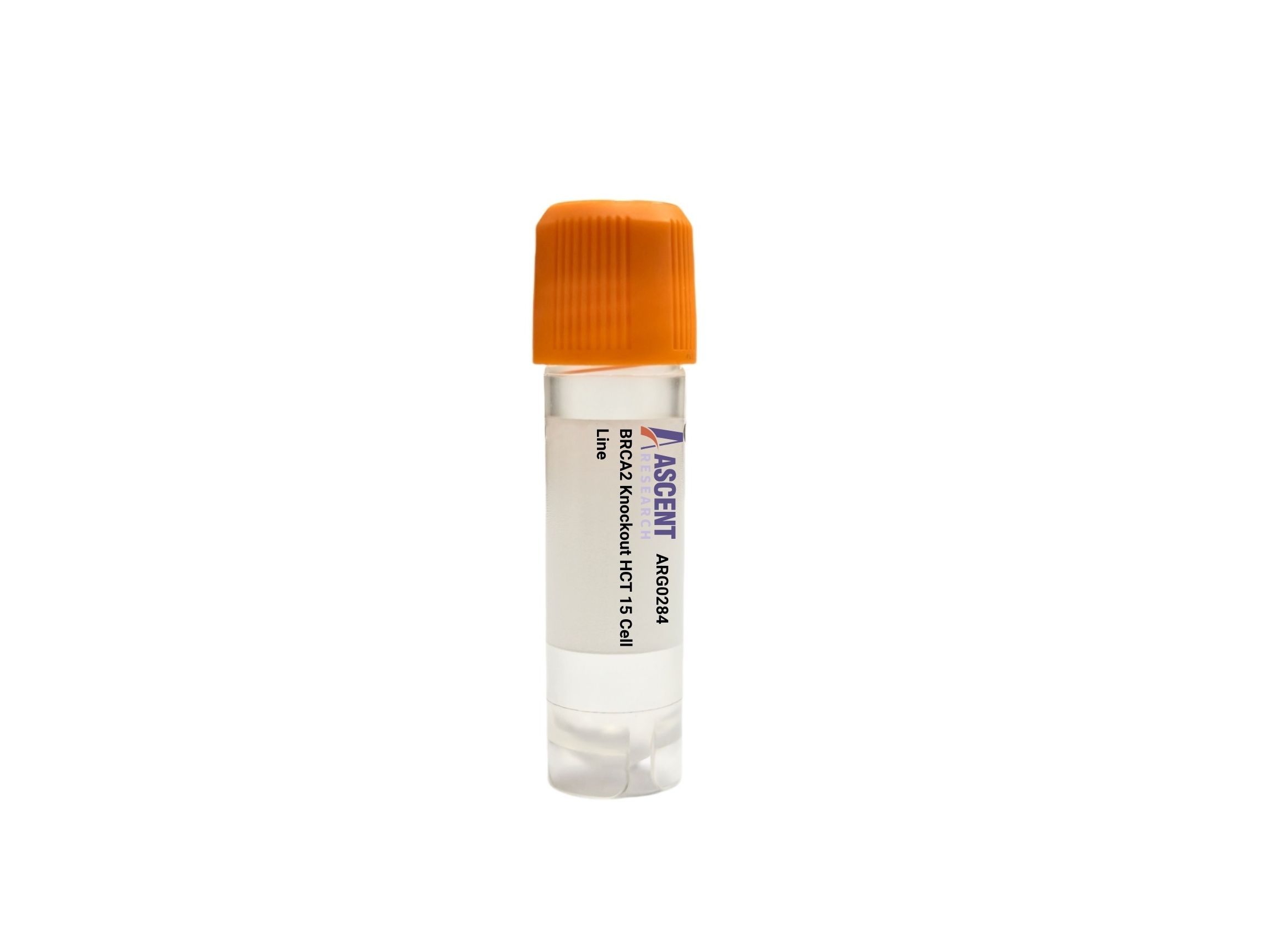
The BRCA2 Knockout HCT 15 Cell Line is a CRISPR/Cas9-edited knockout cell line that disrupts the BRCA2 gene in the HCT 15 colorectal carcinoma cell line, derived from a male patient. This model enables loss-of-function studies of BRCA2, a critical mediator of DNA repair. BRCA2 functions with RAD51 and PALB2 to execute homologous recombination, and its knockout impairs genomic stability, sensitizing cells to PARP inhibitors and DNA-damaging agents. The cell line supports synthetic lethality research, DNA damage response studies, and therapeutic evaluation in colorectal cancer.
 FOXP1 Knockout A2780 Polyclonal Cells
Cat. No. ARG19073
MAP2K2 Knockout HEK293 Polyclonal Cells
Cat. No. ARG12722
ALB Knockout Raji Polyclonal Cells
Cat. No. ARG21121
ADA Knockout HCT116 Polyclonal Cells
Cat. No. ARG34746
DNAJC13 Knockout Raji Polyclonal Cells
Cat. No. ARG39205
DUSP8 Knockout HAP1 Polyclonal Cells
Cat. No. ARG40094
FOXP1 Knockout A2780 Polyclonal Cells
Cat. No. ARG19073
MAP2K2 Knockout HEK293 Polyclonal Cells
Cat. No. ARG12722
ALB Knockout Raji Polyclonal Cells
Cat. No. ARG21121
ADA Knockout HCT116 Polyclonal Cells
Cat. No. ARG34746
DNAJC13 Knockout Raji Polyclonal Cells
Cat. No. ARG39205
DUSP8 Knockout HAP1 Polyclonal Cells
Cat. No. ARG40094
The BRCA2 Knockout HCT 15 Cell Line is a precisely engineered CRISPR/Cas9-edited knockout cell line designed to disrupt the BRCA2 gene in the HCT 15 human colorectal carcinoma cell line. This loss-of-function model provides a controlled system for delineating BRCA2-mediated processes in colonic epithelial cells. The cell line is a crucial resource for advancing understanding of DNA repair dynamics and tumor suppressor mechanisms.
HCT 15 is an established colorectal adenocarcinoma cell line isolated from a male patient, retaining colonic epithelial characteristics and displaying typical cancer-related genomic alterations. Its use in research spans decades, offering a robust platform for oncogenic studies. The knockout of BRCA2 in this context allows exploration of how DNA repair deficiencies contribute to colorectal tumorigenesis and therapeutic response.
BRCA2 functions as a tumor suppressor, playing an indispensable role in homologous recombination repair by facilitating the loading of RAD51 recombinase onto resected DNA double-strand breaks. This activity is orchestrated through interactions with PALB2, BRCA1, and DSS1, and is integrated into the Fanconi anemia pathway. Upstream, DNA damage activates kinases ATM and ATR, which phosphorylate targets including Chk1, while transcription factors p53 and E2F1 regulate BRCA2 expression. Downstream, BRCA2-dependent RAD51 recruitment promotes strand invasion and accurate repair, maintaining genomic stability. The BRCA2-RAD51 axis is further coordinated with the MRE11-RAD50-NBS1 complex and RPA in the DNA damage response.
In the HCT 15 colorectal carcinoma host, BRCA2 knockout leads to pronounced homologous recombination deficiency, resulting in accumulation of unresolved DNA double-strand breaks and increased genomic instability. This defect causes heightened sensitivity to PARP inhibitors, such as olaparib, and to DNA crosslinking agents, mimicking synthetic lethality observed in BRCA-mutated tumors. The model thereby enables mechanistic dissection of colorectal cancer vulnerabilities and assessment of DNA repair-targeted therapies in a clinically relevant intestinal epithelial setting.
This cell line is instrumental for diverse experimental applications, including synthetic lethality screens, PARP inhibitor sensitivity assays (via colony formation or viability assays), and chemosensitivity profiling to DNA-damaging agents. Researchers can monitor DNA repair efficiency using RAD51 foci immunofluorescence, ??-H2AX staining, and comet assays, while Western blotting validates key pathway components. Additional uses encompass cell cycle checkpoint analysis and tumor biology studies. For technical inquiries and ordering, please contact Ascent Research.